

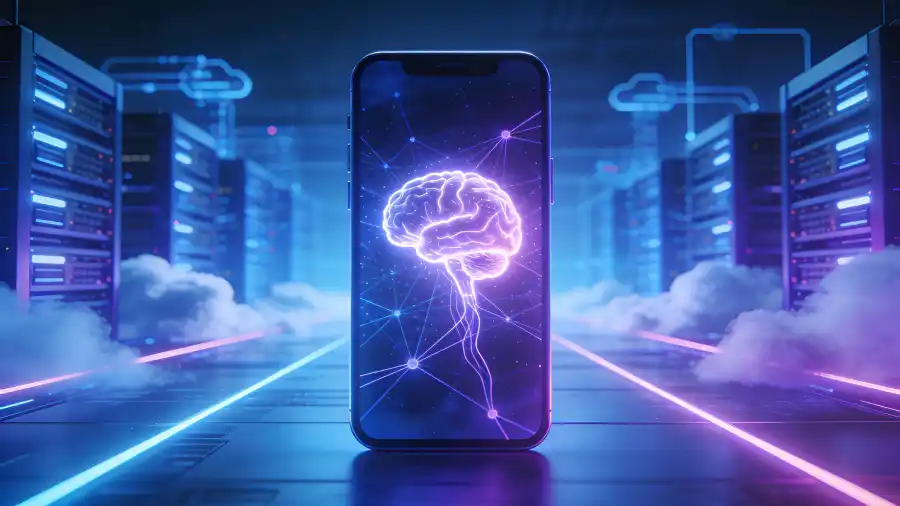

Forget the cloud: The future of AI isn’t in a distant server farm – it’s in your pocket, finally awake, and it doesn’t need Wi-Fi to prove it, finds Satyen K. Bordoloi
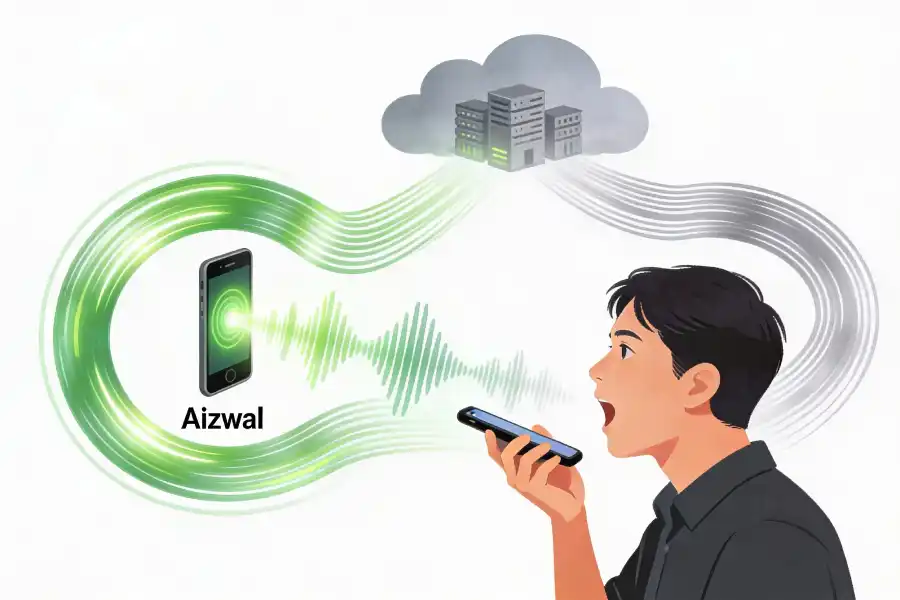
Most people don’t have a clue how the “magic” on their devices works. Let’s say you’re in Aizawl, dictating a message on your chat instead of typing. That simple voice snippet isn’t processed on your phone. Instead, it embarks on a transcontinental sprint, thousands of miles to a humming server farm in the United States, gets transcribed, and then races back to your screen. All this happens in seconds, sure, but it’s a digital marathon for a task that should be a quick stroll inside the phone itself.
This process, repeated billions of times daily, is the central architecture – and the fundamental flaw – of modern AI: a crippling dependency on the cloud. This limitation begs the question: why can’t the intelligence just live on the device? The answer was brutal physics and finite resources: fitting a capable AI model into a phone was like fitting a supercomputer into a walnut. Doing so would guzzle battery, heat your device supernaturally, and be super slow.
The dream of a genuinely local, private, and instantaneous assistant was always years away. But it would seem that moment has arrived, and characteristically, Google might have quietly cracked the code with something deceptively simple.
Enter the Quiet Contender – FunctionGemma
Since December 18, the AI world has been whispering praise for a tiny titan that Google shipped out without any fanfare. Its name: FunctionGemma. In the dry, understated prose of Google’s blog, they describe it as a “specialized version of our Gemma 3 270M model tuned for function calling.” They pitch it as “a strong base for further training into custom, fast, private, local agents that translate natural language into executable API actions.”
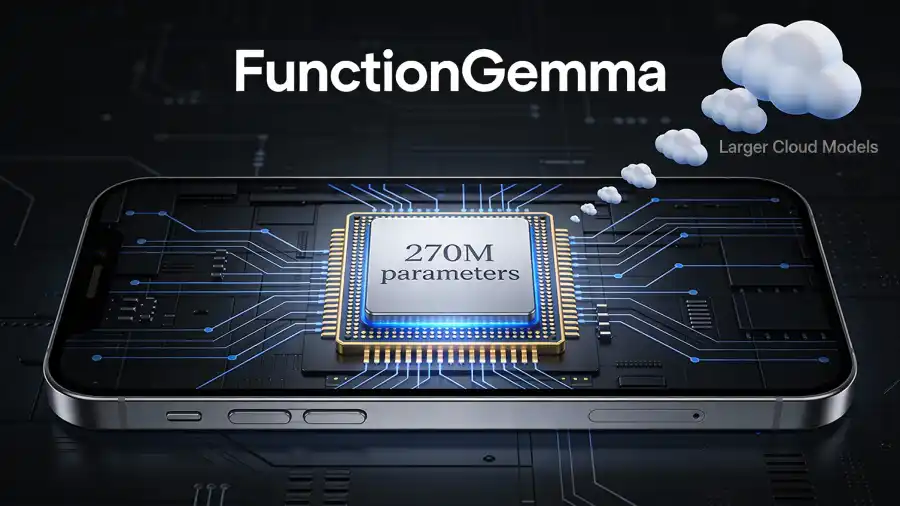
Let’s translate that into English. This is a 270-million-parameter model designed to live entirely on your phone. No servers required. No data packet traversing the globe. Its sole, elegant purpose is to take a spoken or typed command and translate it directly into an action your phone’s apps can execute. It can turn “Set a timer for 10 minutes” into a series of digital button presses that the Timer app requires, all offline.
The Intelligent Bouncer for Your Data
The real genius of FunctionGemma isn’t just its ability to work offline. It functions as a discerning decision-maker, an intelligent traffic controller. When you ask it to “Add a contact for my new plumber, Vijay,” it recognises this as a simple on-device task and does what you asked, with zero data leaving your phone. Your private contacts remain just that – private. But if you then ask it to “Find me a recipe for gajar ka halwa and summarise the top three reviews from food blogs,” the model performs a quick internal assessment, understands that this is not something that can be executed locally, and realises that the request requires searching, fetching, and synthesising external information.
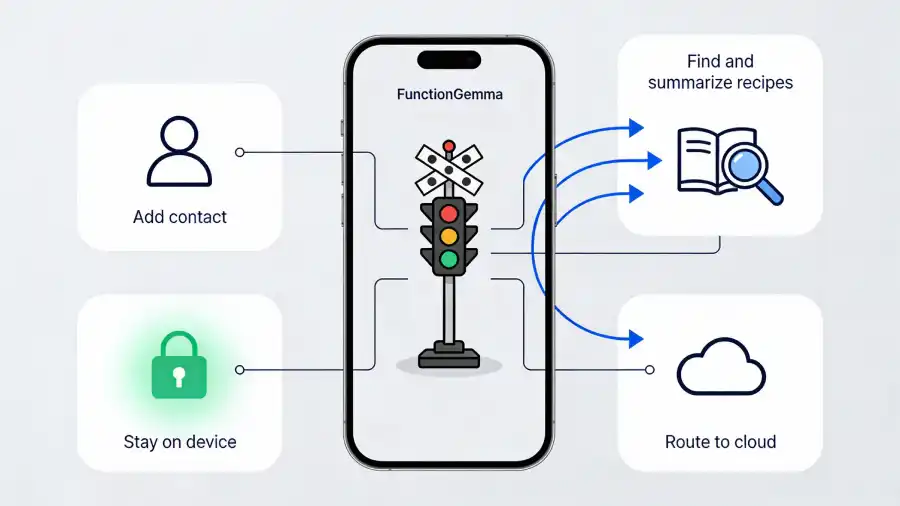
Instantly, it shifts modes and sends only that query to a cloud-based model, such as Gemini. The simple stays home; the complex takes a trip and comes back home with goodies. This hybrid architecture offers both the privacy and speed of local compute and the vast knowledge of the cloud, with the device itself intelligently choosing the path.
The Agent We Were Promised
Google officially calls this a developer’s dream, a building block for custom systems. But in viewing FunctionGemma solely through the lens of developer tools, Google seems to be missing the forest for a very significant, world-altering tree. Because this, to me, is the foundational step towards a proactive AI assistant we have been promised, but have yet to receive. For years, “assistants” have been glorified voice-search portals, requiring specific phrasing and offering little beyond reading web pages back to us.

FunctionGemma is the agent Gemini was supposed to be, and which Google wants it to be, but hasn’t quite become. Because an AI assistant is not about answering questions, which most AI models so far have been; it’s about performing tasks the user assigns. Imagine you’re cooking and your hands are covered in wet flour. You call out to your phone, “Send a text to Mom: “running late, but the groceries are on its way!”” The message is composed and sent just via your voice command.
Later, you say, “Log my 30-minute walk from this morning into my health app.” It’s done. This is proactive, private assistance, not reactive, cloud-bound querying. It turns your voice into immediate action.
The Limits of Today, The Blueprint for Tomorrow
Of course, it’s not yet the omniscient major-domo from science fiction, the Rosie from Jetsons. Current limitations are real and essential to acknowledge. FunctionGemma is a brilliant specialist, not a generalist. It excels at discrete, well-defined tasks: “call this person,” “add that event,” “play this song.”
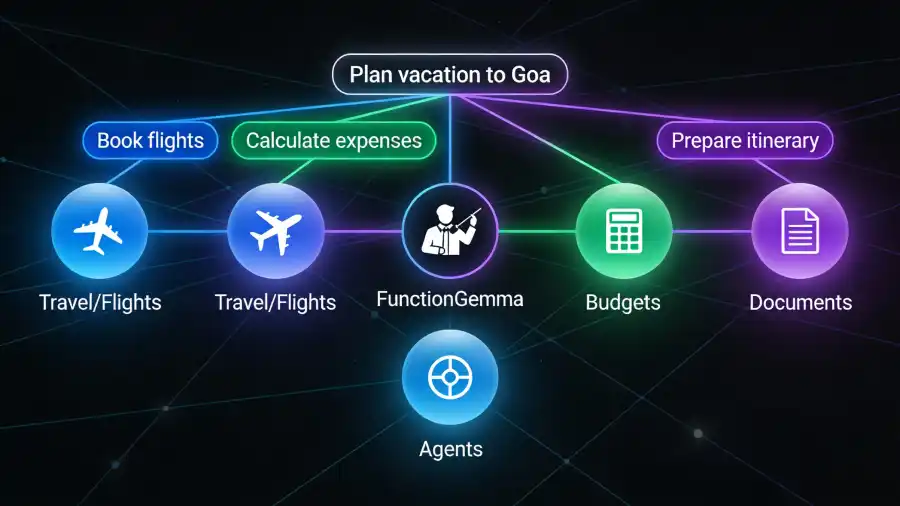
It isn’t yet orchestrating complex, multi-step projects like “Plan my vacation to Goa, finding flights under 15k, booking a sustainable hotel, and creating a day-by-day itinerary.” That requires a group of specialised agents working in concert, a “multi-agent stack” where one handles travel, another manages budgets, and a third drafts documents to present to you. Yet, FunctionGemma is the first crucial step in that direction.
Additionally, the current model requires fine-tuning for specific apps and functions: a bit of teaching after installation. But this is a trivial price to pay for a seismic shift in productivity and, more importantly, in sovereignty. Sovereignty over your data and your privacy. Your personal business stops being the business of a distant server farm.
The Dawn of the Personal AI Industry
This brings us to the heart of the matter: the trillion-dollar vision of the Personal AI Assistant (PAIs). I’ve argued for years that the endgame isn’t some nebulous, god-like machine mind we’re calling Artificial General Intelligence. What we need, and what will truly revolutionise our day-to-day lives, is a stack of specialised, local AI agents working in concert on our devices. A digital board of directors in your pocket, each expert in its domain, coordinated by a master agent like FunctionGemma.
Apple Intelligence points to this future but remains tethered mainly to its own ecosystem and the whims of the cloud. FunctionGemma provides the actual, open-source-friendly blueprint for a more universal and private approach. It demonstrates that the key is not to build one gargantuan model, but to be a nimble, efficient conductor that can manage both local resources and cloud-based utilities. That ‘slight’ shift in approach could mean the world for PAIs.

A Vision from the Silver Screen
This is the first, crucial step towards a future that isn’t incremental tech upgrades, but towards one that looks like the world of Spike Jonze’s film Her, not in the eerie, emotional entanglement, but in the ubiquity and quiet competence of the assistant. In the movie, the AI, Samantha, wasn’t an app you opened; she was in the operating system, in the earpiece, seamlessly woven into the fabric of the protagonist’s digital and physical existence.
She handled the mundane: sorting emails, organising files, and facilitating the complex – the protagonists’ love life, all as an invisible digital layer over our very solid, physical reality. FunctionGemma is a giant step toward that reality. It envisions a world where your phone stops being a slab of glass and metal you buy and becomes a sentient portal you call upon. The distinction between asking your phone and asking your assistant dissolves because they are finally the same entity.
The future, then, isn’t just about faster voice commands. It’s about a fundamental shift in our relationship with technology: from users of tools to directors of our digital lives. It’s a device that anticipates, executes, and manages tasks on our behalf, keeping the vast majority of our life’s digital footprint under our own roof.
Google’s FunctionGemma, this tiny, unassuming model, isn’t just a tool for developers. It’s the seed of that future: the quiet beginning of your phone’s brain transplant, and the undeniable dawn of the assistant that finally, truly, assists. The race to build the trillion-dollar personal AI is no longer speculative. With FunctionGemma, the starting pistol has just been fired, and the track is sitting right in your pocket.
In case you missed:
- Gemini & Copilot accessing your content: A great data grab in the name of AI assist?
- Bots to Robots: Google’s Quest to Give AI a Body (and Maybe a Sense of Humour)
- Meet Manus AI: Your New Digital Butler (don’t ask it to make coffee yet)
- Beyond the Hype: The Spectacular, Stumbling Evolution of Digital Eyewear
- OpenAI, Google, Microsoft: Why are AI Giants Suddenly Giving India Free AI Subscriptions?
- 100x faster AI reasoning with fewer parameters: New model threatens to change AI forever
- In Meta’s Automated Ad Creation Plan, A Fully Transformed Ad World
- The Major Threat to India’s AI War Capability: Lack of Indigenous AI
- NVIDIA’s Strategic Pivot to Drive our Autonomous Future with Innovative Chips
- “I Gave an AI Root Access to My Life”: Inside the Clawdbot Pleasure & Panic of 2026