

Forget poetry writing, DeepSeek, the real Chinese AI revolution does backflips, and is headed for homes across the world, writes Satyen K. Bordoloi.
Remember that viral video of a robot playing table tennis with unnerving precision and grace, and winning a point? That one was fake; it was just a robot juxtaposed over a human. However, just two and a half years later, we are at the cusp of that near-parlour trick deep-faked by an AI video tool, turning real. And I didn’t believe it at all when I first saw it.
Right on the first day of the India AI Impact Summit, a clip of a similar type of robots, dancing with superhuman dexterity alongside some Chinese children, began flooding my socials. I smiled: Chinese AI video makers like SeeDance were proving themselves the best in the world at deepfakes. But the clips didn’t stop, and this time they were of different angles and an entirely different movement.
That is when it hit me: this was not a fake, but real robots, doing nunchucks, stick fights, and backflips in perfect sync with kids. The future had just arrived, and it had caught even me, a hawkeyed AI and robotics advancement watcher, napping. It hadn’t just arrived; this future was being broadcast live on Chinese television, and a record number of people watched it.
In the same week in which India proudly stretched a four-day summit into a fifth of self-congratulations, the real tectonic shift in technology, its real viral moment, happened just north of India. It was an “accidentally on purpose” flex of China’s tech prowess. While we in Delhi were busy discussing what words to use in which policy, China unveiled its master plan – not in the form of a white paper full of words, but as a live performance that enthralled millions.
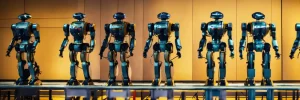
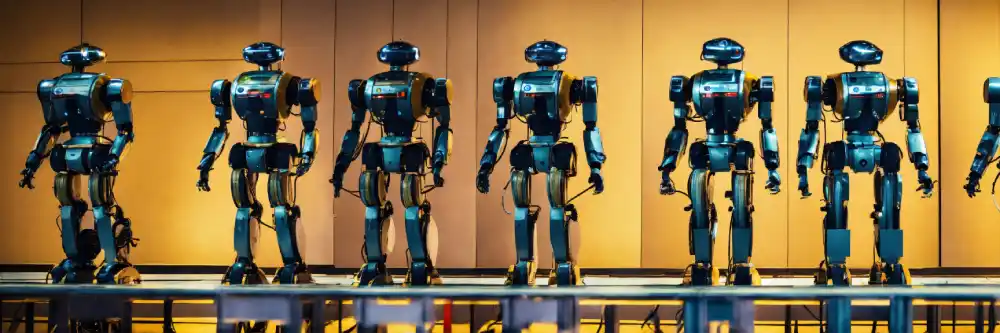
That was China’s Spring Festival Gala, quite literally the most-watched TV program on Earth. And as the South China Morning Post noted, despite a “star-studded line-up of human performers,” the real celebrities were made of metal and silicon. The stars of the show weren’t pop idols, but a troop of H1 humanoid robots from Unitree – yes, the same Unitree whose robot dog Galgotia University tried to pass off as their own.
These weren’t just standing there, blinking; they were kicking, dancing, and sparring with tiny human martial artists in a perfectly synchronised, utterly mesmerising display. Agreed, it was rehearsed. But so is a Beyoncé concert. The difference is, Beyoncé doesn’t have to worry about her hydraulic fluid freezing mid-pirouette.
To call it impressive would be an understatement of the year
My jaw was literally on the floor. Why? Because on October 28, I watched America’s most advanced robot: the 1X Neo – backed by all the right Silicon Valley VCs, being tested by Wall Street Journal reporter Joanna Stern. The results were hilariously sad. Stern asked the robot to load 3 items in the dishwasher. The robot took 4 minutes and 56 seconds to do so. Get water from a 10-foot distance in one minute. It moved like a teenager who had had her first drink. And all this while a human was controlling it, barely some feet away.
And exactly 111 days from when that video was uploaded, Chinese robots were doing nunchuck routines and full-on wall flips? Movements that are difficult even for humans to do unless we’ve had years of training. Yes, Boston Dynamics has had many viral moments with choreographed dance routines. And that too years ago. Yet, remember that those were in the sterile, controlled environment of their lab. But these Chinese robots were in front of a live audience of thousands and a global television audience of hundreds of millions.
The pressure was on, and they nailed it. Yes, one robot flipped during a bend, but the speed with which it got up and joined the chorus in perfect step made me gasp and wonder if this fall was also part of the dance choreographed before. To pull off that level of precision on that scale suggests that while Elon Musk is busy making bold predictions, China has already left the starting line in the dust. And let’s not forget that for a gala as big as this one, preparations and choreography must have begun months prior.
That means 111 days ago, when 1X Neo was botching a simple dishwasher loading, Unitree robots were already doing flips.
And it checks out as well. Because this was not the first time Chinese robots had stepped out of the lab and into the arena to create spectacles of a type we’ve not yet seen: blending precise engineering with entertainment. Robots in China have run marathons as algorithmic endurance is tested in real-world terrains. There have been robots that have demonstrated their calligraphy skills on rice paper. And those who’ve fought boxing matches, in a straight lift from a highly underrated Hugh Jackman film, Real Steel. It seems there is no science-fiction scenario China isn’t trying to make real.
This brings us to the biggest tech event that began on the same day Unitree robots performed on stage, the one that happened right here in the “Global South.” At the India AI Impact Summit in New Delhi, the largest gathering of its kind in the region, a moment of unintentional hilarity that became a metaphor for the current global tech order.
Galgotias University, in a bid to showcase its brilliance, displayed a robot dog, claiming it as their own creation. The only problem? It was a Unitree Go2. It was made in China, and a little sibling of the very same robots doing kung-fu on TV that same night. In an instant, the summit became a metaphor: While we were busy trying to pass off Chinese hardware as indigenous innovation, the actual Chinese creator of that hardware was showing the world what it could really, like really really do.
The contrast is as embarrassing as it is stark. One country is building the future; the other is trying to take credit for ordering the parts.
And this isn’t just about viral videos and fancy stage shows. The numbers tell the real story. According to estimates, over 80 per cent of all global humanoid robot shipments last year came from Chinese companies. Think about that. At least 8 out of every ten humanoid robots sold on Earth were made in China.
Unitree alone shipped more than 5,500 humanoid robots last year. That a single company’s output exceeded the combined shipments of all its major US rivals, including Tesla (with its Optimus), Figure AI, and Agility Robotics, is telling. And this is just the beginning. Unitree’s CEO, Wang Xingxing, has told domestic media that shipments could quadruple to 20,000 units this year. Then there are other companies, like AGIBOT and UBTECH Robotics. AGIBOT itself sold over 5,000 robots last year.
That fake robot playing table tennis, the parlour trick? Turns out it was more than a deepfake: it was prophecy, a prediction of things to come. Because while we were busy doubting the videos, the companies making them were busy building the factories. The takeover isn’t coming; it’s already here. It’s not happening in a lab in Boston or a factory in Texas, as we had expected. It’s happening live, on primetime, in front of a billion people. We were worried about AI taking over jobs.
Watching these robots, I’m not sure if even the few jobs that were safe for humans to do are really safe anymore. Does that mean utter joblessness for the world? Nah! It means you and I, and all of us, will get employment in factories that make these robots. Even as they replace us. And that is not a prophecy for the distant future: if you’ve seen these Unitree robots, you’d know it as a fact for tomorrow.
In case you missed:
- The Cheaper Than Laptop Robot Revolution: How China’s Unitree Just Redefined Our Future
- Bots to Robots: Google’s Quest to Give AI a Body (and Maybe a Sense of Humour)
- 100% Success Rate: Johns Hopkins AI Surgeon Does What Humans Can’t Guarantee
- Anthropic Accuses Chinese AI of “Stealing”, Internet Points Finger Back At Them
- One Year of No-camera Filmmaking: How AI Rewrote Rules of Cinema Forever
- Anthropomorphisation of AI: Why Can’t We Stop Believing AI Will End the World?
- To Be or Not to Be Polite With AI? Answer: It’s Complicated (& Hilarious)
- Why Elon Musk is Jealous of India’s UPI (And Why It’s Terrifyingly Fragile)
- Meet Manus AI: Your New Digital Butler (don’t ask it to make coffee yet)
- OpenAI, Google, Microsoft: Why are AI Giants Suddenly Giving India Free AI Subscriptions?