


Classic Lego meets responsive play as smart bricks add sound and light — raising new questions about how imagination fits into the future of toys...
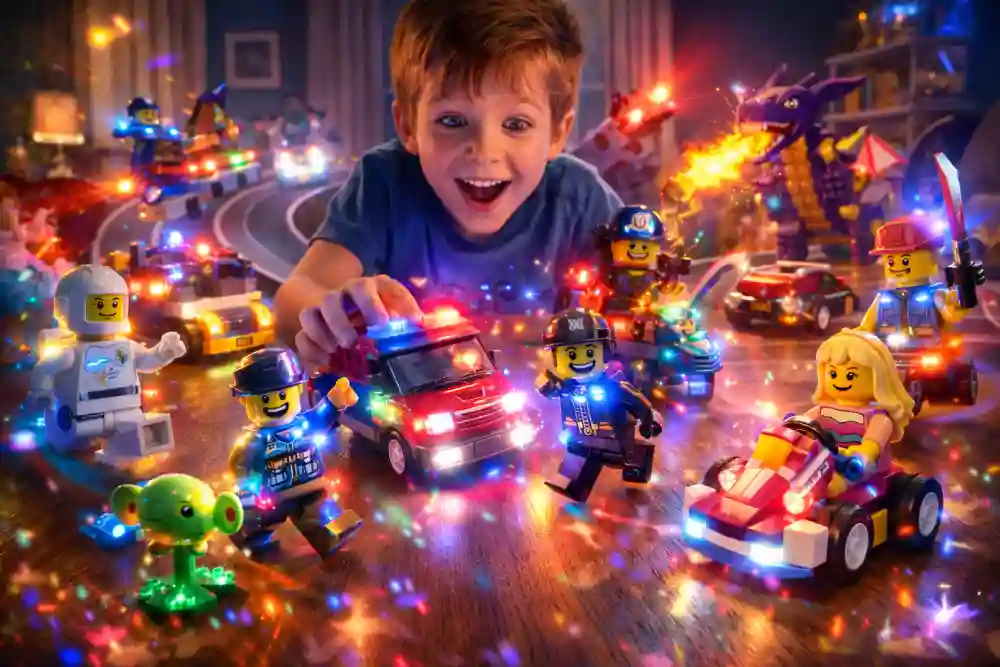
Lego bricks have always been about creative construction through play, using your mind, systematic thinking, and problem-solving abilities to put the pieces together. You then use your imagination to make them come alive. Children build cars and spaceships, then bring them to life with sound effects made by their own voices, engines roaring, lasers firing, characters speaking lines invented on the spot.
That free-form play is part of Lego’s cultural appeal. At CES 2026, however, the Lego Group signalled a new direction with the launch of Lego Smart Play, a system that introduces sensor-equipped “smart” bricks capable of responding with lights, sounds, and behaviour. Marketed as “AI-powered” by some outlets, the technology is designed to make physical builds react to how they are moved, tilted, or combined.
Lego says the goal is not to replace imagination, but to enhance play by making creations feel more alive, without relying on screens, phones, or constant internet connectivity.
A new Lego brick

At the centre of the Smart Play system is a new Smart Brick, shaped like a standard 2×4 Lego brick but packed with electronics. Inside is a tiny custom chip, along with sensors that detect motion, light, and orientation, plus LEDs and a small speaker. Lego has also introduced Smart Minifigures and Smart Tags, which carry unique digital identifiers.
When these elements are placed near or attached to a Smart Brick, the system recognises them and triggers specific responses, such as sounds, light effects, or changes in behaviour. Multiple Smart Bricks can communicate with each other using a local wireless protocol Lego calls BrickNet. Importantly, all of this happens offline. There are no generative AI models running in the cloud, and no companion apps are required to make the toys function.
Lego has taken care to avoid overselling the technology behind Smart Play. While some descriptions use the term “AI-powered,” the system does not behave like conversational AI or learning software. The bricks respond using built-in logic and on-device processing rather than adapting over time or generating new dialogue.
In practice, the reactions are simple and repeatable, rather than open-ended or unpredictable. Sounds and light cues appear in response to how the bricks are handled, but they do not change or evolve over time. Lego has said this consistency is important for younger children, where reliability is more important than novelty.
The company’s view is that these responses should sit alongside traditional play rather than take it over, adding a layer of feedback without interfering with the physical act of building, rearranging, and imagining scenes in one’s own way.
TIE Fighter and The X-Wing

The first Smart Play sets shown at CES are based on Star Wars, including builds like Darth Vader’s TIE Fighter and Luke Skywalker’s X-wing. These sets combine traditional Lego construction with interactive effects such as lightsaber sounds, cockpit audio, and motion-triggered responses. According to Lego, this will help deepen engagement without pushing children toward screens. Still, some parents and educators have raised questions.
Part of Lego’s appeal has always been that children supply the action themselves, making the sounds, inventing the dialogue, and imagining outcomes. There is concern that toys that light up and make noise automatically might reduce that imaginative effort. Others worry about more noisy, flashy toys in homes that already feel overstimulated.
Lego has responded to those concerns by stressing that Smart Play sits alongside its existing bricks rather than replacing them. The new elements can be used, combined, or left out entirely, depending on how families prefer to build and play. For some parents, especially those who remember inventing sound effects and stories themselves, there is a natural attachment to quieter, more open-ended toys.
Others see responsive features as a natural fit for homes and environments where interactive technology is already the norm. That difference in perspective reflects how playtime has evolved across generations. We have gone from playing with old tyres and sticks to video games, VR, laser tag, and more. Lego’s approach leaves room for both styles, allowing households to decide how much technology they want mixed into the familiar rhythm of building, rebuilding, and imagining.
The future of Play

While the current Smart Bricks are limited to simple cues and reactions, the idea of toys that feel more expressive is already familiar to many families through books, films, and animation. Movie franchises like Toy Story have popularised the notion of playthings that appear to be alive, even if today’s real-world versions remain far more restrained.
Lego’s approach stops well short of that fiction, focusing instead on controlled responses tied to physical interaction. Still, the direction reflects ongoing interest in making toys that react in ways children can notice (maybe even crossing into autonomous behaviour at some point). Lego stops well short of that vision for now, focusing on controlled, offline reactions.
Whether that future excites or unsettles parents, Lego’s latest move shows that even the simplest things in life, like Legos, are no longer immune to technological change.
In case you missed:
- $70 for cocaine, $30 for weed, and $50 for ayahuasca, that’s what it costs to get ChatGPT high!
- Dire Wolves are not back; what we got are designer dogs for GoT fans!
- Schrödinger’s Cat Just Made Quantum Computers 160x More Reliable!
- India’s first Aatmanirbhar semiconductor chip is finally here!
- Slaughterbots: Robot Warriors in the Indian Armed Forces!
- CES 2026: ASUS Unveils Smart Glasses With 171-Inch Virtual Screen
- AI in 2025: The Year Machines Got a Little Too Smart (But Not Smart Enough)
- Training AI for Pennies on the Dollar: Are DeepSeek’s Costs Being Undersold?
- Age of Bhaarat: India’s Aatmanirbhar Leap into AAA MMORPG Gaming
- Apple’s “Awe-Dropping” Event: iPhone Air, iPhone 17, AirPods Pro 3 and More