



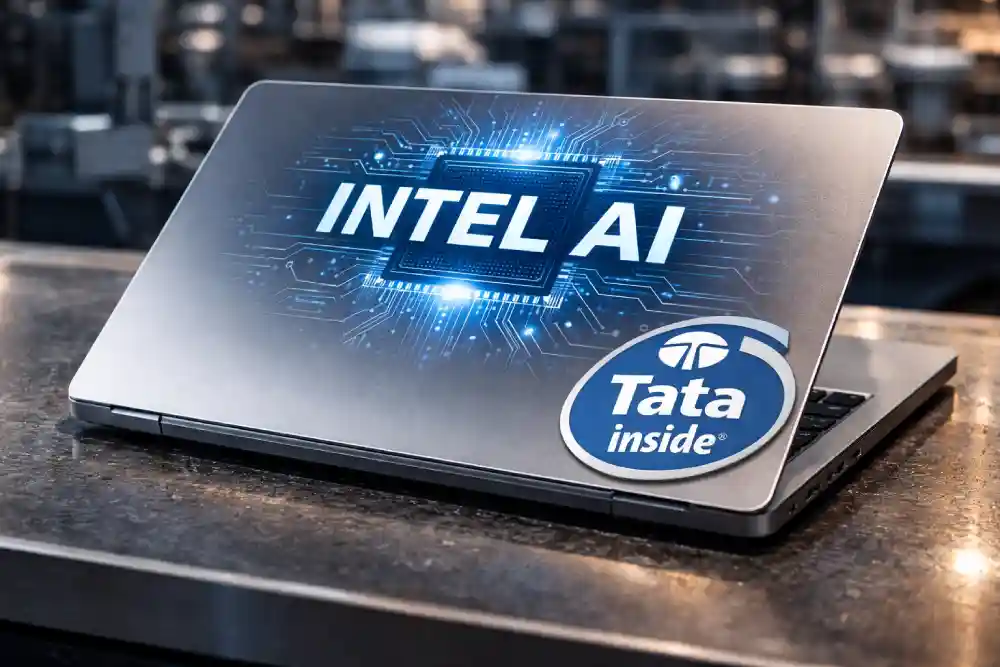

A new Tata–Intel partnership signals India’s growing role in global chip and AI PC manufacturing
India’s long-stated ambition to become a global semiconductor hub is moving decisively from policy to production. In a major development for the country’s electronics ecosystem, Tata Electronics has entered into a strategic alliance with US chip giant Intel to explore manufacturing and advanced packaging of Intel products in India.
Intel’s participation gives Tata Electronics an anchor customer as it develops its new semiconductor facilities in India. The two companies have agreed to work together on manufacturing and advanced packaging of Intel products, while also examining opportunities in AI-focused personal computing. The announcement does not include commitments on production scale or commercial launch dates.
The announcement outlines specific areas of technical collaboration rather than firm production commitments. It comes as chipmakers increasingly distribute manufacturing across multiple countries. In this environment, India is positioning itself to participate more actively in the global semiconductor supply chain.
$14 billion across 2 facilities

At the heart of the Tata Intel collaboration are two large semiconductor projects being developed by Tata Electronics. One facility (which we’ve covered before) is a greenfield chip fabrication plant being developed in Gujarat to manufacture advanced semiconductor components. The other is an assembly, packaging, and testing (OSAT) unit in Assam that will process silicon wafers into finished chips. These two sites form a major part of Tata Electronics’ semiconductor manufacturing plans in India.
The Assam facility is expected to begin operations in 2026, while chip output from the Gujarat plant is planned for a later stage, around mid-2027. Intel is participating in the project in a technical capacity linked to manufacturing and packaging. While the two sites are located in different states of India, they’re both integral to Tata’s “bigger picture.”
The scale of Tata Electronics’ semiconductor ambition is underscored by an estimated investment of nearly $14 billion, divided across the Gujarat and Assam facilities. This puts the project among the largest private-sector commitments in India’s chip fab, or even electronics manufacturing history. Industry analysts view Intel’s involvement as a vote of confidence not just in Tata but in India’s evolving semiconductor policy framework, which offers incentives for fabrication, packaging, and advanced manufacturing. Semiconductor manufacturing involves high capital costs and complex technology.
The Tata–Intel arrangement is set up as an ongoing collaboration rather than a single supplier contract, allowing the two companies to work together across multiple areas over time. For the Tata Group, which already has operations in electronics manufacturing and related services, semiconductors add a new line of business within the broader technology sector.
Intel’s AI push in India

For Intel, the agreement with Tata Electronics covers more than chip manufacturing. The two companies have said they will work together on AI compute and AI PC market development, including systems built around Intel processors. This opens the possibility of AI-enabled laptops and personal computers being assembled in India as part of Tata Electronics’ broader manufacturing plans.
The companies have described the work as exploratory and have not announced production volumes or timelines. Intel is currently expanding its range of AI-focused PC products, while demand for such devices is increasing in India. The company has also stated that partnerships with local manufacturers form part of its approach to manufacturing and packaging outside its existing facilities.
The Tata–Intel collaboration sits within India’s ongoing efforts to expand domestic semiconductor manufacturing across fabrication, packaging, testing, and related activities. Government incentive programmes in recent years have sought to attract large investments involving established global technology companies. Intel’s role as the first major customer for Tata Electronics’ semiconductor facilities provides an early commercial use case for the project.
Tata Electronics has not released staffing details for the facilities. Operations at the sites include setting up manufacturing equipment, handling materials during production, and carrying out chip processing activities on the factory floor. The components handled at these facilities are all a part of hardware supply chains for computers and other electronic devices.
As AI PCs Rise, India Adds Manufacturing Muscle
This collaboration has happened at a time when the global semiconductor industry is witnessing a sustained and accelerated expansion, with industry projections estimating the market could approach $1 trillion (in annual value) by the end of the decade. At the same time, AI-capable personal computers are becoming a standard category, with chipmakers increasingly designing processors specifically for on-device AI workloads.
India, which already ranks among the world’s largest PC consumption markets, is now adding manufacturing infrastructure to that demand base.
The upcoming OSAT facility in Assam is expected to handle chip assembly and testing, while the Gujarat plant is planned to support fabrication at a later stage.
Intel has described India as a long-term market for AI computing, and Tata’s facilities introduce physical production capacity into that equation. The result is a shift from participation through consumption to participation through manufacturing, at a moment when global supply chains are actively being rebalanced.
In case you missed:
- India’s first Aatmanirbhar Chip Fab: TATA leads the way!
- 4 New Chip Fabs and a Rallying Cry from The Red Fort!
- India’s first Aatmanirbhar semiconductor chip is finally here!
- India’s First Paid Chip Prototype: Kaynes Fires the Starting Shot
- One Chip to Rule Them All: The 6G Chip at 100 Gbps!
- India, iPhones, China & Trump: The Foxconn Story!
- The Sodium-Ion Breakthrough That Could Unplug Lithium’s Reign
- China Builds World’s Largest Neuromorphic Supercomputer: Darwin Monkey
- Tesla’s India Launch: It’s not about the Model Y, it’s about the AI!
- Slaughterbots: Robot Warriors in the Indian Armed Forces!