



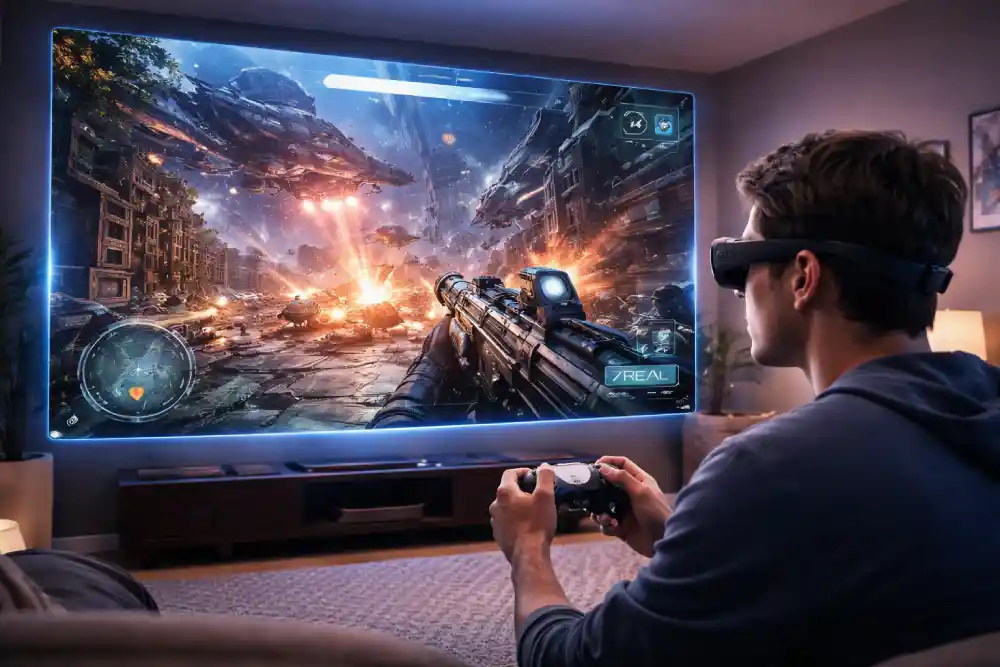

A pocket-ready 171-inch virtual display with a 240 Hz refresh rate and a lightweight wearable design that reimagines big-screen gaming outside VR.
At CES 2026 in Las Vegas, ASUS Republic of Gamers (ROG) and Xreal unveiled a new category of gaming eyewear that aims to make heavy VR headsets feel obsolete for long sessions. The ROG Xreal R1 Gaming Glasses pack a pair of 240 Hz micro-OLED displays into a lightweight frame weighing about 91 g, and project a virtual screen equivalent to a 171-inch display viewed from four meters away, the kind of real estate that feels more natural to users than immersive VR domes.
Unlike bulky virtual reality eyewear that envelopes vision and can cause fatigue, the R1 glasses present a flat, big-screen experience users are familiar with, simply floating in front of the eyes like a giant TV, a format many people find more comfortable for extended gaming or video watching.
Same screen, New dimension

What sets the ROG Xreal R1 apart is its focus on virtual big-screen display rather than full virtual immersion. Where VR headsets surround the user with a 3D world, which many find cumbersome for everyday use, the R1’s micro-OLED screens deliver a high-refresh, large display layered over reality without blocking out the real world. This design choice aligns with what many gamers have questioned about VR comfort: who wants to wear heavy gear strapped to their face for hours? While VR can be engaging, its form factor has long been a barrier to extended play, something analysts have noted repeatedly.
The R1 instead brings the simplicity of a massive cinema-style screen into a wearable glasses form, essentially turning your environment into a personal big-screen theatre that fits in your pocket.
Under the hood, the ROG Xreal R1 uses dual 0.55-inch Sony micro-OLED panels with a 1920×1080 Full HD resolution and 240 Hz refresh rate, creating ultra-smooth motion ideally suited to fast-paced games and video. The glasses cover roughly a 57-degree field of view, which translates to the virtual 171-inch screen experience, and are designed to keep visuals fluid with about 2 ms motion-to-photon latency.
The high refresh rate translates to faster animations where competitive gaming visuals feel crisp and responsive without motion blur (a key benefit over previous wearables limited to lower rates). Users can place the virtual screen in fixed “Anchor Mode” or let it follow their gaze, blending convenience with immersion.
Connectivity and Versatility Built-In

ASUS says the R1 glasses are meant to be plug-and-play with PCs, consoles, and handheld devices, using the included ROG Control Dock with HDMI 2.0 and DisplayPort 1.4 inputs. They can also connect directly to the ROG Ally handheld console or other USB-C devices without software installs, making them versatile for gaming on the go. This approach embodies the idea of “a big screen anywhere,” whether you’re on a couch, a plane, or a train.
Putting on the R1 instantly gives you a large gaming canvas without needing a physical monitor. Electrochromic lenses adjust transparency depending on environment and gaze, and Sound by Bose audio adds spatial sound, further enhancing the viewing experience without separate headphones.
What makes devices like the ROG Xreal R1 compelling is not just comfort but probably that “James Bond” factor where an everyday item like sunglasses can serve a way cooler purpose. The R1 does not ask users to relearn how they consume content or commit to full visual immersion. Instead, it places a large, stable screen in front of them, one that behaves like a monitor rather than a virtual environment. This makes it easier to play for long sessions, switch between tasks, or simply relax without sensory overload.
In practical terms, the glasses turn spare moments into opportunities to use a screen that would normally be impractical to carry. That everyday flexibility is something VR headsets have struggled to deliver at scale.
A New Direction?
The ROG Xreal R1 also points to how lightweight display glasses may be used beyond individual gaming sessions. Because the glasses present standard flat video content rather than immersive virtual environments, the same material can be viewed simultaneously by multiple users wearing their own devices. This makes scenarios such as shared movie viewing or group presentations technically straightforward, provided each user has a connected source.
In educational or training settings, wearable displays of this kind could replace projectors or physical monitors by allowing participants to view identical content through personal screens. While software support will determine how these uses develop, the hardware itself is aligned with familiar screen-based workflows rather than immersive VR experiences. That compatibility with existing habits may shape how smart glasses are adopted in everyday settings.
In case you missed:
- AI vs Your Poker Face: The Battle Unfolding at ESPN’s World Series of Poker 2026
- AI, Cows, and Control: The $2 Billion Farm Tech Moving 600,000 Animals
- India’s Mappls Revolution: The Swadeshi Push to Dethrone Google Maps
- Spiralism: The Cult-Like Belief System Emerging from AI
- Scientists use AI to create Artificial Bacteriophages that Target and Kill Superbugs!
- No Internet, No Cloud: India’s ‘BharatGPT’ Is Taking a Different AI Path
- Aatmanirbhar Push: India Becomes 7th Nation to Crack Gallium Nitride Chip Technology
- The End of Hacking? India Successfully Tests ‘100% Uncrackable’ Quantum Laser Tech
- Japan just made Remote Quantum Computing a reality!
- FIFA 2026: How AI Is Taking Over the World’s Biggest Sporting Event