




The great Indian workplace is quietly being rewired by people who have figured out cheat codes using AI, but are terrified to tell anyone, except Reddit, finds Satyen K. Bordoloi
One of my friends, Akbar (name changed, for reasons that will become obvious), works at a financial analysis firm in Bengaluru (city changed for reasons that will become, well, obvious). Every morning at work, he logs in, opens his laptop, and lets his AI tools do the heavy lifting that used to consume most of his day – pulling data, crunching numbers, building the kind of reports that once required sustained suffering and three cups of strong coffee every hour. It now takes him less than an hour to do what he used to spend a day on.
The rest of his workday? Well, it’s a masterclass in the performance of labour. Akbar stares purposefully at spreadsheets. He types with the focused energy of a man solving world hunger. He sends occasional email updates and sometimes pretends to overshoot on time. Most of this time, though, he watches YouTube, reads, reel-surfs, or takes a walk. He is, by his own admission, happier than he has been in years.
His manager thinks he’s extremely diligent. His colleagues think he’s under a lot of pressure. He corrects neither, and nobody suspects a thing.
Akbar is not a slacker (I’ve seen him slog). He isn’t defrauding anyone either because his work gets done, gets done well, and gets done faster than before. He has simply discovered something a large part of the corporate world pretends isn’t true: that a large portion of what we call “work” can be done easily with AI, but doing so means the value of many people goes down.
Hence, it is not easy, yet we should ask this question: should he say anything to management?
The Confession That Set the Internet on Fire
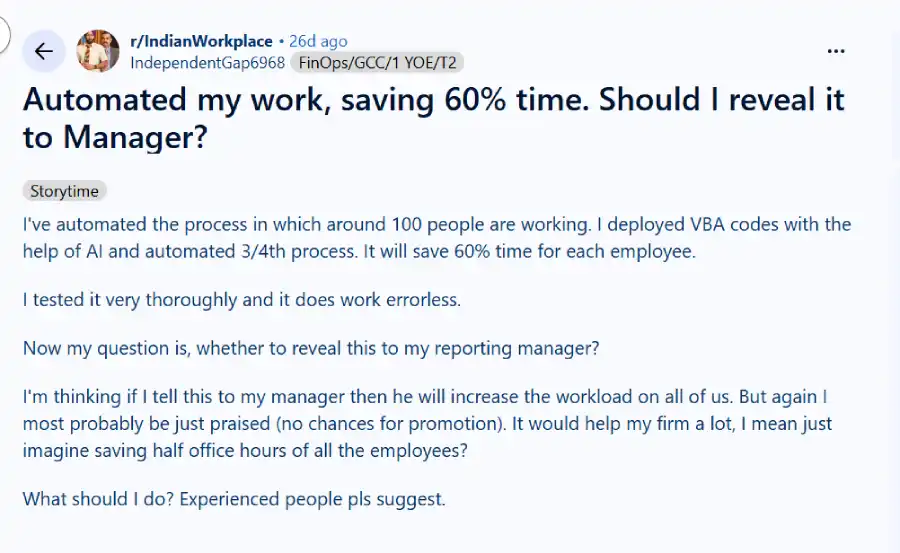
“Managers are di*ks. Management is mostly a scam; a job consisting just of asking people if they have finished theirs, and nothing more”, this is the gist of responses that a person got when they posted on Reddit at r/IndianWorkplace that they did something akin to what my friend Akbar also does. Naturally, the post went viral.
A user going by the handle IndependentGap6968 posted their confession: they had automated a major business process involving around 100 people, reducing manual effort by approximately 60 per cent, deploying VBA code with the assistance of AI to automate nearly three-quarters of the workflow. They tested the system. It worked errorlessly. It was silent and efficient and beautiful.
And they had absolutely no idea whether to tell their boss about it.
The hesitation was specific: “I’m thinking if I tell this to my manager then he will increase the workload on all of us. But again I most probably be just praised (no chances for promotion).” This is the employee’s dilemma in its most Indian form. You do something genuinely clever, make things better for yourself and your entire team, and all you’ll get next is: more work, less credit, same salary, even as your manager writes a LinkedIn post claiming the achievement as team initiative.
The internet, naturally, had opinions, with several commenters strongly advising the user to keep the tool private. One person wrote, “Do not reveal it. Keep it to yourself. Use the time you have saved to do something else.” Another said: “If it was western management sure, but Indian managers will take credit and give more work.”
Another had an even better response: “I had done same nearly a month back now i hve to do max. 1hr of work , dont tell anyone , i use this time to study and switch, inidna managers always take credit there’s no doubt , i will throw this tool after on mail on my last working day…”
Among them all, the one that deserves a standing ovation said: “Pose as a different organization… contact your firm and tell that you can save 4 hours a day per employee via a solution. Sell this to them.” Then there were the cautionary tales, stories about companies rewarding efficiency with layoffs, with one user talking about his girlfriend’s MNC, where a senior employee who had built systems and automated processes was eventually laid off after the company realised it could run the work more cheaply elsewhere.

The Paradox at the Heart of India’s Workplace
Much like India’s tech space, companies here in general are late to the bandwagon. There is so much pretence that the belief, as I have often encountered, is that if an employee uses AI, management would look at them as lazy or replaceable. This is in contrast to much of the world, where many have flipped the script as I wrote recently in Sify, with companies like Accenture, among others, training their workforce with a blunt objective: those who couldn’t demonstrate AI adoption would be shown the door. Enterprise software company IgniteTech went further, requiring employees to spend a fifth of their work time experimenting with AI, post about it on Slack, and self-assess their usage. The lowest-scoring performers were culled from the company, including some long-standing hands.
So we have arrived at this magnificent absurdity of Indian management: if you could make your job more efficient by using AI, you could be fired because that means you’re redundant, even as abroad you’d be fired for not using AI and keeping up with the rest. This, even as a July 2025 research report from Lightcast found that job postings mentioning AI skills offer salaries 28% higher on average, jumping to a 43% premium for roles requiring at least two AI skills. The global market is screaming that AI fluency has value. But Indian workplaces mean employees like my friend Akbar or Reddit user IndependentGap6968 can’t talk about their efficient use of AI.

India’s Particularly Sharp Edge of This Knife
The stakes, when it comes to India using AI in the workplace, is higher than anywhere else – as I wrote in a previous piece – for reasons not to do with individual employees and everything with scale. India produces over 1.5 million engineering graduates annually, of which only 10% secured employment in 2025, according to a TeamLease report. Hence the traditional promise: study hard, get a job, be set for life, was already fraying before AI arrived. Now it is unravelling at lightspeed.
TCS, the country’s largest private employer, announced layoffs of 12,000 employees while simultaneously implementing a bench policy that limits unallocated project time to just 35 days annually, beyond which employees face “career degrowth or termination.” Oracle India followed with cuts specifically targeting software development and cloud services roles, framing them not as performance failures but as “skill mismatches.” A polite phrase for: we found something cheaper, perhaps AI. Experts predict these moves could lead to 400,000 to 500,000 job losses in the IT sector over the next two to three years. This is not a storm on the horizon, but a hurricane in our midst.
And what’s worse is the cruelty of the new workplace, where the old workplace pyramid – wide base of junior employees, narrow top of senior leadership – is giving way to a diamond model where the middle bulges with specialised, tech-enabled roles and the entry-level base simply… shrinks.
AI handles routine tasks while human resources concentrate on middle management and specialised positions, creating a job market that demands immediate expertise rather than offering training opportunities for newcomers. This means the 22-year-old who graduates next year will walk into a market that has no patience for learning curves, no room for growth through apprenticeship, and a growing preference for the AI agent that can do their job at a fraction of the cost and without asking for a maternity policy.

What Akbar Knows That His Manager Doesn’t
The uncomfortable truth with people like IndependentGap6968, who are uncomfortable with their truth of discovering AI can do things better, is that people like them are not the problem; they are the solution. They found a tool and a way to milk it to create value. The problem is that they have to do it quietly, post it anonymously on Reddit instead of proudly proclaiming it. It is rational self-preservation in a system that has made it abundantly clear it will not reward him proportionally.
Hence, the real question the Indian workplace needs to reckon with is not whether employees should reveal their AI efficiencies. It is why the answer is so obviously, universally, heartbreakingly “no.” When smart people do better work and hide it because disclosure can only hurt them, that is an institutional-level failure of trust and not that of personal morality.
Will our companies learn to reward efficiencies rather than punish them? I’ll check back with Akbar in a few years. And you do so with the Reddit user. My bet is that they won’t.
In case you missed:
- With AI Set to Destroy Millions of Indian Jobs, Traditional Career Advice is a Death Trap
- After Years of Job Slashes, Companies Use AI to Boost People, Not Replace Them
- OpenAI, Google, Microsoft: Why are AI Giants Suddenly Giving India Free AI Subscriptions?
- Use AI or Get Fired: The New Workplace Ultimatum Hanging Over Every Job
- Companies Fired Staff for AI. Now AI Costs More Than Staff. Together It’s Still Half the Story
- Lost Job to AI? The Real Enemy Isn’t The Bot – It’s Your Boss. Here’s Proof
- Not Fastest, but Frugalest: Why Indian EVs Are Suddenly World-Class
- How India Can Effectively Fight Trump’s Tariffs With AI
- The AI Peace Race: Why India’s Real Opportunity Starts Where the Arms Race Ends
- How Can Indian AI Startups Access Global VC Funds?