



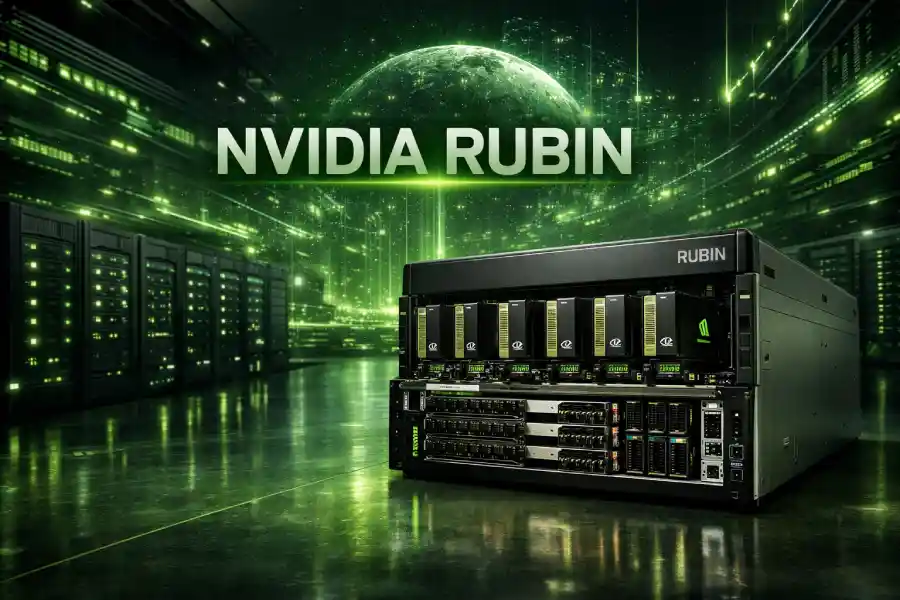

Nvidia’s new Rubin platform signals a shift toward cloud-scale AI infrastructure, designed to run massive training and inference workloads as managed systems rather than standalone chips.
Nvidia has unveiled Rubin, a new AI computing platform intended to power the next generation of large-scale AI supercomputers, marking a major evolution in how the company approaches data-center-scale computing. Announced at the start of 2026, Rubin is positioned not as a single chip but as a tightly integrated platform combining multiple processing components, networking technologies, and system software.
According to Nvidia, the goal is to meet the rapidly rising computational demands of advanced AI models, particularly those used for training and inference at scale. The company describes Rubin as a successor to its Blackwell architecture, designed to address cost, energy use, and performance constraints that are becoming increasingly prominent as AI workloads grow in size and complexity. The announcement reflects Nvidia’s broader strategy of treating entire data centers as programmable AI systems rather than collections of individual processors.
Designing AI Infrastructure for Scale and Deployment

At the core of the Rubin platform is a new generation of Nvidia hardware designed to operate as a single, coordinated system. Nvidia says Rubin combines multiple chips, including a new GPU and a general-purpose CPU, alongside high-speed interconnects that allow them to function as one large computing unit.
Rather than focusing on raw chip specifications alone, the company emphasizes how these components work together across racks of servers. Rubin is designed to support AI models that require massive parallel processing, as well as ultra-quick communication between compute elements. Nvidia’s official release highlights the fact that the new platform is optimized for both training and inference workloads, with a special emphasis on reducing overall cost (per AI task).
This approach signals a possible end to standalone accelerators and a renewed focus on fully integrated AI infrastructure.
Nvidia CEO Jensen Huang framed Rubin as a response to what he described as an unprecedented surge in global demand for AI computing. In an interview reported by The Guardian, Huang said AI is moving beyond experimental use into a phase where it is becoming core infrastructure for governments, enterprises, and scientific research.
Huang said the growth of AI workloads is pushing demand for computing systems that can operate at a much larger scale than earlier architectures. He also referred to ongoing challenges linked to supply capacity and regulatory limits, including export controls that affect where advanced chips can be shipped. According to Nvidia, Rubin is intended to give customers a consistent platform for building large AI systems, reducing the need for custom hardware configurations that can slow deployment or complicate expansion.
From Research to Production

Nvidia has also outlined how Rubin fits into the practical operation of large AI data centres. The platform is designed to manage training and inference workloads as continuous processes rather than isolated tasks, with computing, networking, and system controls handled together. The company says this design is intended to improve how hardware resources are used over time, particularly as AI workloads grow in scale and complexity.
Power consumption and efficiency are a growing concern for operators running large AI systems, and Nvidia notes that Rubin has been built with those constraints in mind. The company also points to gains in inference performance, reflecting increased demand for running AI models in production settings rather than only in research. These use cases are further expanding across sectors that rely mainly on large volumes of real-time AI output.
The People Matters report notes that as AI infrastructure scales, organisations are paying more attention to ongoing operations, including system maintenance, deployment management, and integration across data centres. Nvidia’s Rubin platform is presented as a packaged system rather than a collection of custom-built components. This reduces the need for site-specific engineering work once systems are deployed.
The report suggests that such platforms shift emphasis toward standardised operation and lifecycle management, which can influence how enterprises allocate technical roles and plan future AI infrastructure investments. The report notes that Rubin is aimed at enterprises and cloud providers seeking scalable AI capacity, rather than niche research users. By offering a standardized platform, Nvidia is attempting to lower operational complexity, while at the same time, also supporting the growing need for AI-ready infrastructure across sectors.
Rubin’s Place in Nvidia’s Platform Strategy
Rubin follows Nvidia’s Blackwell architecture as the company’s next major step in its AI hardware roadmap, with deployment expected to take place through partners and cloud providers over the coming cycle. Nvidia has indicated that Rubin is aimed at large-scale data centre environments where AI workloads are expected to run continuously rather than in isolated bursts. The platform is positioned for enterprise customers and hyperscalers that require three things.
Predictable performance, long-term support, and the ability to scale systems over time. Coverage of the launch suggests that Nvidia sees Rubin as part of an ongoing cadence of platform updates, rather than a one-off release. Adoption will depend on how quickly cloud providers and system integrators bring Rubin-based systems online, but the company’s messaging makes clear that future AI infrastructure will be delivered as managed platforms rather than individual components.
In case you missed:
- NVIDIA’s Isaac GR00T N1: From Lab Prototype to Real-World Robot Brain
- Training AI for Pennies on the Dollar: Are DeepSeek’s Costs Being Undersold?
- NVIDIA just dropped “ACE” at CES 2025: Truly intelligent NPCs coming soon!
- China Builds World’s Largest Neuromorphic Supercomputer: Darwin Monkey
- Japan just made Remote Quantum Computing a reality!
- Tata Electronics to Manufacture Intel Chips & AI Laptops in India!
- From Earth to Orbit: Data Centers are Heading Out to Space!
- India’s first Aatmanirbhar Chip Fab: TATA leads the way!
- Schrödinger’s Cat Just Made Quantum Computers 160x More Reliable!
- DeepSeek’s AI Revolution: Creating an Entire AI Ecosystem