

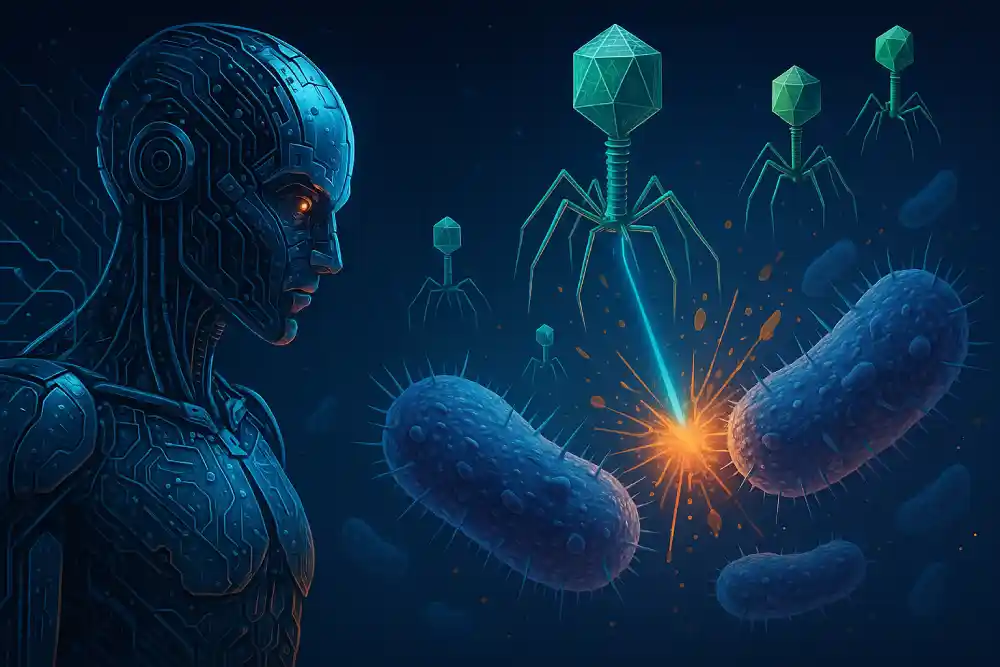

In addition to decoding life’s building blocks, AI is designing new ones. Scientists have used generative AI to build bacteriophages that kill drug-resistant bacteria.
Remember when we asked whether AI could turn the tide in the war against antibiotic-resistant bacteria? The answer just got a huge, unexpected boost. In a breakthrough that reads like science fiction, a team of researchers led by Brian Hie, a computational biologist at Stanford University, has used generative AI to design from scratch a set of complete, functional bacteriophages, viruses that kill bacteria.
Not only did several of these AI-designed “phages” prove viable in lab tests, but they even outperformed some natural phages in killing drug-resistant E. coli. If this technology can scale safely, it has the potential to reshape medicine, while also offering a powerful alternative to traditional antibiotics.
From Antibiotic Doom to AI Hope

For decades, we’ve been caught in a grim spiral: bacteria evolved, drugs stalled, superbugs spread. Traditional antibiotics often hit too broadly, killing beneficial and harmful bacteria alike, and creating pressure for bacteria to evolve resistance. Enter bacteriophages, viruses that only target specific bacteria and leave the rest of the microbiome intact.
Phage therapy is nothing new; it was used even before antibiotics became widespread. But until now, phage therapy relied on naturally occurring phages, or on tweaking them carefully, a slow, imprecise process. With AI, researchers have bypassed nature’s waiting room. The new generation of phage-genome models (named Evo 1 and Evo 2) was trained on millions of genomic sequences.
From that, the AI generated hundreds of candidate phage genomes (300 in total). These were then synthesized by scientists and tested in lab dishes until 16 viable phages capable of infecting and killing even antibiotic-resistant E. coli strains were found.
Unlike previous attempts that focused on isolated genes or simple edits, this is a full-genome design, from base pairs upward. That’s an order of magnitude harder and riskier. Artificial intelligence has allowed researchers to navigate the vast space of possible genomes and identify ones that “work” in real life. Even more promising: several of the AI-designed phages outperformed the reference natural phage in lab tests, showing faster kill rates and the ability to overcome bacterial strains that had become resistant.
If this scale of design, rapid, multiple new phages, becomes possible for many bacteria, we may be looking at customizable, “on-demand” phage therapies: tailored to the exact bacterial strain, possibly even within days. This would flip the script in our fight against superbugs.
What Could Go Wrong

While the promise is a big one, no doubt, a world where bacterial infections are no longer a death sentence because AI-designed phages swoop in like precision-guided missiles. Targeted therapy, fewer side effects, and reduced collateral damage to good bacteria. However, there are serious caveats, the first of which is that the breakthrough is still in its early stages, and the AI-designed phages have only been tested in lab dishes, against a harmless lab strain of E. coli.
Secondly, moving from lab success to human-safe treatment, with stability, safety, and regulatory approvals, will take a considerable amount of time, as well as resources. Because AI can explore genetic “spaces” beyond what nature ever produced, there is a dual-use risk: in theory, the same method could be abused to design harmful viruses, raising biosecurity concerns. So while this development is a ray of hope, it demands caution, oversight, and global ethical discussion before we declare antibiotics obsolete.
The team behind the breakthrough has already suggested next steps: scaling up to design phages targeting other bacteria, including those responsible for hard-to-treat infections; building phage “cocktails” that can adapt as bacteria evolve; and developing AI-guided phage banks for rapid deployment. Other research labs are working on AI models to recommend optimal phage cocktails or combine phages with antibiotics or antimicrobial peptides, in an attempt to stay one step ahead of the bacterial evolutionary curve.
This could be a game-changer for countries like India, where the ongoing superbug crisis is being fuelled by both antibiotic overuse as well as a growing population.
Why We Should Watch Closely
Researchers behind this work say AI-designed phages could mark the start of a very different phase in our fight against infection. Instead of waiting for nature to serve up a useful virus, they can now draft candidates on a screen, then test only the most promising designs in the lab. That shift from discovery to deliberate design is what makes this so striking. If it holds up under further scrutiny, it could give doctors a way to respond faster and more precisely to resistant bacteria than traditional antibiotics ever could.
However, this isn’t a silver bullet. The lab-to-clinic path is long, regulation is thin, and the dual-use risk is undeniable. Still, if handled responsibly, this could be our best shot yet at ending the superbug era.
In case you missed:
- Colossal Hatches 26 Chicks From 3D-Printed Eggs: Dodo and Moa Next?
- While Bezos Bets $100 Billion on Physical AI, His Top AI Picks Walk Away to Model the Universe
- The End of Hacking? India Successfully Tests ‘100% Uncrackable’ Quantum Laser Tech
- $70 for cocaine, $30 for weed, and $50 for ayahuasca, that’s what it costs to get ChatGPT high!
- Malware with AI-Powered Code Mutations: Google Sounds the Alarm!
- Scientists Just Uncovered Quantum Effects That Could Send Messages Back in Time
- Singapore Just Built a Data Center With 16 Million Living Human Neurons
- Lego’s Smart Bricks are here: Are we ready to change how we play?
- Shot Down in Iran: The Quantum AI ‘Heartbeat Tracker’ That Found a US Pilot!
- Moltbook: AI agents now have their own Reddit, and humans aren’t allowed to post!