


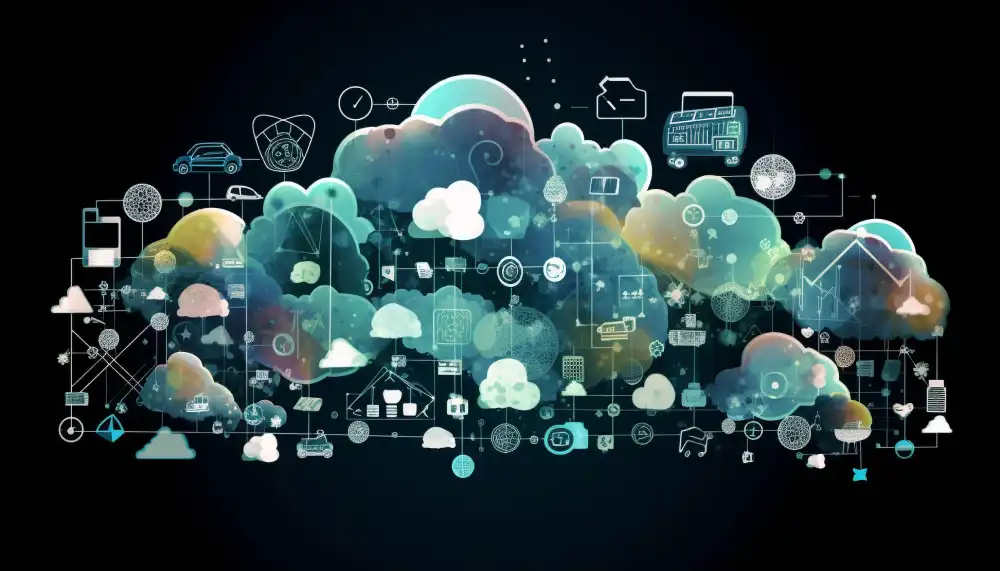

Imagine running a SaaS (Software-as-a-Service) platform where hundreds of businesses, from Fortune 500 firms to small bakeries, use an application simultaneously, with each of them expecting their performance to be unaffected by others and their data to be completely private
This is exactly the kind of everyday reality that multi-tenant cloud architecture is designed to handle — many isolated worlds, a shared infrastructure. Multi-tenant cloud architecture is a cloud computing model where many tenants share the same infrastructure but maintain data security and isolation. This model not only ensures streamlined management, but also cost savings and efficient utilisation of resources.
This article does a deep dive into the aspects of multi-tenancy in the cloud, and how the advent of artificial intelligence (AI) is shaking up the multi-tenancy problem in enterprises.
What Is Multi-Tenancy In Cloud Architecture?
In cloud computing, multi-tenancy refers to the fact that a cloud vendor has multiple customers using the same computing resources. Despite sharing these resources, the cloud customers aren’t aware of each other, with their data being kept completely discrete. Cloud services would be far less practical without this concept, making it a crucial component of cloud computing seen in many kinds of public cloud computing environments, including SaaS, PaaS (Platform-as-a-Service), IaaS (Infrastructure-as-a-Service), serverless computing, and even containers.
Multi-tenant environments see customers sharing not only the same application and operating environment, but also storage mechanisms and hardware. This is on the other end of the spectrum from virtualisation, where all applications run on discrete virtual machines with their own operating systems.
Think of a multi-tenant cloud as an apartment building. While all residents share the same infrastructure that delivers utilities such as power and water, they have keys to their own apartments. The provider (for instance, the landlord) sets the overarching performance expectations and rules for customers (the tenants), with the individual customers having private access to their data.
How Does Multi-Tenancy In Cloud Computing Work?
- Single Database, Single Application: In this architecture, all users share a single database along with a single application. Moreover, every tenant’s data is isolated and differentiated within the same database using tenant-specific identifiers or schemas. Since there’s only one database to manage, this configuration simplifies maintaining and deploying the application. That being said, challenges may arise in data security and scaling as all data coexists in the same physical database. So, there are increased risks of leakage of data between tenants or data breaches.
- Multiple Databases, Single Application: This configuration involves one single application being connected to multiple databases. It ensures data isolation at the storage level as every tenant has their own database. Not only does it reduce the risk of “noisy neighbour” issues but it also enhances data security, as each tenant’s data operations are confined to their own database. However, this increases the complexities of the infrastructure and could require more resources for management and maintenance.
- Multiple Databases, Multiple Applications: In this configuration, every tenant has their own separate database and dedicated application instance. Among all multi-tenant setups, this model offers the highest level of security and isolation as well as extensive customisation and optimisation of the application for every tenant. However, it comes at a cost: higher operational complexity and resource consumption. Hence, this setup is usually used in scenarios where tenants need high and dedicated control over their environment.

How Are Multi-Tenancy And Single-Tenant Architecture Different?
When designing SaaS applications, providers need to choose a tenancy model: single or multi-tenant. This choice has major implications on operational complexities and scalability, along with the resources required to serve the application.
Single-tenant configurations provide a single instance of the infrastructure/software to a single customer. Not only is it physically isolated from other customers and includes all customer data, but also user operations and data aren’t shared with other application instances. Furthermore, the provider manages the software instance on dedicated infrastructure, usually within their own database, while providing the user a high level of flexibility over hardware and software customisations and thus, improved security and more control for the user.
However, scalability is limited, the instance needs to be configured, and complexity increases for users, along with the likelihood of also being more expensive for the user despite the software functionality remaining the same.
Multi-tenant architectures, on the other hand, serve multiple users with a single instance of the software application. While all users or tenants share common features such as resource management, business logic, and security, they’re all isolated from the others to protect their private settings and data.
Moreover, customer data is kept confidential via permission mechanisms ensuring that every customer can see only their own data. Not only is this model cost-saving for providers, but also users receive important benefits such as ease of use, automated setup, and scalability. However, security risks are greater, as well as reliability and performance concerns.
Securing AI Agents: The New Multi-Tenancy Cloud Challenge
Today, practically every enterprise is an AI enterprise, with industry forecasts suggesting that 40% of enterprise applications by the end of 2026 will have embedded task-specific agents — a number that was just 5% in early 2025. So, many enterprises are about to discover unique security challenges when deploying AI agents in multi-tenant cloud models.
Resolving this requires enforcing strict encrypted boundaries for every tenant, role-based access controls, zero-trust networking, and more. When AI agents operate within sandboxed execution environments with scoped credentials and no cross-tenant visibility, they make cloud-native AI deployments both securely isolated and scalable.
In case you missed:
- The Multi-Cloud Security Blueprint for the AI Era
- The Rise Of Cloud WAN and SD-WAN: Network For The AI Era
- Is GPU-As-A-Service The New Cloud Gold Rush?
- AI Infrastructure: Building Scalable Architecture For The Future
- The Rise Of Agentic Cloud – Reshaping Cloud Infrastructure In 2026
- All About Cybersecurity-as-a-Service
- Decoding Backdoor Attacks in Cybersecurity
- Desktop-as-a-Service in 2026: A Comprehensive Guide
- All About AI Sandboxing
- All About Edge AI: A Comprehensive Look