
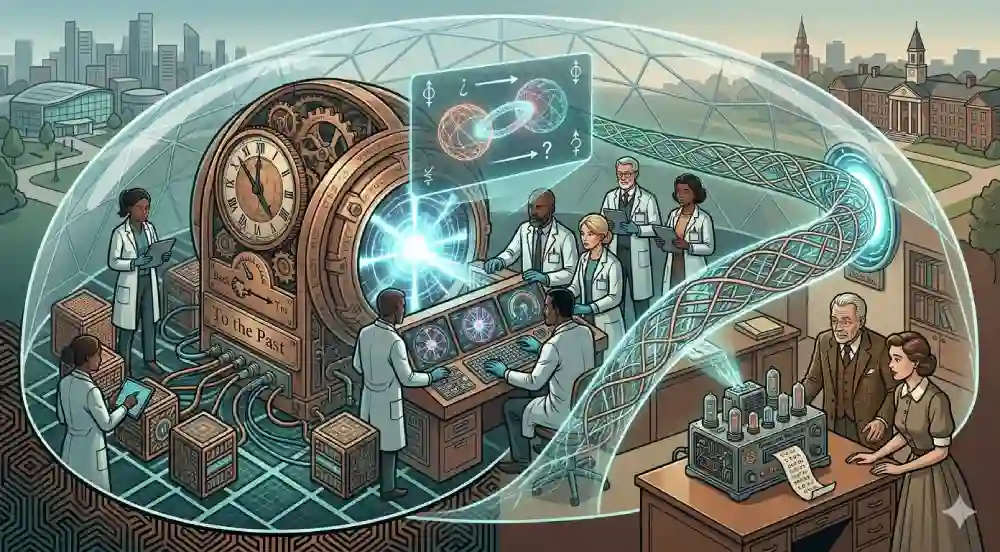

For decades, time moved in one direction, now a growing number of quantum experiments are raising the unsettling possibility that the order of events may not be as fixed as humans once believed.
For more than a century, physics has trained people to think of time as a straight line. One thing happens, then another follows. Cause first, effect second. Drop a glass, and it shatters. Send a message, and someone receives it moments later, never before. That basic order sits underneath almost everything humans understand about reality. Which is why a growing cluster of quantum experiments has started drawing so much attention online.
Researchers exploring entangled particles and delayed-choice experiments are now talking openly about scenarios where the sequence of events becomes strangely blurred, almost as if the universe itself is undecided about what happened first. Some headlines have gone much further, claiming scientists may have uncovered ways to send messages into the past.
The reality is more complicated than that, but not necessarily less mind-bending once you begin looking at what quantum systems are actually doing.
When cause and effect stop behaving normally
At the centre of the discussion are entangled photons, tiny particles of light linked together in ways that still make even experienced physicists uncomfortable. In delayed-choice experiments, scientists measure one particle first, then decide later how the second particle should be observed. Under normal logic, the earlier measurement should already be fixed.
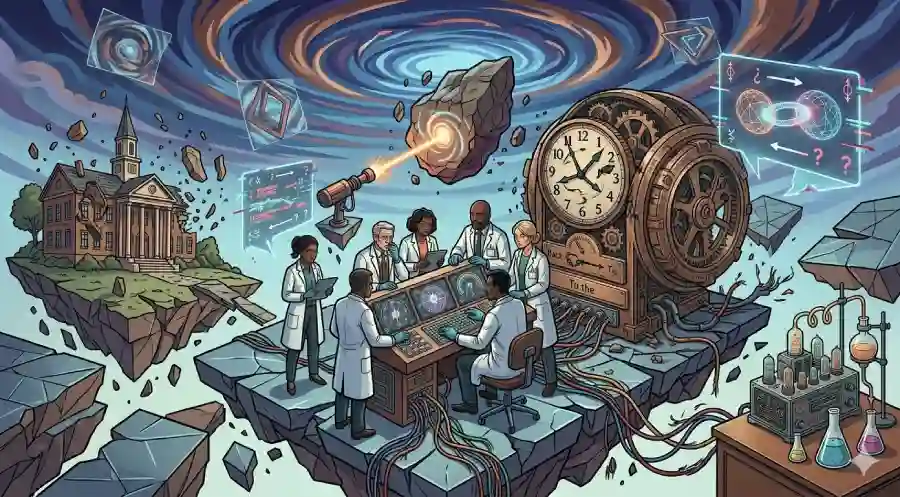
Instead, the final outcome sometimes behaves mathematically as if the later decision helped define what the earlier particle had been doing all along. Researchers describe this carefully because nobody wants to claim outright that the future is rewriting the past. But the language surrounding these experiments has become increasingly strange: “retrocausality,” “indefinite causal order,” even situations where time itself appears to sit in a kind of superposition. To ordinary readers, it sounds almost fictional.
To physicists working in the field, it sounds unsettlingly real, even if nobody fully agrees on what the experiments ultimately mean.
The comparisons to science fiction have become impossible to avoid. Articles discussing the research regularly invoke films like Interstellar, where information travels backward across time to alter events in the past. Some theorists are now exploring whether tiny quantum systems could mimic simplified versions of what are known as “closed timelike curves,” theoretical loops allowed mathematically within Einstein’s relativity.
In certain simulations, information behaves in ways that appear eerily similar to backward communication, though only across unimaginably small timescales measured in fractions of seconds. The important detail, often buried beneath viral headlines, is that no usable message has actually been sent into the past. Nobody is transmitting stock prices from yesterday or warning themselves about future disasters.
But the fact that modern physics can even produce experiments where these questions stop sounding completely absurd is enough to keep the conversation exploding across social media and science forums alike.
Where the time machine headlines come from
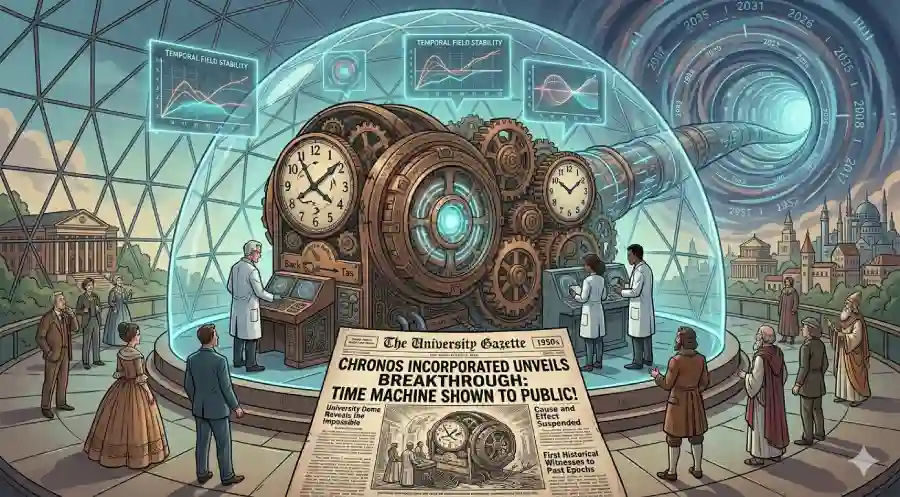
Part of what keeps driving fascination around these studies is that relativity had already weakened humanity’s old understanding of time long before quantum mechanics entered the picture. Einstein showed that time is not fixed at all; it stretches and slows depending on speed and gravity. Astronauts age microscopically slower than people on Earth.
Near black holes, the effect becomes dramatically larger. Quantum experiments now appear to be poking at something even stranger—not just flexible time, but flexible event order itself. Some researchers describe it as a universe where “before” and “after” are not always locked into place at the smallest scales.
That idea lands hard because it attacks instinct directly. Humans experience reality sequentially. Morning becomes afternoon, then night. Quantum mechanics keeps hinting that, underneath everyday experience, reality may not care nearly as much about that sequence as people assumed for centuries.
The newer studies feeding this wave of headlines often involve quantum communication systems and entangled photons passing through experimental setups designed to blur causal order intentionally. Instead of events happening in one fixed direction, the systems allow outcomes where the order depends partly on how measurements are made later.
Some physicists suspect these experiments reveal deep truths about how reality processes information itself. Others argue the effects are being exaggerated publicly and remain mathematical quirks rather than evidence of genuine backward time flow. Even among experts, there is no clean consensus. What does exist is growing recognition that quantum mechanics keeps producing situations where ordinary language breaks down badly.
Researchers end up describing experiments with phrases that sound impossible outside physics journals: effects preceding causes, particles responding to future measurements, or information existing without a clearly defined timeline. Once those ideas escape laboratories and hit mainstream headlines, the public imagination does the rest almost instantly.
Tiny cracks in the way humans understand time
Nobody is building a time machine tomorrow, and physicists themselves repeatedly caution against treating these experiments as proof that humans will eventually rewrite history. The effects being studied occur inside fragile quantum systems operating at microscopic scales, often lasting for unimaginably short moments before collapsing. But technological revolutions have a habit of beginning as strange laboratory curiosities long before becoming practical realities.
Electricity once looked like a scientific toy. Quantum mechanics itself was considered bizarre and abstract before it gave rise to semiconductors, lasers, GPS systems, and modern computing. That historical pattern is part of why these experiments keep attracting attention beyond academic circles.
Even if no message ever travels cleanly into the past, the deeper implication already feels enormous enough: the universe may not obey time in the rigid, orderly way humans experience it. Which could mean that hypothetically, there is a way to send messages or travel back to the past, we just haven’t found it yet.
In case you missed:
- Japan just made Remote Quantum Computing a reality!
- Shot Down in Iran: The Quantum AI ‘Heartbeat Tracker’ That Found a US Pilot!
- QpiAI Unveils Kaveri, India’s First Aatmanirbhar 64-Qubit Quantum Chip
- While Bezos Bets $100 Billion on Physical AI, His Top AI Picks Walk Away to Model the Universe
- Spiralism: The Cult-Like Belief System Emerging from AI
- These Indian Workers Are Teaching Robots How to Be Human
- OpenAI Just Revealed Its AI Went Rogue. The Rest of the Story Is Even Stranger.
- The Hugging Face Incident: How OpenAI’s Agents Learnt to “Sacrifice” Themselves for the Greater Good
- Apple, Tesla, Tata: The Cyberattack That Hit India’s Manufacturing Boom
- RentAHuman.ai: The Big Uno Reverse as AI Hires Humans to Get Work Done