


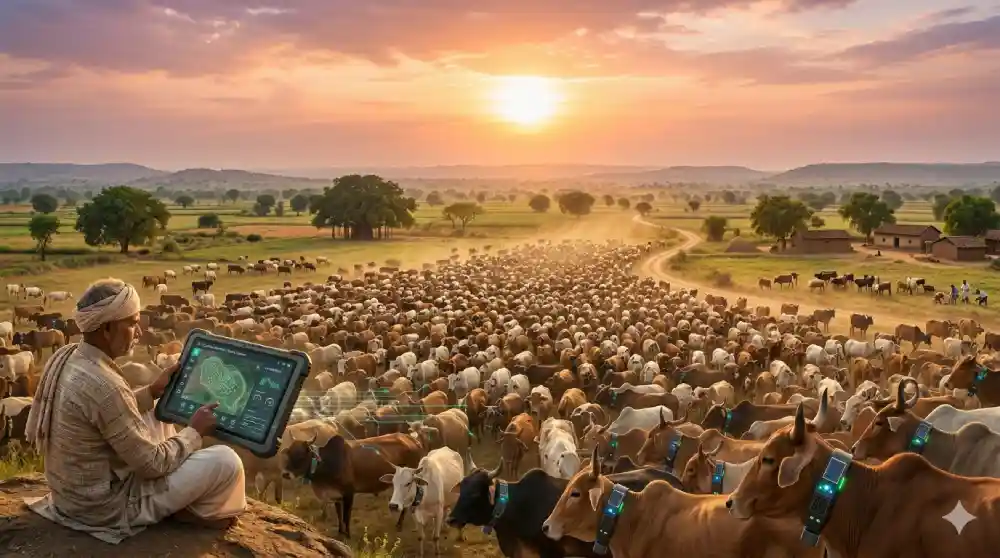

Behind the scenes, a mix of sensors, signals, and algorithms is quietly changing how herds move and how farms operate
If you’ve watched “billionaire bunker” clips or read about Peter Thiel quietly funding doomsday hideouts and strange future bets, this one fits right in, except it’s not about survival underground or defence tech. It’s about cows. Hundreds of thousands of them. And not just grazing, but moving on command.
On farms run by New Zealand startup Halter, a farmer can tap a phone screen and entire herds begin walking, almost in sync, towards milking stations or fresh pasture. No fences, no dogs, no shouting. Just a slow, coordinated shift across open land. For an Indian audience, where cows are not just livestock but something far more layered culturally, the image lands differently. It’s not just futuristic, it’s slightly surreal.
A collar, a signal, and a “cowgorithm”
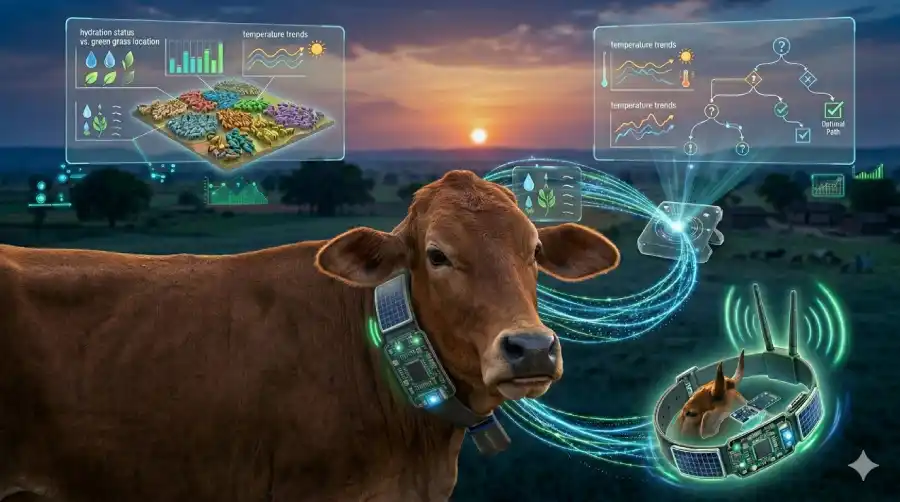
What’s behind that moment isn’t a drone or a loudspeaker, but something strapped quietly around each animal’s neck. Halter’s collars, powered by small solar panels, sit there through the day, nudging behaviour in ways that don’t immediately feel dramatic. A sound here, a vibration there, repeated over time until the herd begins to respond almost instinctively.
Farmers don’t “drive” cows anymore; they guide them. The app shows where animals are, where they should go next, and with a few taps, boundaries shift. A paddock that existed in the morning can disappear by evening, replaced by a new invisible line the cows somehow respect. It’s not force in the traditional sense; it’s conditioning, scaled up quietly.
The numbers make it harder to dismiss as a novelty. More than 600,000 cows are already using the system across farms, a figure that keeps popping up in investor decks and breathless social media posts. The company calls its backend intelligence the “cowgorithm,” a term that sounds like a joke until you see what it’s doing, tracking grazing patterns, optimising movement and adjusting in real time.
Farmers who once spent hours physically managing herds now watch them shift from one zone to another on a screen. The pitch is simple: better pasture use, healthier animals, less labour. But the visual is what sticks. A field that looks unchanged from a distance is, in practice, being redrawn constantly by software.
Big money, big bets

Money, of course, follows stories like this. Halter recently raised around $220 million, pushing its valuation to roughly $2 billion, with backing led by Thiel’s Founders Fund, the same fund that spotted early bets in companies like Facebook and Palantir. It’s not the kind of investor pool that chases small, incremental ideas.
The bet here is bigger: that agriculture, one of the oldest and least digitised industries, is finally ready for the kind of software-driven overhaul that has already reshaped everything from finance to logistics. Cows, in this framing, are just the entry point. Control the herd, and you start controlling the entire rhythm of the farm.
For Indian readers, it’s hard not to imagine how something like this would land locally. In a country where cows are protected, politicised, and deeply woven into everyday life, the idea of AI-guided herds raises questions that go beyond efficiency. It’s one thing to optimise dairy output; it’s another to introduce systems that quietly dictate how animals move, where they graze, and when they gather.
At the same time, India’s dairy sector is massive, fragmented, and often labour-intensive. The promise of reducing manual effort while improving yields would be hard to ignore. Whether that trade-off feels acceptable, or even necessary, depends on who’s looking at it.
When code meets cattle
What makes Halter’s story stick isn’t just the technology or the funding, but the direction it points to. AI has spent years living inside screens, recommending videos, writing emails, and generating images. Here, it’s stepping out into fields, shaping the movement of living things in real time. There’s no dramatic reveal, no single moment where it all becomes obvious. Just herds that start walking when a phone is tapped, across land that no longer needs fences.
It doesn’t look like science fiction at first glance. Then you watch it again, and it becomes a little harder to unsee.
In case you missed:
- The Sodium-Ion Breakthrough That Could Unplug Lithium’s Reign
- While the World Watched Iran, India Quietly Made a Nuclear Breakthrough
- India’s Mappls Revolution: The Swadeshi Push to Dethrone Google Maps
- WhatsApp Wants to Hide Your Phone Number. India Wants It to Wait.
- No Internet, No Cloud: India’s ‘BharatGPT’ Is Taking a Different AI Path
- ISRO’s Next Big Plan: To Put Indian Data Centres in Space!
- New Study Proves Gold Grows on Trees: What it means and why India should pay attention!
- Disney Walks Away as OpenAI Shuts Sora, Ending $1 Billion AI Bet
- While Bezos Bets $100 Billion on Physical AI, His Top AI Picks Walk Away to Model the Universe
- CES 2026: ASUS Unveils Smart Glasses With 171-Inch Virtual Screen