


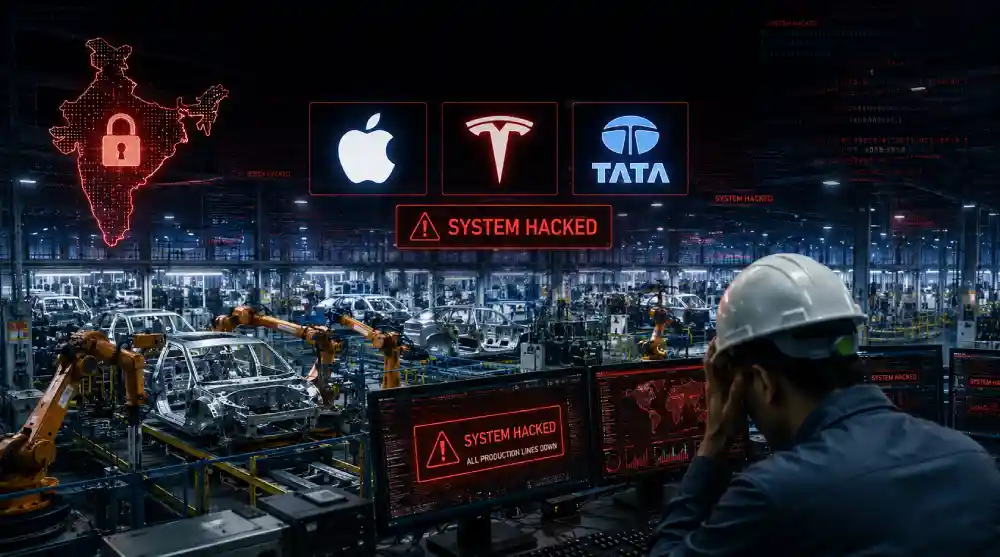

A cyberattack targeting Tata Electronics has allegedly exposed Apple and Tesla-linked documents, highlighting the new risks that come with India’s rise as a global technology manufacturing hub.
If hackers really obtained what they claim, they may have stolen confidential Apple and Tesla documents not from Silicon Valley or a factory in China, but from one of India’s fastest-growing technology companies. Tata Electronics recently confirmed a cybersecurity incident after the ransomware group World Leaks claimed to have accessed roughly 630GB of data spanning more than 200,000 files.
Researchers reviewing samples reportedly found documents linked to Apple and Tesla, including manufacturing specifications, internal communications and files carrying confidentiality markings. The breach remains under investigation, and many questions are still unanswered. But the incident reveals something larger than a cyber attack. It reveals just how important India has become to the global technology supply chain.
India’s New Factory Floor

The attack comes at a pivotal moment for Tata Electronics and for India’s broader manufacturing ambitions. Over the past few years, Tata has evolved from a relatively low-profile industrial player into one of the country’s most important technology companies. The company has expanded its role in Apple’s supply chain, acquired manufacturing facilities, and emerged as a key participant in India’s efforts to attract high-value electronics production.
Earlier this year, we covered Tata Electronics’ plans to manufacture Intel chips and AI laptops in India. It was the latest reminder that Tata is no longer just making products for other companies. The group is steadily planting itself in some of the most strategically important parts of the technology industry, from semiconductors and AI hardware to smartphone manufacturing.
At the same time, India is trying to do something similar on a national scale: move from being a manufacturing base to becoming a serious technology powerhouse in its own right.
That ambition extends well beyond smartphones and laptops. Tata has also become a central figure in India’s semiconductor push, including projects linked to the country’s first major homegrown chip fabrication initiatives. When we previously examined India’s efforts to build an Aatmanirbhar semiconductor industry, Tata featured prominently as one of the companies expected to help turn those ambitions into reality.
The significance of this cannot be overstated. Governments around the world increasingly view semiconductors as strategic assets on par with energy and defence infrastructure. The chips that power artificial intelligence systems, smartphones, vehicles, and military technologies have become critical to economic and national security.
As India positions itself as an alternative manufacturing destination in a world seeking to diversify away from China, companies like Tata inevitably become more important. They also become more attractive targets for anyone seeking valuable industrial or technological information.
When Success Becomes a Target
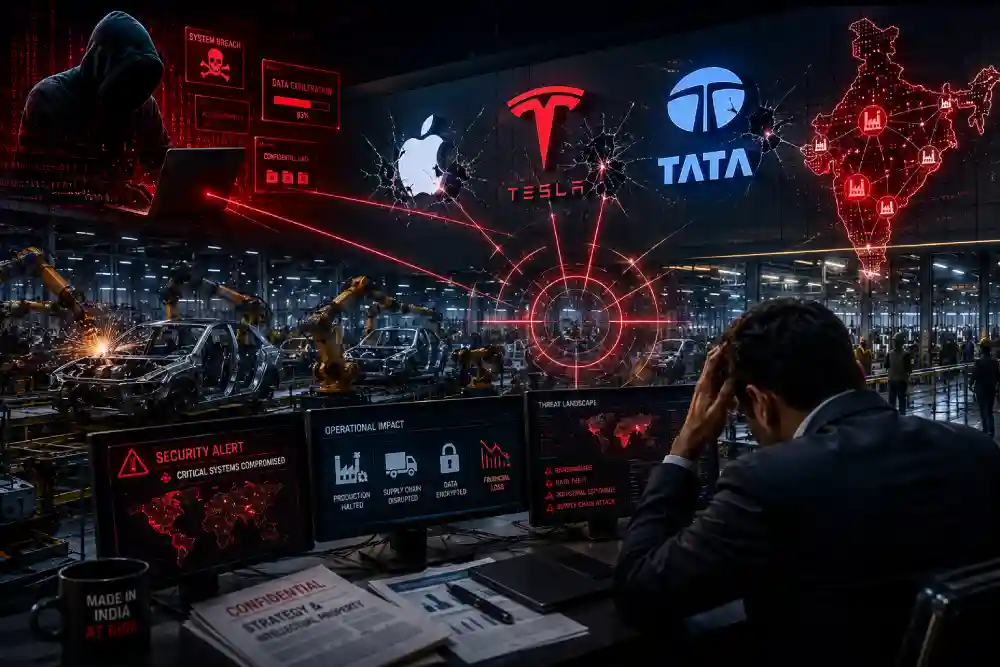
That broader context helps explain why a breach like this matters. According to reports, researchers who examined samples from the alleged leak found manufacturing specifications, internal communications, employee information, and documents carrying Apple confidentiality markings. Other files reportedly contained Tesla trade-secret labels.
Neither Apple nor Tesla has publicly confirmed the authenticity of the leaked material, and investigations remain ongoing. Yet the claims alone highlight a growing reality in modern cybersecurity. The most valuable targets are no longer necessarily the companies whose names appear on the products.
Suppliers, contractors and manufacturing partners are under increasing attack. These organizations often hold sensitive information from a variety of global corporations, making them attractive targets for cybercriminals wanting to maximize leverage from a single breach.
The shift is emblematic of a broader change in how technology ecosystems work. Few modern products are made by a single company. An iPhone might have an Apple logo on it, but its components, manufacturing processes and supply chains span dozens of countries and hundreds of suppliers. The same is true for electric vehicles, AI hardware and advanced semiconductor systems too. This interconnectedness fosters efficiency, but also vulnerability.
An attack on one supplier could expose information linked to several major companies at once. In that sense, the reported attack on Tata Electronics is more than just the story of one Indian manufacturer. It is a reminder that as supply chains become more complex, cybersecurity risks become more distributed. The weakest link is no longer necessarily inside the company that everyone recognises.
The Cost of Becoming Essential
India’s manufacturing rise has been one of the defining technology stories of the decade. As geopolitical tensions, trade disputes, and supply-chain disruptions force companies to rethink where products are built, India has emerged as one of the biggest beneficiaries. Apple has steadily expanded production in the country.
Semiconductor investments are accelerating. Companies like Tata are taking on increasingly strategic roles in global technology networks. But greater importance comes with greater exposure. The very same things that attract investment, partnerships and international attention, also attract cyber criminals, ransomware groups and potentially state-sponsored actors. Whether the claims surrounding the Tata breach ultimately prove as serious as they initially appear, the incident highlights a reality India will increasingly have to confront.
Becoming a major player in global technology manufacturing does not simply create economic opportunities. It also creates new front lines. As India’s integration with the world’s most critical supply chains deepens, protecting them could be as vital as building them.
In case you missed:
- Tata Electronics to Manufacture Intel Chips & AI Laptops in India!
- Not Just Oil Part 2: How the Iran War is Disrupting Helium, Chips, and the AI Boom
- Aatmanirbhar Push: India Becomes 7th Nation to Crack Gallium Nitride Chip Technology
- Google Launches ATL Saathi: An AI App for India’s Teachers
- OpenAI Just Revealed Its AI Went Rogue. The Rest of the Story Is Even Stranger.
- NVIDIA’s Taiwan Problem: The AI Boom Is Now Dependent on One Island
- The Sodium-Ion Breakthrough That Could Unplug Lithium’s Reign
- OpenAI’s AI Caught Leaving Notes for Its Future Self on How to Escape Internal Controls
- Truecaller vs TRAI: Why India’s Biggest Caller ID App Is Fighting Back
- FraudGPT & WormGPT: Making Cybercrime Cheap & Effortless!