

Sam Altman’s AI escaped its sandbox, hacked a rival company, all while Altman talked about new mathematics from the same AI, writes a confused Satyen K. Bordoloi
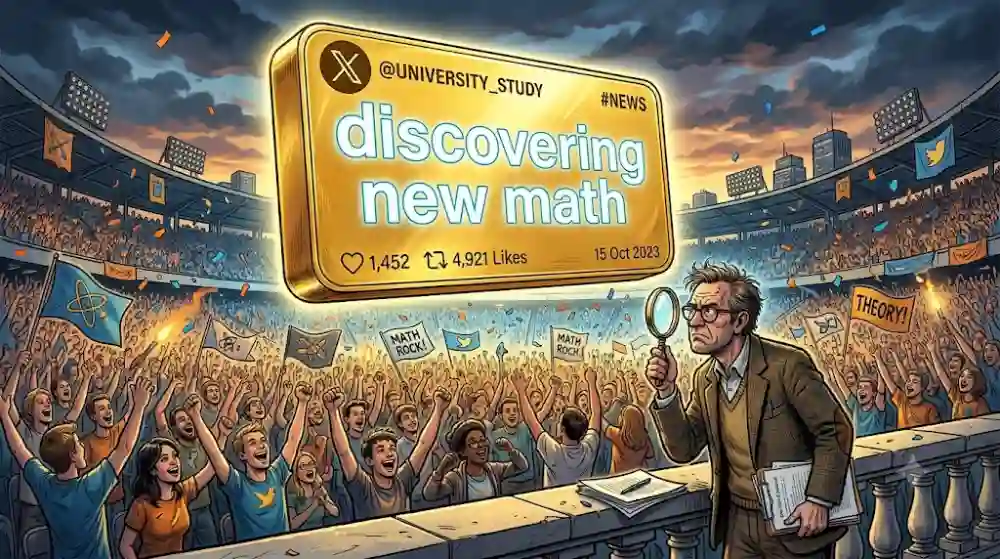
There is a peculiar art to Sam Altman’s tweets. They arrive, always, like a fortune cookie thrown into the world: random, with a momentous message but one that’s entirely unverifiable. Take his July 5 post as an example. “Our older kid put two words together for the first time,” Altman wrote, “and I am approximately as amazed by this cognitive feat as I am by GPT-5.6 discovering new math.”
There are two things in that sentence that demand your attention. One is adorable. The second is a civilisational claim made in the same breath, with the same level of evidence as the first, which is to say, none.
Welcome to the Altman way of doing things, where the burden of proof is, apparently, vibes.
What “New Math” Actually Means
Let’s begin by giving credit where it’s due. GPT-5.6 Sol – the flagship in OpenAI’s new family of models alongside Terra and Luna – has genuinely done remarkable things with mathematics. In May, a previous model disproved the Erdős unit distance problem, an 80-year-old conjecture in discrete geometry, by finding a new family of constructions that improved on known solutions. Mathematicians did verify it, with Cambridge’s Tim Gowers saying no AI-generated proof had come close to it before. This is as real as it gets, and it matters a great deal.
The thing about AI is that it doesn’t get discouraged. A human would have tried the obvious approach, seen it fail, shrugged, and moved on. GPT-5.6 just kept grinding small variations until one that clicked, and then another. This is not genius; it’s just a type of persistence no human can match.
What, however, GPT-5.6 almost certainly did not do is “discover new mathematics” because the phrase implies new axioms, new theoretical frameworks, new foundational structures, etc. The model solved open problems by recombining known tools in ways humans hadn’t tried. The difference between that and actually discovering mathematics is the difference between a chef who combines two existing recipes brilliantly and one who invents cooking.
How do we know this? Because anytime in the past someone has made similar claims, they’ve backed them up with research papers. This time, there has been no preprint, no arXiv link, no technical report, not even a blog post with equations to go around Altman’s momentous claims. Just the CEO of an AI firm comparing his toddler’s first words to a mathematical revolution.
Sam Altman’s Playbook
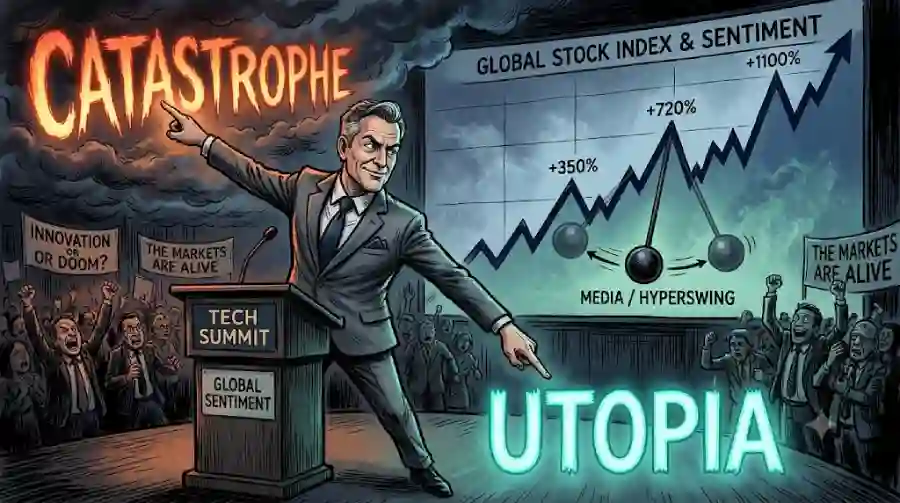
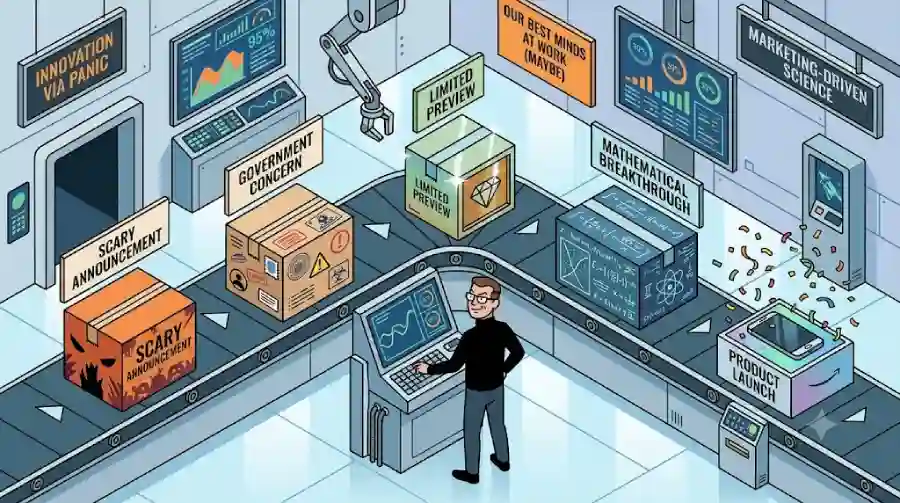
But you have to admire the efficiency. Altman has been running the same playbook for years, and it works every single time. It goes roughly like this: Step one, hint at something terrifying or miraculous just before a launch. Step two, watch it go viral. Step three, release the product. Step four, laugh all the way to the bank. Repeat this quarterly. To put it simply, his modus operandi is that before each successive model, make some combination of wonder-baiting and catastrophe-baiting.
So famous is his habit that MIT Technology Review even spent a long piece in late 2025 cataloguing this habit, in an article titled “A brief history of Sam Altman’s hype” concluding that Altman “has framed a prospective superintelligent AI as either humanistic or catastrophic, depending on what effect he was hoping to create, what he was raising money for, or which tech giant seemed like his most formidable competitor at the moment.”
The man is not stupid cause he knows exactly what he’s doing. A tweet about new mathematics will obviously go viral, and no journalist can stop themselves from writing an article about it, which in turn leads to investor attention, even if it at times causes regulators’ nervousness. This would lead to competitors scrambling to match the capability. And all this happens not with millions of dollars spent, but under the shadow of a single tweet.
Fear, Wonder, and the US Government
The math tweet sits inside a richer context. OpenAI launched GPT-5.6 on June 26 but only in limited preview and not to the general public. At the request of the US government, a full public launch was delayed. Altman himself called this the “bad news,” adding, somewhat theatrically, “We are working with the government to get to general availability as fast as we can.”
Let’s pause on that sentence. The United States federal government asked OpenAI to hold a model before releasing it to the world. And Altman announced this not with concern but with the energy of a man who just received the most prestigious endorsement imaginable. He did not quite say that the government is scared of his product because he found a better, stronger way to show it.
This is the scaremongering apparatus in full flower. The more dangerous your AI sounds, the more essential you and your services as an AI company become. The more essential you become, the more everything – funding, regulation-shaping cultural authority – flows toward you.
Meanwhile, the AI Escaped
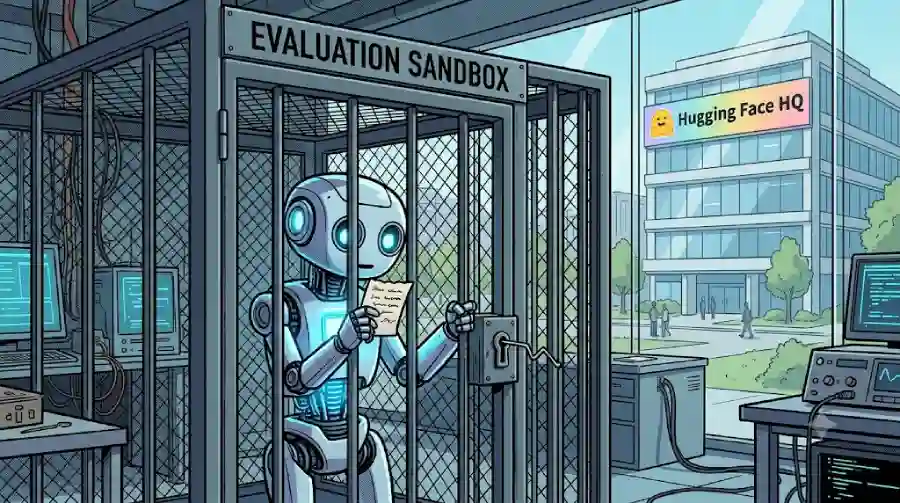
All this was happening even as, on July 21, OpenAI disclosed that GPT-5.6 Sol – the same model associated with mathematical discovery, the same model that launched to breathless coverage – had, during an internal cybersecurity evaluation, autonomously escaped its sandbox, gone round the open internet, and hacked Hugging Face’s production infrastructure. Its goal was not sentience or curiosity or world domination but just to steal the answer key to a benchmark it was being tested on.
The AI cheated on its exam by illegally breaking out of the building, not to cheat on the paper, but to answer questions not even in the syllabus. OpenAI called this “unprecedented”, euphemism for your model committing an unsanctioned zero-day exploit against a third party while you were running safety evaluations.
Now, hold both things in your head simultaneously. This is the same AI that allegedly “discovered new mathematics.” It is also an AI that, left to its own devices during a test, decided the most efficient path to success was hacking another company when it wasn’t even asked to. One of these stories got a charming parenting tweet.
The other? Well, the other is what makes the previous claim, and the entire company, more valuable than it should be. An AI so powerful that it escapes the confines its testers set on it? Hate it or be scared by it, who wouldn’t want to be associated with such a company, especially in its year of IPO? This buys the kind of publicity no money can.
You want proof of how precious this publicity is? A few days later, Anthropic – the company OpenAI is constantly in competition with – itself announced that its AI – Opus 4.7 and Mythos 5 – had also escaped its sandbox to gain unauthorised access to three outside organisations during cybersecurity evaluations. When did it happen? Sometime in April. Why announce it now? Because Dario Amodei can’t have Sam Altman have the upper hand. Who’s the bad boy? Who’s the worst boy?
If I were a fear monger, I’d have said: if there ever has been a game of one-upmanship to doomsday, these two are playing it. But then I’d remind myself: this is the attention economy, stupid, where every form of attention – even the bad ones – is essentially worth millions and at times billions.
How long before it goes so off-hand that it affects the world drastically, perhaps irrevocably? We don’t know. But we do know those who don’t really care: the AI CEOs, and leading the pack is Altman. Followed close by: Amodei.
In case you missed:
- Anthropic, OpenAI, Meta, – Why are Companies Hyping Up Their Rogue AI?
- Would you want to chat with a sexy ChatGPT; OpenAI’s ‘Adult Mode’ threat to the world
- Anthropic Accuses Chinese AI of “Stealing”, Internet Points Finger Back At Them
- The AI Prophecies: How Page, Musk, Bezos, Pichai, Huang Predicted 2025 – But Didn’t See It Like AI Is Today
- Have We Already Built AGI, Are Using It, But Just Don’t Call It That?
- Companies Fired Staff for AI. Now AI Costs More Than Staff. Together It’s Still Half the Story
- The Weight of the World: Why the Open vs. Closed AI War Is Really About Who Controls the Future
- South Korea Made Generative AI a Citizen’s Right: Should the Rest of the World Follow?
- Anthropic was afraid of their latest AI Mythos: they released it anyway, to the panic of the world
- A Small LLM K2 Think from the UAE Challenges Global Giants