



Dockets are bursting, judges are drowning in cases, and litigants’ hair is greying, yet India’s AI use in courts is dismal even as the rest of the world builds AI judges, finds Satyen K. Bordoloi
The scene in one of India’s oldest courts, Tis Hazari, New Delhi, hasn’t changed much since its inauguration in 1958. Layers of paper files lie tied with red ribbon, dust settling on them, even as a clerk shouts for a file he hasn’t been able to find for hours. Somewhere in this chaos, walks in a litigant with eyes hopeful that a property dispute he filed in 2015 will finally get a hearing.
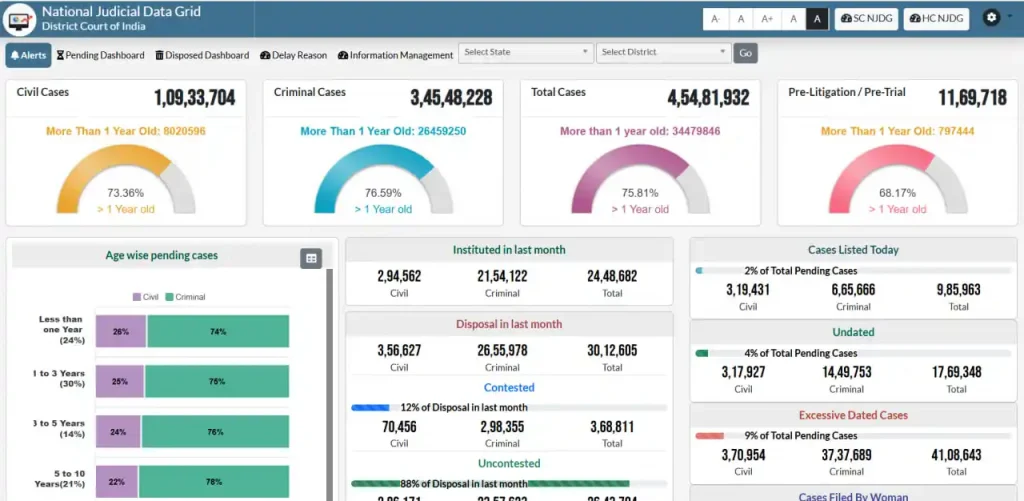
The numbers regarding India’s judicial system have become so mind-numbing that they’ve lost meaning. 5.58 crore pending cases spread across the Supreme Court, High Courts, and district courts, growing by 60,000 cases every month. In the Supreme Court alone, pendency stood at 92,828 as of the end of January 2026: an increase of over 10,000 cases in just one year. Nearly 46 lakh cases have been pending in district courts for over a decade.
And worst of all, about half of all pending matters in the lower judiciary are petty criminal offences: traffic challans, minor regulatory breaches, etc., that clog up the judicial system. The government – central and state governments – by their own admissions, is the biggest litigator in the country, responsible for nearly 73% of matters before the Supreme Court, much of it repeatedly criticised in the media as frivolous.

We’ve been told for decades that the solution to these numbers is to increase the number of judges. Seems plausible in a country with 21 judges per 10 lakh people, compared to the recommended 50. Yet the uncomfortable truth is that even those states that filled their vacancies didn’t see the backlog disappear. The problem is thus not capacity, but design.
To rub salt into the injury, while Indian courts debate matters like whether to install more fans and ramps, other nations have gone so far as to build digital, AI judges.

The Global Race to Reboot Justice
China, as it seems to have become a cliché in recent years, is living in the future through bold experiments in introducing AI into courts. By the end of 2022, China’s “smart courts” had integrated AI into most of their core adjudication and enforcement processes, covering all their basic-level courts nationwide. This wasn’t some pilot project, but a systemic upgrade in which AI now assists with everything from case filing to evidence review to sentencing guidance.
The Chinese judiciary moved through three distinct phases: first, they digitised what existed, then turned their temples of justice into “smart courts” with AI serving as a “machine clerk” to handle transcription, document management, and administrative tasks. Now they have entered the third phase: “digital courts,” where AI systems act as “judge’s partner,” performing legal research, flagging relevant precedents, and even identifying inconsistencies in evidence. Shanghai courts alone handle millions of cases with these AI systems.

In the United States, AI tools like COMPAS predict recidivism risk for bail and sentencing decisions (though they have been criticised for bias). In Singapore, customised AI systems advise parties to the Small Claims Tribunal on their legal positions. And Estonia is planning to have robot judges handle small-claims disputes under €7,000 – something India must deploy immediately. Even the UK, notoriously cautious about judicial technology, now allows AI for summarisation and administrative tasks, though it doesn’t allow legal research and analysis.
The pattern is obvious as judiciaries from Bangkok to Bogota treat AI not as a replacement for judges but as helpers and a force multiplier that can strip away administrative drag that consumes judicial bandwidth, leaving human minds free for what only we can do: see things empathically, in proper contexts, and perform normative judgments.

The Great Indian Exception
It is not true that Indian courts have not taken steps towards AI adoption. The Supreme Court, in collaboration with IIT Madras, has developed AI tools for defect identification in electronic filing, with about 200 Advocates-on-Record having access to it. Then there’s SUPACE – the Supreme Court Portal for Assistance in Court Efficiency, which is supposed to understand factual matrices and search precedents intelligently. There’s also LegRAA, an AI-based legal research tool developed by NIC under the guidance of the Supreme Court, and Digital Courts 2.1 provides courts with voice-to-text features and translation capabilities.
So much is happening that it looks like India is on the rise in AI adoption. So what’s the problem?
The problem is that nearly all of these are in pilot phases, controlled deployments, or experimental stages, and the larger courts have limited access to these tools. The official government statement itself admits: “The current scope of AI-based solutions remains limited to controlled pilot deployments”, aka: we are tinkering but don’t know when they’ll be available for everyday use.

Add to this the fact that the district and taluka courts, where 4 crore cases are pending, don’t even have basic facilities like online hearings, and overall, the digital infrastructure remains patchy at best. Many courts still operate on paper-based systems because the “digital” infrastructure exists only in name.
The Gram Nyayalaya system, designed to bring justice to villages, received just Rs 50 crore in central allocation, barely enough to keep the lights on. Same for the e-Courts Phase III project, approved for 2023-27, which had an allocated budget of a mere Rs 53.57 crore for “Future Technological Advancement,” including AI integration.
As you can see, the contrast with our neighbour China couldn’t have been starker. There, AI deployment is a top-down national strategy backed by strong political will and financial muscle. What we have in India is a series of isolated experiments dependent on individual judicial enthusiasm rather than national policy.
Why We’re Stuck
It is true that the Union Budget 2026-27 allocates 0.08%, i.e. Rs 4,509 crore, to the judiciary, with states bearing 90% of the financial burden. But irregular fund flow, poor centre-state coordination and insufficient attention to outcomes hamper progress. Courts are getting better buildings when what they need is better bandwidth; they are getting hardware when what they need is training.
Then there’s the procurement process built for rigid security, which is incapable of keeping pace with fast-moving technologies. Legacy systems don’t talk to each other, and data exists in silos. And without clean, accessible, machine-readable data, AI becomes nothing more than an expensive toy.
Despite all this, the biggest hurdle is perhaps the judicial community’s fear of AI. Judges worry about becoming dependent on black box algorithms, lawyers worry they’ll be replaced, and civil society worries about bias embedded in training data itself. All legitimate fears that have come true in different examples in the US and China. Yet we must remember that the key way to mitigate risk is to manage it well. The judicial ship is safest on the shore, away from the AI ocean. But a ship’s work is to sail, not sit safe at shore.

Something needs to be done. And done fast. I’m not a legal expert to suggest a roadmap out of the mess. But I am sure our nation has experts in both law and AI who can draft a comprehensive blueprint that the government can implement. And it’s not difficult to know what to do, just by looking at the problem.
The risk of not doing anything is huge. The backlog will soon hit six crore, maybe seven, and the average time for case resolution will shoot up exponentially as most litigants will die before they see a verdict. A bad judicial system deters FIIs. And the poor? They’ll stop coming to courts altogether, realising that only those who can afford expensive lawyers seem to get justice.
In such a scenario, our most precious Constitutional goal of justice – social, economic, and political – goes down the drain? This is even as the tools exist, and other countries have shown that they work. In India, we have the minds, the talent. What we now need is the will.
It is said that justice delayed is justice denied. What does that say about the 5.6 crore people still waiting for a verdict?
In case you missed:
- The 3-Hour Countdown: India‘s New AI and Deepfake Rules Spark a Free Speech Firestorm
- The AI Peace Race: Why India’s Real Opportunity Starts Where the Arms Race Ends
- The Verification Apocalypse: How Google’s Nano Banana is Rendering Our Identity Systems Obsolete
- Indian AI’s Power Problem: We Woke Up Late to AI, We’re Still Half-Asleep
- How India Can Effectively Fight Trump’s Tariffs With AI
- Sci-Hub’s War To Keep Research Free Has Got A Free-AI Upgrade
- OpenAI, Google, Microsoft: Why are AI Giants Suddenly Giving India Free AI Subscriptions?
- GoI afraid of using foreign GenAI in absence of Indian ones? Here’s how they still can
- With AI Set to Destroy Millions of Indian Jobs, Traditional Career Advice is a Death Trap
- South Korea Made Generative AI a Citizen’s Right: Should the Rest of the World Follow?