





After firing people indiscriminately under the guise of AI efficiency, companies are charting a new course by using AI to augment human talent rather than replace it, writes Satyen K. Bordoloi
In this dawn of the AI era, public public debate about the technology mostly falls into two camps: doomsayers who talk of mass layoffs are pitted against starry-eyed evangelists who posit AI as a solution for everything. So far, the more the second group innovates, the more hopeless the former group feels, as they see hundreds of thousands of people being fired across companies, tech and otherwise, thanks to AI.
The emergence of Agentic AI has only made things worse. Companies can now build an endless array of AI tools to automate almost every process conceivable. The result is greater layoffs like the 12,000 laid off at one go by TCS in 2025. Although the company claimed it wasn’t due to AI, the chain of events isn’t particularly complex to stitch together.
TCS is a global IT services firm whose earnings come from other companies outsourcing tasks to it, ranging from software development and IT support to consulting. Automation from AI and AI Agents makes sure that many of those client companies can now build cheap AI tools to more or less do the same things that TCS employees were paid a lot to do.
This means not just TCS, but India’s entire outsourcing industry is involved in routine or commoditised services, which are under competitive pressure not from other companies or a nation, but ubiquitous, cheap intelligence.

The result: A greater likelihood of mass layoffs in India than in other countries. However, I have one problem with this narrative: in focusing on layoffs caused by AI, we miss another interesting story unfolding in the nation that created AI – USA, and other developed nations. Savvy companies, after many rounds of AI-driven layoffs, are realising that the most sustainable path is to amplify human judgment, creativity, efficiency, and autonomy with AI, rather than treating AI as a chainsaw to ruthlessly cut costs.
Corporations as far apart as Tokyo and New York are going beyond merely using AI chatbots and are creating tools to weave them into every facet of their work. This is freeing employees, especially mid and top management, from the drudgery of routine work, leaving them with enough time to unlock their capacity for chasing new ideas, businesses and as a natural extension, profits. Staffers who lean on AI for routine chores are devoting time and intellect to strategy, relationship-building, innovation and expansion of their businesses.
Take Yahoo, Japan. The 11,000-employee survivor of the dot-com bust has decreed that every single person must integrate generative AI into their daily workflows. Their bold aim: doubling productivity by 2028.
By automating about 30 per cent of rote tasks, such as drafting documents, summarising meetings, tracking expenses, and pulling competitive data, management believes employees will use the reclaimed hours for higher-order thinking and problem-solving.

Early rollouts of SeekAI templates for agenda-setting, note-taking and proofreading have already shown promising gains, turning AI into a support layer, not a substitute, for human work.
Yahoo Japan is far from alone: within Shopify, CEO Tobias Lütke has also stressed an “AI-First” hiring rule, meaning teams must first prove AI cannot fulfil a particular need before hiring someone else for the job. They’re using AI to generate product descriptions, personalise marketing emails, and assist shoppers in real time. Even performance reviews emphasise AI fluency, meaning AI knowledge, use, and augmentation are now part of employees’ career goals.
Microsoft, too, has weaponised AI to uplift employees. Its Copilot suite spans code generation, analytics, presentation design and more, and has been made a must-use tool. Engineers use it for boilerplate code, analysts generate quick-turn dashboards on it, and writers speed up report drafting. Here, too, job promotion rewards are based on creative AI adoption. The message is clear: for Microsoft, mastery of AI equals mastery of work.
JPMorgan Chase is also riding high on the AI bandwagon. They have created a LLM Assistant for their 60,000 engineers, traders, and compliance officers. Since its 2024 launch, this AI companion has improved developer productivity by up to 20 per cent and accelerated loan document reviews. Here too, management is being incentivised to “resist headcount growth” by redeploying and retraining staff in AI-empowered roles.
The bank is investing $300 million annually in reskilling programs that involve prompt-engineering boot camps to ethics seminars.
Among consumer goods companies, PepsiCo has embarked on “four or five big bets” to embed AI across their global value chain. This is centred on PepGenX, an internal AI sandbox where marketers, supply-chain planners, and food scientists experiment with generative models using AWS Bedrock and Salesforce Agentforce.

They are using AI to tweak Frito-Lay production lines for zero unplanned downtime, slash energy use by 20 per cent in smart factories and compress R&D cycles from nine months to six weeks. With AI, global sales teams use real-time insights that blend warehouse data, point-of-sale trends, and local weather to tailor promotions for 5 million retailers.
The automotive world is far from being left behind in AI-driven transformation. The BMW Group has launched a GenAI self-service platform that gives every employee – from plant floor managers to UX designers – direct access to AI-building tools that help with tasks such as simulating ergonomic assembly tasks in a digital twin environment and automating root-cause analysis for cloud incidents.
BMW’s vision for this drive is to use AI as a digital grease for factory machinery, enabling human engineers and logisticians to tackle complexity rather than get trapped in mindless repetition.

Even networking titan Cisco has an AI Assistant for its Webex subsidiary that delivers meeting summaries, action-item lists, and real-time translations. IT teams use AI-driven workspace designers to visualise coverage for audiovisual setups, while frontline workers engage remote experts via hands-free headsets. Their internal hiring now favours candidates with technical skills suited to the role and who are AI-savvy.
In these companies, AI is doing two things: lifting the burden of monotony and freeing up employees for more creative tasks and deliberations. But crucially, it is making companies realise that they can expand their business by deploying AI. Thus, the focus is gradually shifting from using AI for cost-cutting to deploying it to increase profit. AI is thus being used as a tool to unleash human potential on the problems only humans can solve.
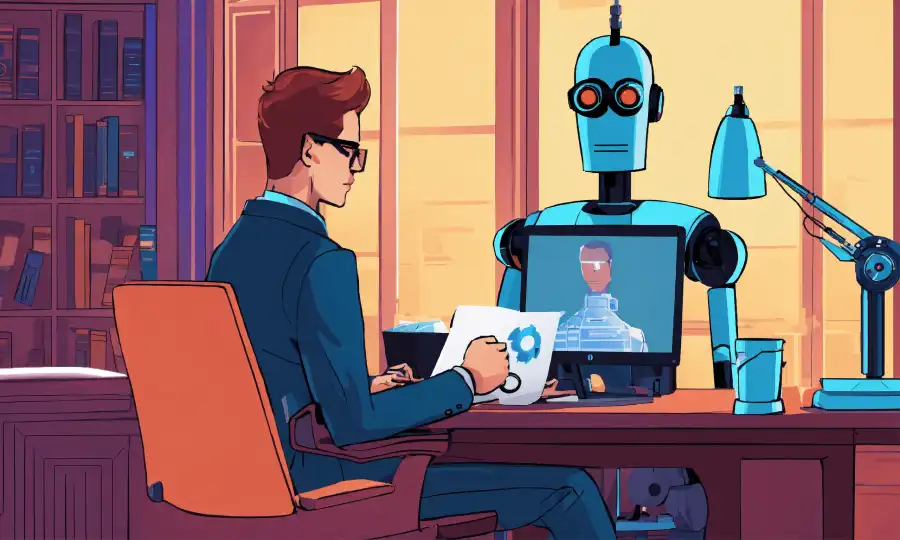
The future of work, as should be evident from these examples and the many others not mentioned here, isn’t one of man versus machine. Rather, it is about an artful collaboration between the two to turbocharge human talent. And that world, where AI is not weaponised to axe jobs but to spur human creativity, is not a distant dream.
It is unfolding all around us, in boardrooms and factory floors across the globe. And both workers and employers are becoming richer and wiser for it. Where we are heading, thus, is not a future of doom and gloom; rather, it is one of hope and celebration.
In case you missed:
- 95% Companies Failing with AI? An MIT NANDA Report Misread by All
- The B2B AI Revolution: How Enterprise AI Startups Make Money While Consumer AI Grabs Headlines
- The Default Bias: Why Women’s Underrepresentation in AI is Turning the World Crooked
- Does your company need AI or simple automation? Don’t spend more on wrong solutions
- AI Browser or Trojan Horse: A Deep-Dive Into the New Browser Wars
- Gemini & Copilot accessing your content: A great data grab in the name of AI assist?
- 100x faster AI reasoning with fewer parameters: New model threatens to change AI forever
- The Cheaper Than Laptop Robot Revolution: How China’s Unitree Just Redefined Our Future
- These 3 Economists Discovered the Secret Code of Progress & the Formula to Survive AI
- From Generics to Genius: The AI Revolution Reshaping Indian Pharma