



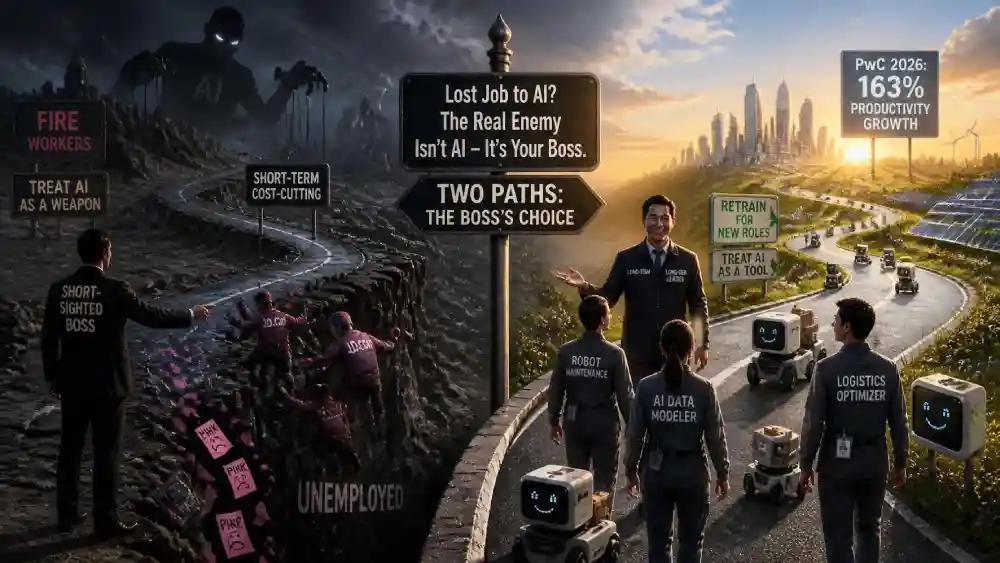

While companies hide behind AI to fire thousands, one Chinese billionaire is choosing to retrain his workers even while automating, something few in the world are doing, even when research finds it’s profitable, finds Satyen K. Bordoloi
Richard Liu, founder of JD.com, China’s answer to Amazon, is a very rich man. Not as rich as Jeff Bezos, but after what he’s done, he surely will become more popular among workers than Bezos, with his billions, can ever dream. First in a company town hall in May, then on platforms across the world, including the 2026 APEC China CEO Forum, Liu admitted that AI, automation, and robotics will affect hundreds of thousands of jobs in his company. But he did what perhaps no CEO has done in the world so far: he promised not to fire a single employee.
In an internal speech reported by Bloomberg, Liu said: “JD.com will not fire a single front-line worker replaced by machines,” adding that the company would do everything possible to safeguard employment for hundreds of thousands of staff. And he wasn’t just blowing smoke. To support that promise, JD.com launched an internal retraining program called Nirvana, signing contracts with approximately 120 schools across China to retrain delivery staff in skills that include robot maintenance and AI model training. The proposed transition is from outdoor courier work to indoor roles servicing the very robot fleets that will eventually replace the delivery function.
What makes this truly laudatory is that this has come at a time when JD.com’s profits have halved. Choosing not to cut headcount under such profit pressure, from a purely financial perspective, is a counterintuitive move. The standard industry response would have been to “optimise headcount” – aka fire people, offset costs, and protect next quarter’s numbers. JD.com chose the exact opposite path.
Now contrast that with what’s been happening everywhere else. Let’s start with Oracle.

The Great AI Cover-Up
Between March and June this year, Oracle eliminated up to 30,000 positions, roughly 20% of its global workforce, targeting legacy database administrators and on-premises support teams. And this, despite a 44% cloud revenue growth and AI infrastructure expansion with over $156 billion being redirected to AI data centre buildout. Just the opposite of what JD.com did. And Oracle is not alone.
Amazon cut 16,000 corporate jobs, following 14,000 cuts in October 2025 — about 9% of its corporate workforce in three months. And what did Salesforce CEO Marc Benioff say to contribute to the “literature” of our times: “I need fewer heads.”
Then there is Klarna, which cut roughly 700 customer service workers, but as customer satisfaction declined, reversed course and began rehiring, with CEO Sebastian Siemiatkowski admitting they “went too far” and that “lower quality” was the result of prioritising efficiency over service. So, the AI supposedly doing the work of 700 people was, it turns out, doing it badly. The 700 people knew things about customers that no model had been trained to feel. But by the time leadership figured that out, 700 livelihoods had already been upended.
In 2026, 56% of layoff events affecting over 156,000 workers explicitly cited AI, automation, or machine learning as a driving force. Yet, a survey from Resume.org in January recorded 6 in 10 companies admitting that they frame layoffs or hiring slowdowns as AI-driven even when the real reason is financial.
Read that again. Six in ten. So, in the majority of cases, it is not AI that’s killing these jobs. The quarterly earnings call is. AI just becomes the latest, the most socially acceptable, zeitgeist of an excuse for doing what short-sighted management has always done: cutting costs and calling it a strategy. This even as the algorithm is being tried, convicted, and sentenced.
AI Is Not the Villain. It Never Was:
Here’s the uncomfortable truth: AI didn’t fire anyone. A boss always did. That is not to say that AI is not causing job cuts. It is. But again, the one responsible is not AI, but a human making the decision to fire people, instead to – like Richard Liu did – retrain them or have them do other things.
The most important thing we forget in all this is that AI is not a consciousness, but a tool that companies can deploy to grow their business, supervised by humans. This means instead of firing employees to save a bit of money, they can redeploy the same humans with AI tools to increase profits. Take this hypothetical example. Say a company replaces ten customer service agents with a chatbot and saves $500,000 a year.
Instead, if the same company gave the same ten employees AI, it’d allow them to handle multiple times the volume while also upselling, resolving complex cases, and building genuine customer loyalty. It’s true that the company would be denied the savings of $500,000. But then it’ll make a million, or millions more. The math isn’t complicated. The ability to see it is.
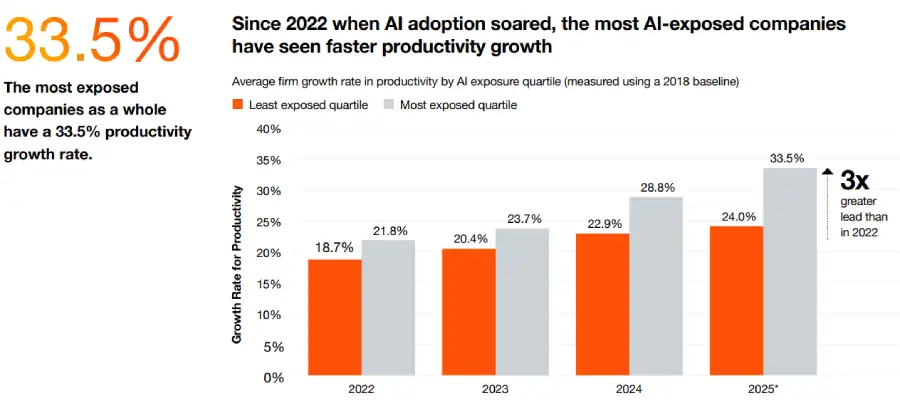
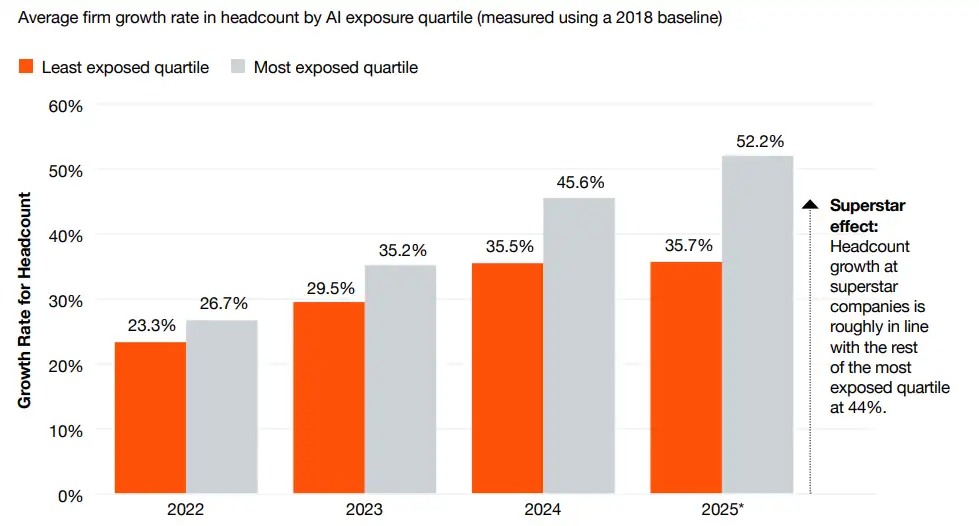
Because, and this will blow your mind, PwC’s 2026 Global AI Jobs Barometer found something truly stunning. The top 20% of companies most exposed to AI achieved average labour productivity growth of 163% on average since 2018, and these firms are not using AI only to cut costs; instead, they use AI to enhance human performance and create new forms of value, so much so that headcount growth at these most AI-exposed companies is outpacing that at the least exposed ones. And another surprise: the wages in these companies are rising faster than in others. So, in these cases, far from being a job killer, AI used to unlock growth and enter new markets, is actually expanding jobs and increasing salaries.
Take a moment to accept this because it is the opposite of common street logic. That the companies treating AI as a weapon against their own workforce are not just making a moral error. They are making a strategic one, one that is losing them money.
The Boss Problem, Not the Bot Problem:
The short-termist boss as a species lives on quarterly targets, stock options vesting in three years, a bonus structure that rewards cost reduction while punishing ambition that could make more. And it’s not entirely his fault either because everything in the incentive structure of modern corporate life pushes toward cheap and fast decisions: fire the allegedly redundant, automate everything you can, declare roaring profits on an earnings call from these, and let whoever comes next figure out why the product got worse in the process.
Yet, there are those small groups of companies pulling sharply ahead in the race to generate real financial returns from AI. The PWC report found that nearly three-quarters of AI’s economic value is captured by just one-fifth of organisations, and these top-performing companies are not blindly deploying more AI tools but are working hard to use AI where it’s useful, where it can inspire growth and business reinvention, and mainly in pursuing new revenue opportunities.

One-fifth or 20%. The other four-fifths, i.e. 80%, are fighting over the scraps of cost-cutting while the 20% leaders are building moats. The leaders are not rushing to announce how many humans their AI has replaced. They’re quietly deploying AI to find new markets, serve more customers, and build better products, while hiring more people to run the resulting growth.
Richard Liu’s JD.com is a useful provocation here precisely because no one would accuse it of being soft. JD has built one of China’s most automation-heavy logistics operations, and has already experimented with unmanned warehouses, drone delivery, self-driving vehicles and unmanned delivery stations. This is not a company speculating about automation from the sidelines. They are deeper into robots than almost anyone. And yet their founder looked at the human cost of that automation and said: not on my watch. By now, especially after the PwC report, you’ll realise that this is not sentiment. That’s a long-term competitive calculation dressed up in human decency, and the decency makes it no less shrewd.
Liu also called for an internationally recognised protocol governing AI and robot adoption, arguing robots shouldn’t deprive people of the right to work. A Chinese tech billionaire, calling for global labour protections around AI? Meanwhile, Silicon Valley is busy calculating how many support engineers a chatbot has to absorb to make the stocks rise.
To me, and a growing number of right-thinking people, it is clear that the future doesn’t belong to those who fire employees indiscriminately in the name of AI. And as the PWC report and others show, we have growing evidence for the same. Instead, the reverse is being seen to be true: companies best able to use AI are seeing faster headcount growth. And growth begets growth. The companies investing in their people alongside AI aren’t being charitable. They’re being competent.
The villain in the AI-job loss story was never the algorithm. The algorithm doesn’t have a stock portfolio. It doesn’t have a bonus clause. It doesn’t fire people to make a number look better on a slide at an AGM. The algorithm does what it’s told. And who tells it what to do? The boss who never bothered to think beyond the next quarter. The boss who saw a tool for exponential growth and decided to use it as a severance package.
Richard Liu calls his employees brothers, even as for his counterparts elsewhere, it is still just a replaceable headcount. In the difference of that single word lies the difference between a company that chose to turn blue-collar to white collar, while others turn blue-collar to unemployed.
The problem was never the bot. It was always the boss.
In case you missed:
- AI Will Create Double The Jobs It Takes. The Catch: It’ll Take Time
- After Years of Job Slashes, Companies Use AI to Boost People, Not Replace Them
- Use AI or Get Fired: The New Workplace Ultimatum Hanging Over Every Job
- Companies Fired Staff for AI. Now AI Costs More Than Staff. Together It’s Still Half the Story
- Indians Using AI For Faster, Better Work: But Psst.. Don’t Tell The Boss
- Does your company need AI or simple automation? Don’t spend more on wrong solutions
- With AI Set to Destroy Millions of Indian Jobs, Traditional Career Advice is a Death Trap
- Anthropic $30 Trillion Value for AI: Mirage or the New Price of Human Labour?
- A Citrini research blows the AI-doomsday bugle, crashes the market, but is packed with glaring omissions & distractions
- “I Gave an AI Root Access to My Life”: Inside the Clawdbot Pleasure & Panic of 2026