


Like there are tricks to enter global festivals, or win awards, there are stratagems to using AI in filmmaking successfully, says Satyen K. Bordoloi, as he details the same.
When Apple launched the iPhone in 2007, every film enthusiast asked a simple question: Will a feature film made on a camera phone ever play in a theatre? It didn’t take long for people to try, and by 2009, several films shot on mobile cameras began appearing. But it wasn’t until Sean Baker’s Tangerine in 2015 – shot entirely on an iPhone 5 and selected at Sundance, and widely considered one of the finest American indie films of the decade – that the debate finally died. Tangerine wasn’t the first mobile film. It was simply the best.
A similar question has been asked since 2019, when the first AI-generated videos began appearing. My first encounter was animating still photographs using the Remini app. It was rudimentary by today’s standards, but it was stunning enough to convince me that a fully AI-generated feature film was a matter of time. Many have since been attempted and released. None has earned serious recognition. Until this week, when Dreams of Violets – a fully AI-generated 75-minute docudrama – was selected for the official lineup at Tribeca 2026.
The film reconstructs the January 2026 massacre of Iranian civilians during Tehran protests, dramatising the final moments of five people executed in an alley, witnessed by a ten-year-old child with cerebral palsy. It cost just $2,000 to make.
Why this matters
This is the first fully AI-generated film to enter the official selection of a major festival. Until now, AI filmmaking has faced constant backlash – dismissed as soulless, anti-human, a threat to the craft of filmmaking rather than its extension. Tribeca’s selection doesn’t put a full stop to that debate, but it does install a comma into the argument that AI filmmaking is still experimental. Not anymore because it has infiltrated the mainstream, whether the mainstream likes it or not.
And it did so with only $2,000, and by bypassing actors, crews, permits, location access, cameras – every traditional barrier that keeps so many stories untold. This is precisely what people said mobile filmmaking would do for cinema – democratize filmmaking. AI is doing the same thing, faster, cheaper and while giving more control to the creator.
That said, the haters are not entirely wrong.
The film’s real problems
Watch the trailer carefully. Around the 19- to 20-second mark, the woman in the centre of the frame appears without earrings in one shot and with them in the next – a basic continuity error that any first-year film student would catch. That’s not the only one. The uncanny valley feeling that haunts most AI video also hangs heavy in this trailer, with physics that feel slightly off, even when you can’t pinpoint exactly why, inconsistent lighting, colour that shifts between shots, depth of field that behaves strangely, and human movement that never quite convinces.
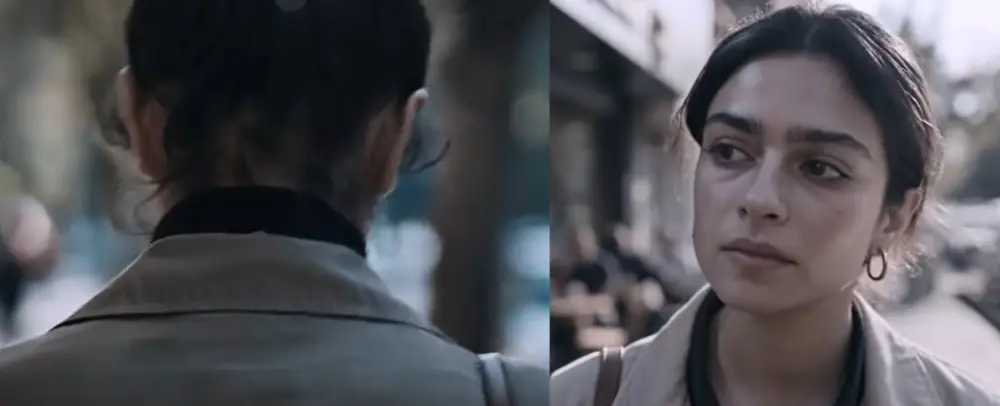
These are not necessarily the problem of the AI tool used. They are filmmaking problems – specifically, the problems of people who understand AI technology but not the craft of filmmaking. Continuity, colour correction, post-production discipline: these aren’t optional refinements for AI prompts, but the very basics of filmmaking. The makers of Dreams of Violets appear to have been technologists who wanted to make a film. It should be the other way round: curious filmmakers should get the help of techies in experimenting with AI.
There is also a harder, political question at the heart of the debate – particularly for this film. Would this film have been selected without its subject matter? The United States, in 2026, has obvious political reasons to highlight Iranian state violence (I’m not condoning it, just pointing it out). The emotional urgency of the story almost certainly smoothed over technical flaws that would have been disqualifying under ordinary circumstances. That’s not an argument against the film’s importance, but we must also not mistake political timing for filmmaking credentials.
What it means if you want to make AI films
None of this changes the fact that the film got selected. And that is a real milestone worth learning from rather than just arguing about. So here are some lessons I can glean from this for anyone aspiring to use AI in filmmaking.
This is obvious but vital: AI filmmaking is no longer a fringe pursuit. I expect to see dedicated AI sections (like sections on vertical and micro-dramas) appearing on platforms like Netflix and Amazon Prime within a few years, if not sooner, along with fuller integration across the entirety of the film production pipeline – from scripting and pre-vis to post-production finishing. That trajectory is already underway across the world, including Hollywood and Bollywood.
The second lesson to be learnt is about what actually got this film through the door. It tells a story that simply cannot be told any other way. You cannot take a film crew into Tehran to document an ongoing massacre without becoming a target yourself. When AI is the only viable tool for capturing a story that would otherwise go untold, selectors and audiences become significantly more forgiving of its limitations. If you are looking for the conditions under which an AI film will be embraced, that is your clearest template: a story that is emotionally necessary, yet practically impossible to make by conventional means. Got something set in Gaza, or Darfur? I suggest you go for it.
The third lesson comes from Tangerine.
What Sean Baker understood that most mobile filmmakers didn’t
Nostalgia was not the reason I started with the Tangerine example. Instead, I wanted to make a point that applies just as directly to AI filmmaking as it did to mobile filmmaking: the tool is never the film.
Baker has won Oscars, BAFTAs, and the Palme d’Or. He is a master screenwriter, a disciplined technician, and – most critically – someone who understands how emotion moves through paper on a screenplay, and finally in the film. The dozens of filmmakers who shot on iPhones before him thought the cheapness of the device was the revolution. Baker knew the revolution had been and always would be in the craft. No amount of technical novelty can substitute for mastering the medium you’re practising. Which, when you’re making a film, is filmmaking – not AI.
The people who made Dreams of Violets didn’t know basic continuity. If Baker had made the same film, he would have caught that earring. Or at least would have been smart enough to hire technicians to supervise aspects of the making.
Going forward, the AI will keep improving. Continuity errors will become rarer, lighting will grow more consistent, and physics will stop feeling wrong. But emotional intelligence, narrative architecture, the ability to build and release tension, the art of setup and payoff which is the essence of filmmaking – none of that can be packaged into a Machine Learning model. It comes from studying films, understanding people, and doing the work it takes to strengthen your craft.
Cinema is the art of illusion. It’s magic. And whether something is accepted – even AI films – lies in how good you weave the spell with your craft.
So, if you’re a filmmaker thinking about AI, don’t put your energy into learning every new tool the moment it drops. Put that energy into learning your craft. The AI will handle itself. The story is still on you.
In case you missed:
- Killing Satoshi: The big movie with an AI pipeline that is Killing Hollywood
- From Spider-cam to Infinite-cam: How AI is Revolutionising Sports Broadcasting
- Disney’s $1B OpenAI Bet: Did Hollywood Just Surrender to AI?
- Anthropic $30 Trillion Value for AI: Mirage or the New Price of Human Labour?
- A man almost cured his dog’s cancer with AI: Could you do the same for your loved ones?
- The Ghost in the Text: Inside Anthropic’s Invisible Watermark
- Companies Fired Staff for AI. Now AI Costs More Than Staff. Together It’s Still Half the Story
- Makers of Toilets & Ajinomoto: The Unlikely Companies Getting Rich Off the AI Boom
- FIFA ‘AI’ World Cup: Is Football An ‘Irritating’ Sideshow To All The Tech?
- The Robots Are Coming; China’s Metal Militia is Leaving the World in the Dust