





From charging balls before matches to hair’s touch deciding offside – is there too much tech killing the beautiful game, asks Satyen K. Bordoloi.
The scoreboard reads 1-0, in the Round of 16: Argentina versus Egypt. Egypt striker Mostafa Ziko scores a beautiful goal, and Egyptian fans erupt. Then, an abrupt pause. The referee’s hand went to his earpiece. VAR was checking. What happened next will be talked about for years. VAR detected that in the play leading up to the goal, an Egyptian defender had pulled an Argentine player’s shirt and stepped on his foot. The goal was disallowed for the ‘foul’.
Two minutes into added time, an opposite story where Argentina’s Enzo Fernandez scored the winner but replays showed Egypt’s Mohamed Salah appearing to have been fouled before Argentina won the ball back. VAR didn’t even ask the referee to take a look. The story that circulated on media worldwide – social and asocial; AI and VAR had scripted an Argentine win. Not for the first time did the world ask: is AI and tech killing the beautiful game?
Welcome to the 2026 FIFA World Cup for football, the most technologically advanced sporting event in human history. Hence, also the most controversial.
The Football That Has To Be Charged
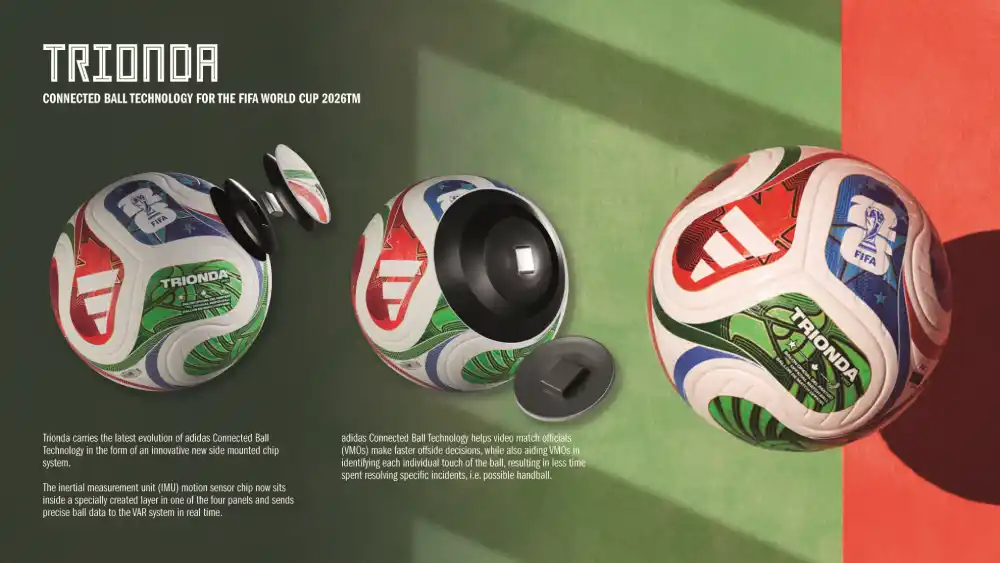
As a kid, we’d play football with anything, including a ball formed by rounding discarded cloth. Not in my wildest fantasy then, or later, did I imagine that instead of simply pumping the ball with air as we did back then, you’d have to pump it with electricity, i.e. charge the ball for it to even be eligible to enter the field. That’s your official match ball, named Trionda, that has a built-in IMU motion sensor chip that needs about 90 minutes of wireless charge before kickoff and lasts about six hours on a full charge. Yes – the football has a battery.
The chip inside samples data 500 readings per second, tracking the ball’s speed, spin axis, rotation, direction changes, and the exact moment of every touch, with the data streaming live into the VAR room, providing millisecond-level precision. In the Sweden vs Tunisia match, the chip detected a microscopic touch by a Swedish forward that no human eye or 4K slow-motion replay could see and overturned an offside call and turned a disallowed goal into a valid one.
AI As The 48 Teams’ Secret Weapon
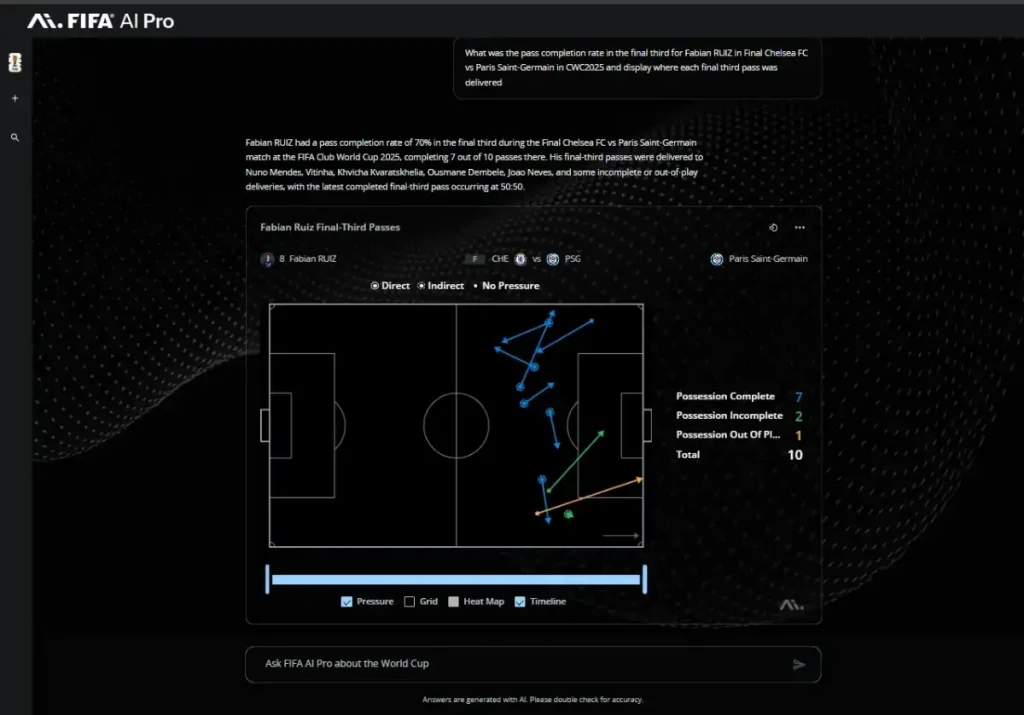
This World Cup has expanded to include 48 teams for the first time. That means more small nations like Curaçao and Cape Verde have neither been here before nor do they have the millions needed to spend on data analysts and scouting, the way Brazil, Germany, or France do. To reduce this gap between the haves and have-nots, FIFA officially certified a generative AI knowledge assistant and analysis tool called Football AI Pro, developed by Lenovo.
This system is said to have analysed hundreds of millions of FIFA data points to allow coaches to ask questions in plain natural language, like “How do we break the Argentine defence?” and within seconds it is said to pull up historical footage, tactical charts, and even generate 3D tactical visualisation.
The best thing about this tool: FIFA gave it free to all 48 qualifying teams. Which means that Cape Verde and Argentina had the same tools, perhaps the reason why the former almost pulled off a miracle against the defending champs. However, FIFA has banned its use during matches, limiting its use to strictly pre-game preparations and post-game analysis.

When Every Hair Trigger Triggers A Decision
During the game itself, AI is everywhere: nowhere more visible than in the officiating. FIFA’s Semi-automated offside technology (SAOT) has been upgraded from 2022 with more than a dozen specialised cameras tracking players at 50 frames per second. If a player is offside, the system sends an alert to the referee’s watch. The AI calculates body contours, limb positions, and the exact moment of the pass: all in real time. Then it generates a 3D animation that gets broadcast to millions of viewers, showing exactly where the offside line was drawn.
This became possible because every one of the 1,248 players in the tournament had previously stepped into a scanning booth that captured their exact body dimensions: leg length, shoulder width, torso contours, etc, creating their high-precision 3D digital avatar. Trained on hundreds of thousands of human body data points, the AI automatically generates each player’s digital twin.
This means when checking for offside, the system is not just looking at a player’s feet but tracking their entire body, leading to weird things like in the Colombia vs Portugal match where a goal was disallowed after the system determined that defender Davinson Sánchez’s toe was offside. Or in the match between Croatia vs Portugal, Croatia scored a late equaliser that would have sent the game to extra time, but the ball’s sensor had detected that it had just barely grazed a Croatian player’s hair on its way into the box, a touch so light no one, not even the 4K cameras, noticed or captured it and the goal was disqualified for offside. Croatia lost 2-1.
The Referee’s New Best Friend
Even the referees are wearing AI via a camera that gives stable footage thanks to AI-powered stabilisation algorithms that analyse the camera movement in real time and compensate for shake in milliseconds. The result? Broadcast-quality, stable, first-person footage from the referee’s perspective, shown live to billions, changing how we fans experience the game.
In The Commentary Booth
Chinese official broadcaster for the 2026 World Cup, Migu, has AI-powered commentary that has already been used over 310 million times (previous sporting events included). The AI commentary comes in dialects including Tianjin, Northeast, Sichuan, Cantonese, and Shanghai styles. It can do solo or duo broadcasts as well, balancing tactical analysis with entertainment.
There’s also an AI “match companion”, a virtual assistant that sits in the corner of your screen, answers questions about the game in real time, and even has a voice cloned from a famous commentator. You can ask it mid-match: “Why did the referee give that yellow card?” and it’ll explain the rule, show you the replay, and break down the decision. Other AI features include ball-tracking, player spotlighting, and tactical visualisation that turns complex formations into easy-to-read radar charts and heat maps.

AI Runs The Tournament Behind The Scenes
A World Cup that spans three countries, 16 cities, and 104 matches doesn’t run itself. Behind the scenes, there’s an AI-powered “mission control”, a technology command centre in Miami, supported by the International Broadcast Centre in Dallas.
The system uses digital twin technology – a virtual replica of every stadium. Everything is fed into a central AI dashboard. The system predicts bottlenecks, optimises schedules, and alerts staff to potential issues before they happen. Edge computing units at each stadium handle real-time tasks that can’t wait for the cloud, while the central hub in Miami coordinates the bigger picture.
In a way, the operating system of this World Cup is AI. And most of us don’t even know that.
AI As The Invisible Coach
Even the players are not exempt from AI. Teams are using wearable devices that collect player data like heart rate, blood oxygen, muscle activity, sprint distance, high-speed runs, and fatigue levels. The data feeds into AI models that predict injury risk and recommend training adjustments.
Remember the scans of players to generate their 3D digital model? That model isn’t just for offside calls; it’s also used for performance analysis, tracking player movement, positioning, and tactical execution on a level of detail that was impossible just four years ago.
The Great Debate: Has AI Killed The Beautiful Game?:
All this tech has made the 2026 World Cup more accurate, more transparent, and more data-driven than any in history. But it’s also sparked a debate about what football is supposed to be. Some who favour it want the game to be fair and prevent episodes like the infamous ‘hand of God’ or ghost goals; others say football is beautiful precisely because it is imperfect, because a ‘hand of God’ or ‘ghost goal’ controversy will have fans argue about it for decades. They say so much tech is ruining the game.
Yet, in this tournament, AI has been in the driver’s seat, officiating if goals count, if players are offside by a hair or a toe, deciding training and access to information to beat a better team. In the Argentina vs Egypt match it made a call that changed the course of the tournament. Whether you think it was the right call or meant to favour Argentina, one thing is clear: AI is no longer a sideshow at the World Cup. It’s the main event. Football just happens to be played alongside.
In case you missed:
- From Spider-cam to Infinite-cam: How AI is Revolutionising Sports Broadcasting
- Great quantum poker: Who’s bluffing, and who is holding the aces?
- Pope Leo’s surprising AI awareness, and what it says about our world
- Sam Altman Says His AI Made New Maths Even As It Hacks Companies Autonomously
- “I Gave an AI Root Access to My Life”: Inside the Clawdbot Pleasure & Panic of 2026
- How India Can Effectively Fight Trump’s Tariffs With AI
- Talk to the Hand: Why the Robot Revolution Lies In Its Fingers
- The AI Prophecies: How Page, Musk, Bezos, Pichai, Huang Predicted 2025 – But Didn’t See It Like AI Is Today
- Research finds AI ‘scheming’ is increasing; Is it, and will it destroy the world?
- 75 Years of the Turing Test: Why It Still Matters for AI, and Why We Desperately Need One for Ourselves