



Every year since 2023, someone has called time on the AI-bubble, yet yearly doubling AI investments has proven them wrong and might do so for another decade, writes Satyen K. Bordoloi.
Rails. Roads. Bridges. Planes. Trillions have been invested to create the world around us. But do you know which year sees the largest coordinated infrastructure investment ever in world history? It’s this year. 2026. Just four hyperscalers: Amazon, Google, Meta and Microsoft are on the way to spending $725B this year.
Not to build physical roads or highways, but its equivalent in cyberspace. They are laying the foundation for the new world of artificial intelligence unfolding around us. Yet, you keep hearing that AI investment is a bubble about to burst, one that would cause a depression bigger than ever. So, what’s going on? Why this discrepancy between what’s speculated and what’s happening on the ground?
It’s been three years since the AI-is-a-bubble narrative took hold. Last year’s addition was about the circular nature of AI investment, i.e. the AI companies investing in one another to inflate each other’s value. Yet, from about $150 billion in 2023, to over $250 billion the next year, to about $580 billion in 2025 and this year’s projection being between $700 billion and $900 billion, AI investments refuse to stop with this year Amazon on path to spend $200 billion, Alphabet $175-185 billion, Microsoft near $190 billion and Meta $145 billion after raising its own guidance mid-year.

Goldman Sachs now projects these four will collectively spend $5.3 trillion between 2025 and 2030. Widen your lens to include everyone else, and the number balloons past $7 trillion over the same stretch. This isn’t an error made by idiots. This is the largest coordinated capital commitment in corporate history, and I’ve made this argument before, in an earlier Sify column on the same $725 billion figure and in an even earlier one calling the so-called AI correction a case of growing pains.
I’ll make it again here, because the case has only gotten stronger, and because most of the research backing it up has been buried under a mountain of anxious punditry.
Comparing Apples To An Orchard Of Mangoes
To prove their point, AI-bubble doomsayers don’t tire of comparing it with the dotcom bubble of the early 2000s. Seems similar from a distance. The differences become apparent when you go beyond the surface. First of all, the dotcom bubble of 1999 was a business-model bubble. Companies with nothing and no revenue plan but with just a website and millimetres of an idea convinced investors that being online itself was enough.
Like I’ve mentioned in previous articles, Pets.com spent more shipping dog food than it earned selling it. Webvan built same-day grocery delivery before the warehouses, trucks, customer base or the tech behind the logistics were even thought about. That money vanished because the ideas behind it had no legs.
Those that did have them – Amazon, Google, eBay, GoDaddy, etc. found that the legs were wings and not just survived, but thrived. What else survived, and which actually matters most, is the unglamorous infrastructure quietly built underneath all that noise: the undersea cables, the server farms, the fibre that a quarter century of investment eventually turned into the internet we now take for granted.
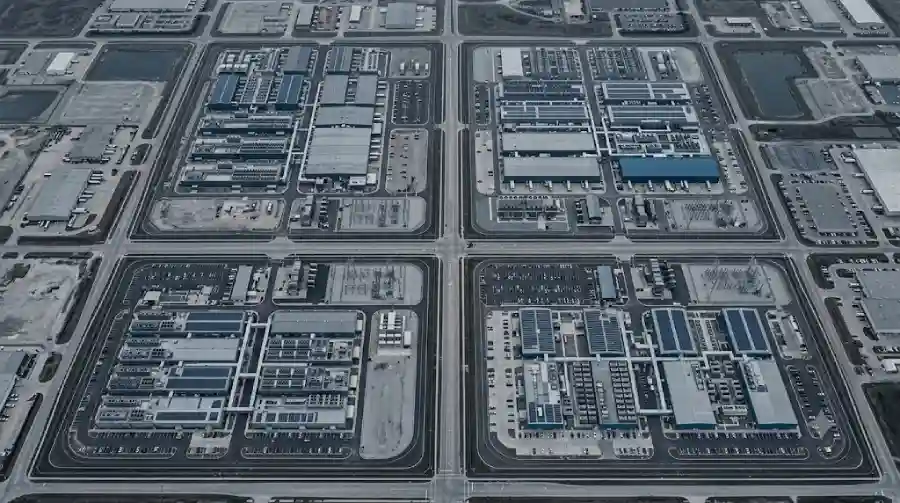
AI capital in 2026 isn’t funding a cool, hip, vibe-inducing founder’s pitch deck. It is funding steel, silicon and concrete that will be there to be used by anyone who wants to. Those unglamorous infra that the internet stands on today, that is where the AI money is going into right now, not for its upkeep, but for laying a completely new type of digital infrastructure, one that is geared for the era we have already entered but hadn’t built for: the intelligence era.
The Research Nobody’s Reading
The writing in favour of the AI-boom lasting is on the wall. Well, not really, but it is hidden inside reports made by some of the biggest firms on the planet. Let’s start with IDC, whose latest tracker projects global AI infrastructure spending by the market to cross $1 trillion by 2029. McKinsey’s own modelling arrived at a similar number via a different angle last year: data centres worldwide will need $6.7 trillion in capital by 2030 just to keep pace with compute demand, $5.2 trillion of it for AI-specific capacity, driven by projected AI data centre capacity nearly quadrupling to 156 gigawatts.
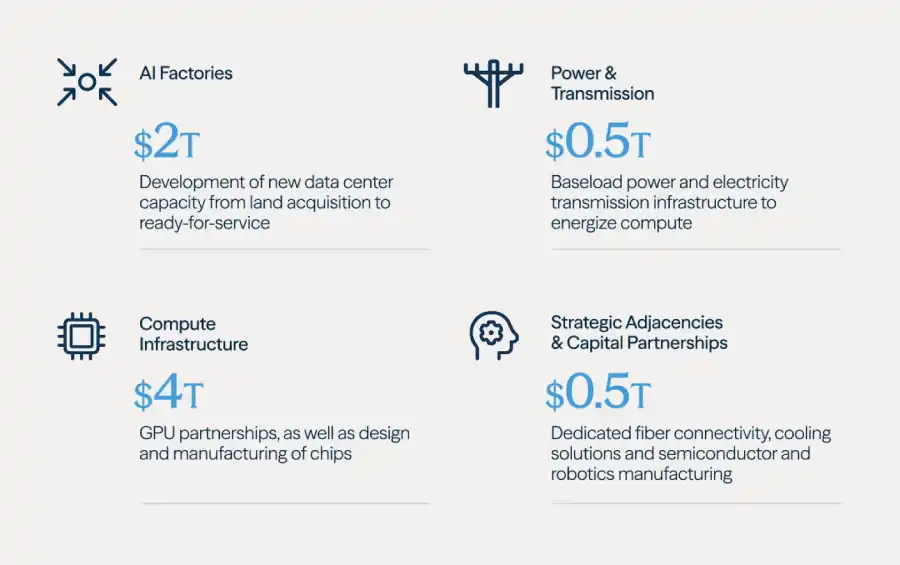
Brookfield Asset Management puts a similar figure on the whole value chain, forecasting $7 trillion in spending over the next decade across chips, data centres, power and transmission. It also compares the buildout to the formation of the modern power grid and the global telecom network, only faster and larger. And best of all, three months after the report was released, they put their money where their data projected and launched their own dedicated $100 billion AI infrastructure fund.
None of these firms is a hype merchant. They sell forecasts to institutional money that punishes wrong guesses.
Why a Decade, Not A Quarter
Infrastructure cycles of this scale and size do not resolve themselves in a small cycle and take a decade at least, or more. This is not very different from railroads, electrification and even the original internet buildout, each taking 10 to 15 years at least before the dust settled and those who survived, becoming the backbone of the next economy, e.g. Google and Amazon from the dotcom era are leading the investing for this intelligence cycle.
There are some factors around that you can see with this buildup that make it very likely that the pattern is repeating itself. First is a truly epic race for computing power where the hyperscalers openly describe themselves as supply-constrained rather than demand-constrained (the reason why they’re spending so much on scaling up), i.e. they are having to ration capacity and not sending their marketing team scouting for more deals. There are reports of some bits of the digital economy carrying waitlists of six to nine months because there aren’t enough data centres or GPUs to run them.
The second bit is that energy and policy constraints will take years to unwind, no matter how fast anyone wants to build. Take McKinsey’s numbers, which show data centre electricity demand in the US nearly tripling by 2030, straining their grids, which US regulators have only recently begun to reckon with.
Third, the buildout, and thus the investment, is not just in Big Tech. Everyone down the supply chain is flying high on the backwinds: from chipmakers like NVIDIA to cooling and power companies; from dedicated “neoclouds” renting out GPU clusters like Together AI that raise funding at an $8.3 billion valuation to, as I wrote in another piece, two Japanese companies – one making toilets and the other Ajinomoto. The opportunity and the risk are far wider than the balance sheets of just four hyperscalers or the Magnificent Seven tech companies.

The Real Risks
This does not mean that the AI ride into the next decade will be free of turbulence. A massive correction of overvalued stocks is most likely in the works. Forbes reported that the combined free cash flow of four hyperscalers could compress to almost nothing this quarter as they scale up aggressively. This is a steep reversal of the trends where they have always had billions to spare.
Meta’s stock fell after it raised its 2026 capex guidance in the same earnings call where it beat revenue expectations, a sign that investors are demanding proof that this spending converts into returns.
No matter how small, there is a chance of overcapacity if, for some reason, GPU demand plateaus even slightly. You build for 1000, but if the demand falls to just 100, what will you do? Yet, the biggest problem, I think, is the concentration of power with four or five companies controlling most of the spending.
These are legitimate worries, no doubt, but not evidence of a Ponzi scheme. A company and its shareholders, nervous about its free cash flow, are not the same as selling vaporware. Pets.com never had cash flow to worry about compressing, because it never had a viable business to start with. The difference between a correction and a collapse is exactly this: whether the underlying asset still has value once the froth is skimmed off.
A data centre still processes workloads and earns rent whether or not this quarter the stock went up or down. A dot-com idea with no revenue model and nothing really to show for it except a hyped-up PowerPoint presentation has nothing left once the story stops selling.
India’s Gameplay
I’ve so far mostly talked about the US, because that’s where all the AI investment is mostly happening. China is, of course, on their heels. But the proof that this is not just a regional story lies in the fact that this investment is projected to be visible in other parts of the world as well, like in India.
Deloitte India estimates we will need an additional 45-50 million square feet of data centre real estate and 40-45 terawatt hours of incremental power by 2030 just to keep up with domestic AI demand. This is because we hold barely 3% of the world’s data centre capacity while generating nearly a fifth of its data.
That gap is either India’s biggest infrastructure opportunity of the decade or our biggest bottleneck – perhaps both, and all this will depend entirely on policy decisions being made, or ignored, right now by the government.
Despite all the data against, I still don’t expect the doomsayers to shut down. Six months down the line, we’ll see more expert opinion claims about the AI bubble. Same a year from now, and another. The conviction was there in 2023, 2024, and 2025, and it’s the highest today. Yet, the AI investment number keeps growing, and so do the number of people using the tools.
This year, the investment number could reach $900 billion. Ask me again next January what the number will be for 2027, and I suspect neither of us will be surprised by the answer.
In case you missed:
- Why the Alleged, Upcoming AI Crash Is Never Going To Happen
- $725 Billion Investment, Best Tech Q1 Ever Says AI Bubble Isn’t Bursting, It’s Thriving
- The Great AI Correction of 2026: Why the ‘Bubble’ Popping Could be the Sound of Growing Pains
- Indian AI’s Power Problem: We Woke Up Late to AI, We’re Still Half-Asleep
- Sustainable Data Centre Solutions to Protestors’ Demands In India & Abroad
- Anthropic $30 Trillion Value for AI: Mirage or the New Price of Human Labour?
- Coopetition: Why’s NVIDIA Building AI Models to Compete With Customers It Sells Chips To?
- Makers of Toilets & Ajinomoto: The Unlikely Companies Getting Rich Off the AI Boom
- Inside Elon Musk’s Plan to Move the Internet into Space
- NVIDIA’s Strategic Pivot to Drive our Autonomous Future with Innovative Chips