


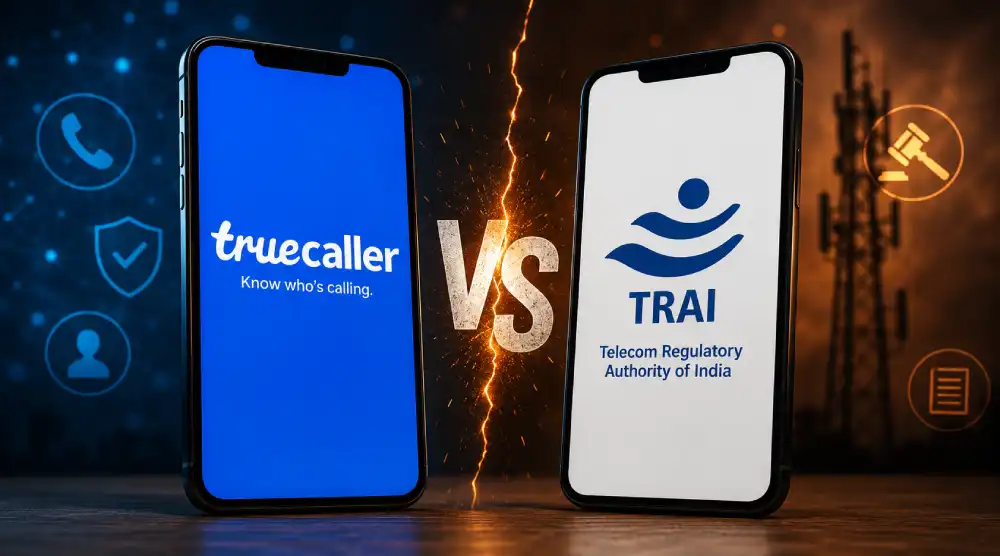

India’s battle against spam calls has taken a new turn as Truecaller challenges TRAI’s proposed anti-spam rules, arguing they could actually make unwanted calls harder to stop.
If you’ve ever ignored a call because Truecaller warned you it was spam, you’re not alone. For millions of Indians, the app has become an unofficial first line of defence against telemarketers, scammers and unknown callers. Now, however, Truecaller finds itself fighting a very different battle.
The caller identification giant has publicly pushed back against India’s telecom regulator, arguing that proposed rules aimed at tackling spam calls could actually make the problem worse. At the centre of the dispute is a simple but important question: who should be responsible for protecting users from unwanted calls, telecom operators or apps like Truecaller? The answer could reshape how hundreds of millions of Indians identify incoming calls and deal with one of the country’s biggest digital annoyances.
A Fight Over Spam Calls
TRAI Asks Truecaller To Stop Spam Warnings On 140, 1600 Numbers| Millions Of Calls May Go Unanswered
The latest disagreement centres on proposals from the Telecom Regulatory Authority of India (TRAI), which wants greater oversight of caller identification apps while also promoting telecom-level systems to identify callers. Truecaller argues the approach misunderstands how spam detection actually works.
According to the company, the regulator’s recent whitelisting rules have unintentionally made life easier for spammers by allowing certain calls to appear more trustworthy than they really are. Truecaller has also questioned why third-party caller ID apps should be regulated at all, saying they simply provide an optional service that users choose to install.
The company insists it neither operates telecom networks nor controls how calls are routed, making comparisons with telecom providers misleading. In its view, forcing caller ID apps into the same regulatory framework as telecom operators “makes no sense.”
The disagreement comes at a time when spam and fraud calls have become one of India’s biggest digital headaches. Telecom operators, regulators and technology companies have all introduced new measures to reduce nuisance calls, including stricter rules for promotional messages, digital consent frameworks and caller authentication systems.
TRAI believes telecom operators are in the best position to tackle the problem because they control the underlying network. Truecaller, meanwhile, argues that its crowdsourced database allows it to identify suspicious numbers much faster than traditional systems. With more than 350 million users in India, the company says it receives billions of data points that help detect emerging spam campaigns before they become widespread.
The debate is therefore not just about regulation but about two competing approaches to solving the same problem.
Who Should Protect Your Phone?

At the heart of the dispute lies a much broader question about digital trust. Should identifying spam calls be the responsibility of the network carrying the call, or the application sitting on your smartphone? Telecom operators have access to network-level information and can block fraudulent activity before it reaches consumers.
Apps like Truecaller, meanwhile, use user reports, machine learning and constantly updated databases to spot suspicious callers. Neither system is perfect. Network-based systems can be very effective against mass spam campaigns but can be slow to adapt. Crowdsourced platforms can respond quickly to new threats but are dependent on user participation and voluntary adoption.
Rather than replacing one another, many cybersecurity experts believe the two approaches are likely to work best together.
The dispute also reflects Truecaller’s unique position in India. While the app is available globally, India has become its largest and most important market by a considerable margin. For many smartphone users, checking a caller’s identity through Truecaller has become almost second nature. That popularity has inevitably attracted greater regulatory attention as governments look for ways to reduce fraud while ensuring user privacy and accountability.
TRAI’s proposals suggest that caller identification should increasingly become a telecom service rather than one provided by independent apps. Truecaller disagrees, saying innovation and competition have vastly improved spam detection over a decade. The winner of this debate may influence not only how Indians make calls, but also how similar services evolve in other countries.
The Future of Caller ID
Few people enjoy receiving spam calls, yet there is still no universal solution to stopping them. Governments want more oversight, telecom companies want more control of caller verification and technology companies believe software can outsmart regulation. The latest tussle between Truecaller and TRAI shows just how hard it is to balance innovation, competition and consumer protection in an age of increasingly sophisticated digital fraud. Whatever the regulator ultimately decides, one thing is already clear.
The fight against spam calls is no longer just about blocking annoying telemarketers. It has become a contest over who controls one of the most trusted pieces of information on your smartphone: the name that appears before you decide whether to answer the phone.
In case you missed:
- Not Just Oil: Iran War Could Put India’s Internet Connectivity at Risk
- WhatsApp Wants to Hide Your Phone Number. India Wants It to Wait.
- Google Launches ATL Saathi: An AI App for India’s Teachers
- India’s Mappls Revolution: The Swadeshi Push to Dethrone Google Maps
- Deepfake Politics: How AI Could Undermine the World’s Largest Democracy
- No Internet, No Cloud: India’s ‘BharatGPT’ Is Taking a Different AI Path
- Sea6 Energy: How India Is Turning Seaweed Into an Alternative to Crude Oil
- Malware with AI-Powered Code Mutations: Google Sounds the Alarm!
- You Can Now Host an NVIDIA Data Centre in Your Home. Some Neighbours Already Want Them Gone.
- Aatmanirbhar Push: India Becomes 7th Nation to Crack Gallium Nitride Chip Technology