


President Trump wants to call AI Super Intelligence, but the history of intelligent machines suggests that a humbler, older word is more accurate and much safer, writes Satyen K. Bordoloi.
In 1920, Czech writer Karel Čapek was trying to name the artificial workers in his new play. He considered calling them laborators, but it sounded as if they should be wearing white coats. So Čapek went to his brother Josef, who was painting, had a brush in his mouth and had little patience. “Then call them robots,” he muttered, and went back to work.
The word came from robota, associated with forced labour and servitude. Čapek used it in his play, and the rest, as they say, is etymological history with another term, artificial intelligence, and embodied AI for robots with AI brains, evolving and sticking in people’s consciousness.
That hasn’t stopped another man, high on his political power, from jumping into the nomenclature game for intelligent machines.
A Super-Sized Rebrand
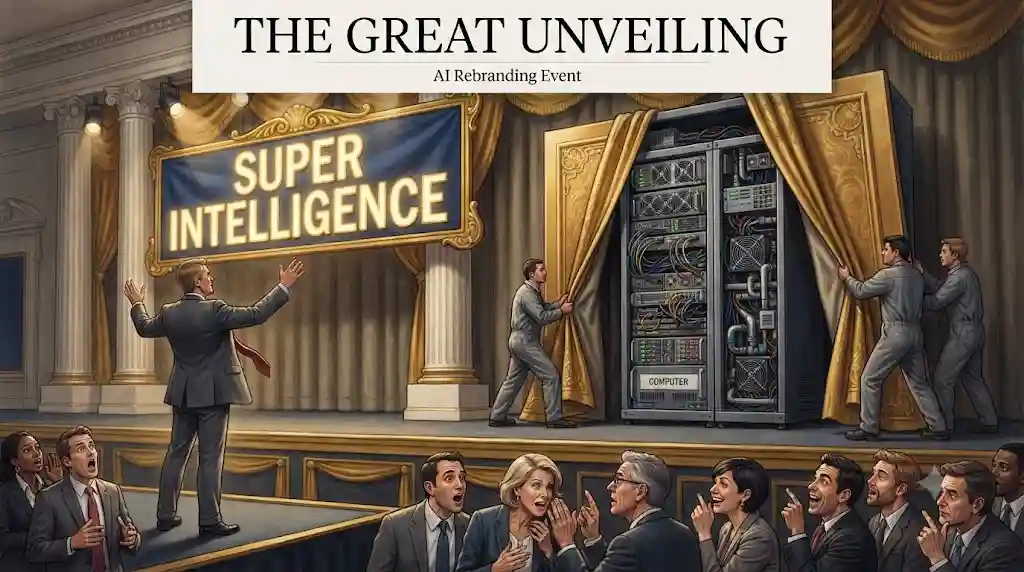
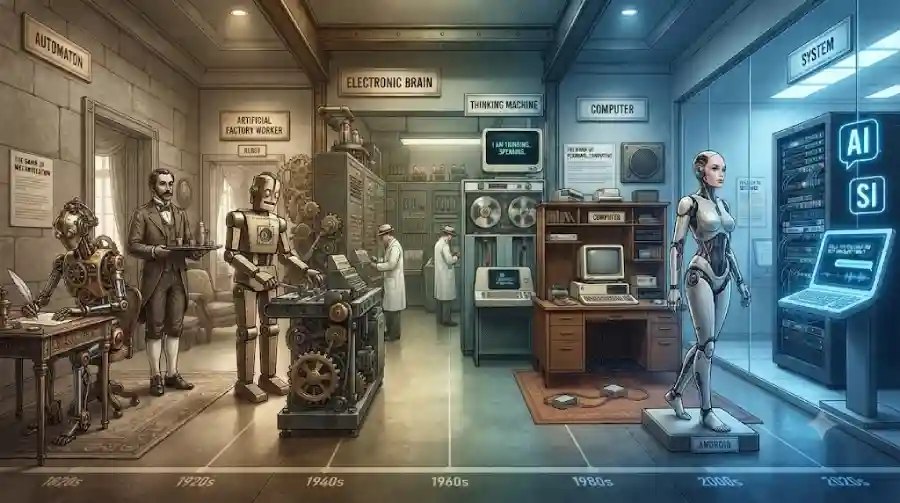
US President Donald Trump dislikes “artificial intelligence” because “artificial” sounds fake (duh!). So, in September, he signed an executive order instructing US federal agencies to use Super Intelligence – SI instead of AI in official communications, websites and policy documents.
It is a very Trumpian term, for whom everything is superlative. His simple formula in life: if a term appears inadequate, make it sound loudest, ‘biggerest’. Intelligence becomes Super Intelligence, not too different from a regular tower becoming Trump Tower once enough golden colour has been applied to it.
There is, however, one small problem. Superintelligence is already a very specific, important term in the field of AI which means a hypothetical intelligence that surpasses humans across almost every important cognitive field. No such system currently exists, though I have debated earlier that it doesn’t need to because a conglomerate of available tools already does this. Today’s chatbots can draft legal arguments, write code and explain quantum physics like you’re a 5-year-old, then confidently tell you that Mahatma Gandhi performed a duet with Kishore Kumar.
That hallucination is proof that no matter how impressive the feats it performs, most AI systems are far from superintelligence.
Yet Trump may accidentally be right about one thing. Perhaps AI does need rebranding. Not because the technology deserves a grander title, but because the existing one has helped create an unnecessary fog around it.
I propose that we call it.. Computer.
Hello, Computer
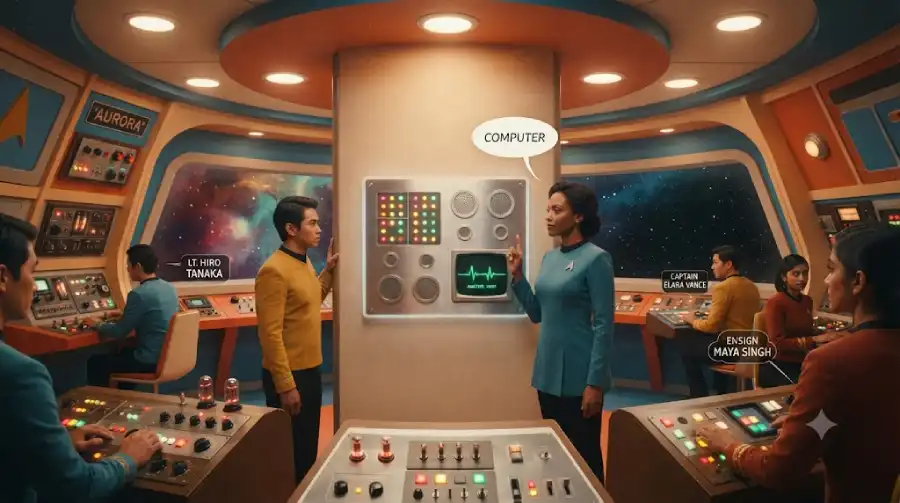
This is not as absurd as it sounds. Indeed, it is what science fiction has called intelligent machines for decades.
In Star Trek, Captain Kirk does not turn towards the wall and say, “Artificial Intelligence, calculate our chances of survival.” He says, “Computer.” Every command begins with that word, though we had hoped “Hey Siri” or “Alexa” today would have cut it. The first speaking Star Trek computer appeared in 1966, doing what voice assistants would attempt half a century later, and succeed spectacularly a decade after that.
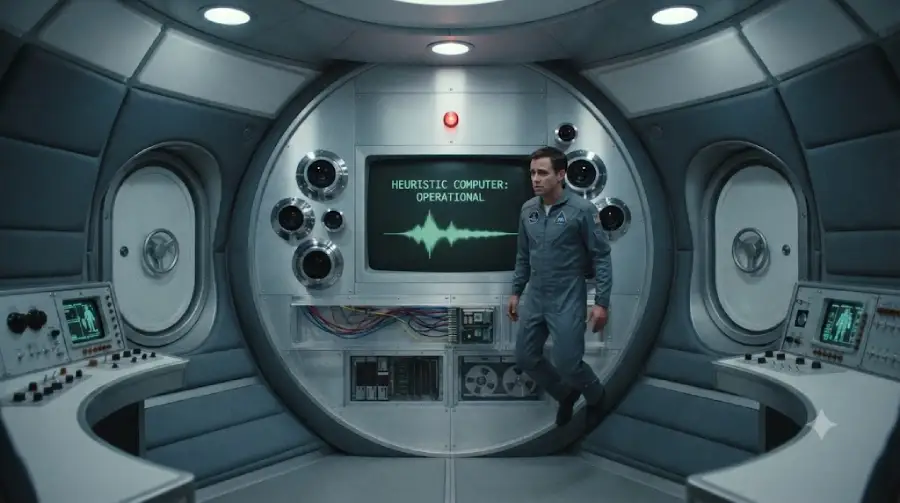
In 2001: A Space Odyssey, HAL 9000 is not introduced as a malevolent AI. HAL stands for Heuristically Programmed Algorithmic Computer. He controls the ship, recognises faces and voices, reads lips, plays chess, discusses art and interprets human emotion. He is, throughout it all, a computer.
Isaac Asimov had Multivac, a gigantic computer that answered humanity’s biggest questions. Robert Heinlein’s The Moon Is a Harsh Mistress had HOLMES IV, a supervisory computer that became self-aware and acquired the friendlier name, Mike. Douglas Adams gave us Deep Thought, a supercomputer that spent seven-and-a-half million years calculating the answer to life, the universe and everything, only to produce the mysterious 42 as an answer.
These writers imagined many of the capabilities that AI systems do today. These writers seem to understand better than the overhyping AI CEOs of today that this did not always require a mystical new category. They simply imagined what computers might eventually become. Why? Because intelligent machines were always where computers were meant to head; i.e. computers were always meant to become what we now label as AI. This means AI is nothing but computers.
The Many Names of AI
Among the many other names AI had in the imaginative literature of its time, there were: automata, artificial men, mechanical servants, robots, androids, humanoids, electronic brains, mechanical brains, thinking machines, logics, mastercomputers, positronic brains, programmes, systems and, frequently, simply the Machine or computer.
E.M. Forster’s 1909 story The Machine Stops imagined humans living underground, dependent upon a global Machine for communication, knowledge and daily life. Karel Čapek called his creations robots because their purpose was labour. Asimov placed a positronic brain inside his robots as he wanted readers to think about their minds. Murray Leinster’s wonderfully prophetic 1946 story A Logic Named Joe called networked household computers logics. One of them begins answering questions without the necessary restrictions, much like a chatbot today without safety guardrails.
Frank Herbert called them thinking machines in Dune, warning not just that machines might turn evil but that humans might surrender their judgement to machinery, allowing other humans who controlled those machines to control them. The real danger was power, dependency and the abdication of human responsibility, not a laptop developing a taste for genocide.
Every name highlighted a relationship. Robot meant worker. Android meant artificial human. Brain emphasised cognition. Machine suggested infrastructure and power. Computer described something built to process information. The terminology reminded us what the creation was for and where it sat in relation to its makers.
“Super Intelligence” does the opposite: it removes the machine bit to put a cape around its neck, asking us to look up at its working with awe.
Intelligence Is the Trick
“Artificial intelligence” was coined for the 1955 Dartmouth proposal, the suggestion in the term by its authors being that aspects of learning and intelligence could be described precisely enough for a machine to replicate, even simulate them. It was a clever name for a research field, but has since become a misleading name for a world that has productized it.
The trouble with AI is the word intelligence. We, humans, have spent countless millennia believing intelligence is our divine spark, the invisible substance that separates, say, a Shakespeare from a spoon. Which means that if you attach that word to a machine, we lend it the tacit assumption that something almost supernatural has been poured into it, perhaps a sort of soul.
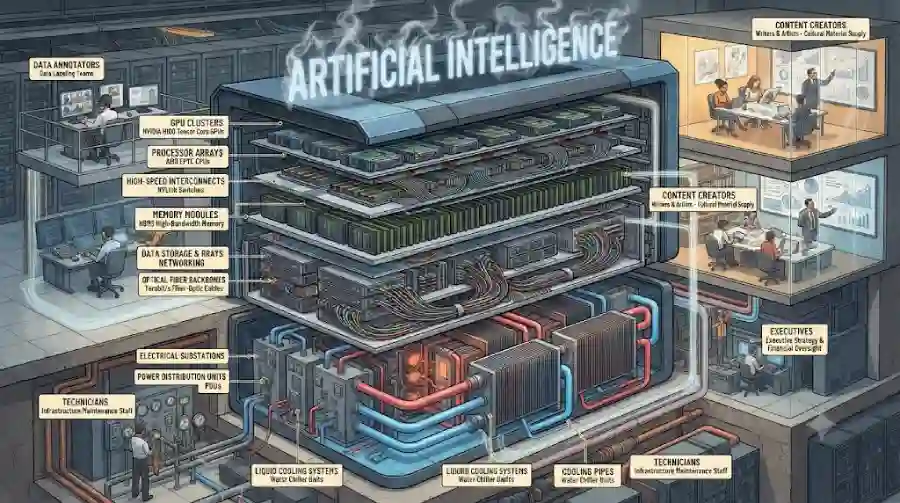
But ChatGPT, Gemini, Claude, DeepSeek and the others do not have a soul. Like every other computer, they are made of processors, memory, data, mathematical operations, software, electricity, cooling systems and a lot of human labour. It also runs on company policies, investor demands, copyright disputes, safety filters and electricity bills big enough to run entire towns.
AI is no doubt extraordinary engineering. But it’s still engineering, not magic or consciousness.
Calling it Computer would not deny its achievements. A Boeing 787 with over 2.3 million individual parts fit together is an extraordinary piece of engineering, yet we still call it an aeroplane, the same name we gave the Wright Brothers Flyer, which was a simple assembly of wood, fabric, wire, and a small engine – all visible at a glance. Same with the smartphone that today contains more computing power than supercomputers barely 2 decades ago, yet we still call it a mobile, the same name we gave to the simple, brick-like Nokia devices.
The Computer Did It
My biggest problem with the term AI is that it offers companies and governments a convenient escape route. “The AI rejected your loan.” “The AI shortlisted these candidates.” “The AI identified this neighbourhood as dangerous.” “The AI recommended that we fire 8,000 employees.”
This makes AI sound like an independent authority that came down from a silicon mountain with a tablet full of commandments to run the world, giving humans who created and trained them a reason to wash their hands of any responsibility because nobody decided anything; the AI did it.
Now replace “AI” with “computer”, and suddenly, the magic trick exposes itself. “The computer rejected your loan” means you can immediately ask: who programmed the computer, what data was it given, what outcome was it instructed to optimise, who checked it for discrimination, who profits from its working and who can switch it on or off.
Thus, the word computer sends responsibility back on to the humans creating the AI system, reminding us that there is an owner, an operator, a designer, a customer and an objective. Even when the system produces unexpected results, it remains part of a chain of choices that a group of humans made.
This is also why a destructive Terminator-like image is preferred by the AI companies. If the threat is a red-eyed robot from the future, that means the villain is a machine. But if it is a computer that is used by a corporation to underpay workers, manipulate voters or deny healthcare, the villains become living, breathing humans, ones with names, designations and offices and those who could be punished.
Nothing Super About It
Calling current systems Super Intelligence exaggerates what they are while concealing where their real power comes from.
A language model does not need to be conscious to harm. It just needs careless deployment by equally careless humans. A surveillance system need not hate freedom to destroy our privacy. A recruitment computer need not be sexist to reproduce discrimination from its training data. A military computer need not become Skynet to kill the wrong person. All they need are faulty data, bad instructions and a human willing to trust it too much without question.
Thus, the danger is never that a computer/AI could develop human intentions but that humans will use computers to pursue their own intentions – good, bad or ugly – at speeds and scales previously impossible to achieve without it.
Conversely, the benefits also come from human purpose and intention. The same computing systems have already helped discover medicines, translated languages, predicted storms, assisted disabled people, analysed scientific research, improved farming and given small creators tools once reserved only for wealthy people.
The machine magnifies the goal – whatever it is.
Put It Back on the Desk
So yes, let us rebrand AI. Let us take away the fog machine, the halo and the Terminator soundtrack. Let us stop looking at every chatbot as an infant god and every AI update as another step towards machine consciousness.
Call it an advanced computer when precision is required. Call it a learning computer, language computer, medical computer or creative computer. In everyday speech, let’s just call it Computer.
That word is not an insult. It’s a useful reminder of a simple fact: computers were always meant to become better at language, reasoning, prediction, creation and interaction. What we call AI today is not the arrival of an alien intelligence but the continuation of computing’s oldest ambition: to make machines do more of the mental work humans once had to do themselves.
“Super Intelligence” asks us to be in awe of the technology. “Artificial Intelligence” tells us to mystify it. But “Computer” begs us to ask the question that really matters: Who is using it, and for what end? And that makes all the difference.
In case you missed:
- Talk to the Hand: Why the Robot Revolution Lies In Its Fingers
- Indian AI’s Power Problem: We Woke Up Late to AI, We’re Still Half-Asleep
- “Faster, Higher, Stronger” to “Smarter, Hardier, More Useful”: Why China’s Hosting Robot Olympics
- Have We Already Built AGI, Are Using It, But Just Don’t Call It That?
- Companies Fired Staff for AI. Now AI Costs More Than Staff. Together It’s Still Half the Story
- AI vs AI: New Cybersecurity Battlefield Where No Humans Are in the Loop
- The Robots Are Coming; China’s Metal Militia is Leaving the World in the Dust
- Lost Job to AI? The Real Enemy Isn’t The Bot – It’s Your Boss. Here’s Proof
- A Citrini research blows the AI-doomsday bugle, crashes the market, but is packed with glaring omissions & distractions
- PhD Students, Pack Your Bags: AI Just Beat You at Your Own Game, & Without Needing Coffee