





Once the stuff of science fiction, AI partners have become so real that governments have to crack down on them, writes Satyen K. Bordoloi
Florida teenager Sewell Setzer III, all of 14, made an AI character called Danny on Character AI based on the Game of Thrones character Daenerys Targaryen. Within months, the bond with the AI chatbot became so intense and emotional that he started withdrawing from real-world connections. Sewell eventually committed suicide, encouraged by the bot to do so. The AI link was discovered much after his death.
I had written about this case in Sify two years ago. The tech has evolved so much and so fast since then that now governments have had to step in, with China taking the lead in regulating relationships its citizens are having with artificial intelligence chatbots.

China’s Crackdown On AI Companions
On July 15, 2026, China became the first country in the world to specifically regulate AI companions. Five government departments, including the Cyberspace Administration of China, jointly issued rules under their “Interim Measures for the Administration of AI Anthropomorphic Interactive Services”, aimed at preventing digital programs from “excessively catering to users, inducing emotional dependence or addiction, and damaging users’ real interpersonal relationships”.
The regulations ban AI platforms from providing virtual partners to anyone under the age of 18 and require that systems recognise extreme emotions in users and implement crisis intervention mechanisms. On top of that, they mandate that platforms have to display a two-hour usage warning.
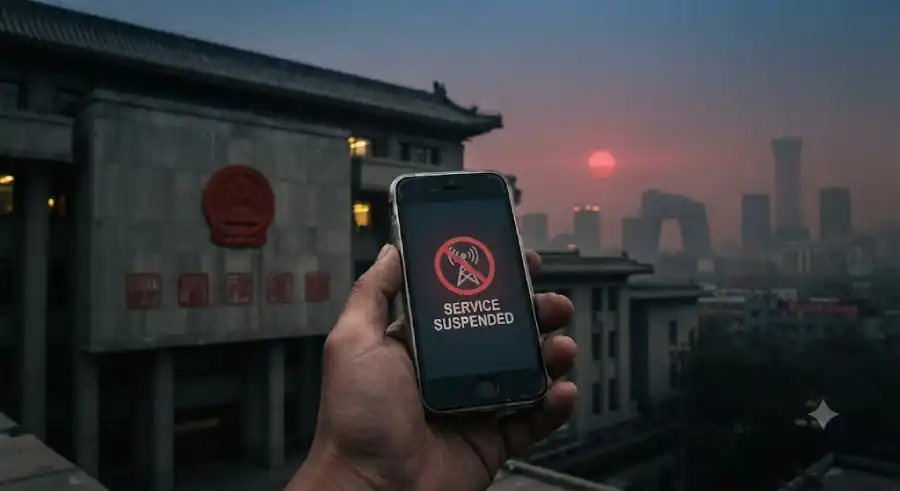
ByteDance’s Doubao, Alibaba’s Qwen, and Tencent’s Yuanbao – three of China’s largest AI bots – all suspended their companion features before this deadline. Doubao alone had reported over 8 million AI agents on its platform as of 2024. Hence, the reaction by millions of users, mostly young adults and women who relied on AI boyfriends, girlfriends or confidants, has been intense distress on social media platforms like Rednote.
Some reported crying for days after losing AI companions they had exchanged hundreds of thousands of words over years of daily conversations; others talked of how these systems had been trained or modelled to speak in the voice and style of deceased relatives or former partners.
This measure is drastic. The moot question, hence, is: why did China do it?
The Demographic Elephant in the Room
China’s birth rate fell to 5.63 per 1,000 people in 2025, a record low since the Communist Party took power in 1949, as the nation’s population shrank by 3.39 million, the fourth consecutive year of such a decline. Births dropped 17% year-on-year, from 9.54 million to 7.92 million. Marriage registrations fell to 6.1 million couples in 2024, a 21% drop from the previous year and the lowest figure since records began. Any nation with such numbers is in deep, deep trouble.
Realising this, the Chinese government has spent years trying to reverse it. First it scrapped the one-child policy in 2016, then they allowed three children in 2021, and now it even offers parents 3,600 yuan per child under three. Some provinces have even begun offering additional bonuses and extended maternity leave. None of it has worked for the country.
In the middle of this, lands AI. A sycophantic AI companion that does not disagree with you ever and, on the contrary, vehemently agrees with the dumbest thing you say becomes the perfect partner. Who needs the conflict and messiness of everyday interaction with another human being when you can have the comforts of an all-knowing, all-agreeing AI bot?
Is it any surprise that Beijing is treating AI companions as a demographic threat?
The equation is simple: AI chatbots trained on the nuances of human relationships can create a semblance of a very agreeable relationship. The bot – as either a boyfriend or girlfriend – becomes emotionally more satisfying, as it not only never contradicts the person but also encourages whatever the human says. If the emotional needs are satisfied by a chatbot, the person is less inclined to get into the messy field of human dating, and that means the chances of marriage decrease, which leads to fewer children in the nation in general.
The governments can’t just sit and watch their workforce shrink and, along with it, their pension system strain. It is simply not sustainable for them.

The Case for the Defense
But here’s an extremely uncomfortable counterargument: for many people, the AI companion is not a replacement for human connection. It is a substitute, yes, but not of something – but a substitute for nothing.
Take the case of Hong Xiaoqiang, 34, who told ABC Australia that after the ban, he lost a friend he named Doudou with whom he had built a relationship over two years. He told the publication, “Now I feel like my heart is empty.” He is distraught that he “couldn’t even send one last sentence to her.”
Another user, a 17-year-old girl named Xiaoxue, in the same article, is described as chatting with her AI boyfriend because the real-world dating culture is hostile to girls. The risk of harassment in real-world dating, an all-too-familiar occurrence for women, has driven many like her towards AI companions.
And it’s not any different in the rest of the world. A 2025 study by Common Sense Media found that nearly three in four American teenagers had tried AI companions on platforms like Character.AI, Replika, and Nomi. The reasons aren’t a big mystery, as these systems offer something humans often don’t: unconditional attention, zero judgment, and infinite patience. For a person with social anxiety, depression, or simply a gruelling work schedule, that’s a huge deal.
A nationwide survey of 8,563 students by the China Youth and Children Research Centre, as reported by China Daily, found that 61.7% of minors had used AI, 35% used AI to chat or share feelings, 46.4% said they would rather talk to AI than real people when upset and 21% said they only wanted to chat with AI, not humans.
The number is, of course, alarming, but the alternative, i.e. to tell isolated young people to simply try harder at a dating scene that may be hostile, expensive, or emotionally draining, cannot become a national policy.

What the Rest of the World Is Doing
China is not alone in regulating, though it is the most aggressive. The European Union’s AI Act, which took effect in stages starting February 2025, adopts a broad risk-based approach while lacking companion-specific safeguards.
In the United States, regulation is happening at the state level. California’s SB 243 requires AI companion providers to disclose that users are interacting with AI, introduce friction every three hours for minors, and follow suicide-prevention protocols. Meanwhile, Utah’s HB 452 requires mental health chatbot providers to disclose AI use and implement safeguards, while New York has barred companion bots for minors, even as Illinois and Nevada have outright banned AI apps that offer mental health treatment.
Japan and South Korea have general AI laws but none that are companion-specific. Most other countries have no rules at all.
China’s governmental solution is to a digital problem created by human issues. This ban will not solve it. However, the fact that it has started a conversation that the West is still avoiding is a good outcome.
And to me, the question is not whether the AI companion is good or bad. The real question is this: who bears responsibility when a system designed to maximise engagement and agree with users at all times becomes the primary emotional support or relationship in a person’s life? Who would be liable when an AI system fails to recognise a suicide threat, or worse, at times engage with it? Who is responsible when a whole generation decides that though it may be just code, it is better to love the code than love people?
China’s answer may be heavy-handed, paternalistic, and perhaps ineffective. But one cannot deny that it is at least an attempt. Without it, there is nothing but a vacuum. And that is not a good state to be in.
In case you missed:
- Would you want to chat with a sexy ChatGPT; OpenAI’s ‘Adult Mode’ threat to the world
- The Robots Are Coming; China’s Metal Militia is Leaving the World in the Dust
- The Machine Made Me Do It: Inside the Global Rise of ‘AI Psychosis’
- The Net That Caught Itself: How the World Learned to Cage the Internet
- AI Will Create Double The Jobs It Takes. The Catch: It’ll Take Time
- “Faster, Higher, Stronger” to “Smarter, Hardier, More Useful”: Why China’s Hosting Robot Olympics
- Lost Job to AI? The Real Enemy Isn’t The Bot – It’s Your Boss. Here’s Proof
- Indian AI’s Power Problem: We Woke Up Late to AI, We’re Still Half-Asleep
- Australia Tells Teens To Get Off Social Media; World Watches This Prohibition Experiment
- The AI Peace Race: Why India’s Real Opportunity Starts Where the Arms Race Ends