


Singapore has built a data center unlike anything running today: its servers contain millions of living human neurons, and researchers are now putting those cells to work as computers.
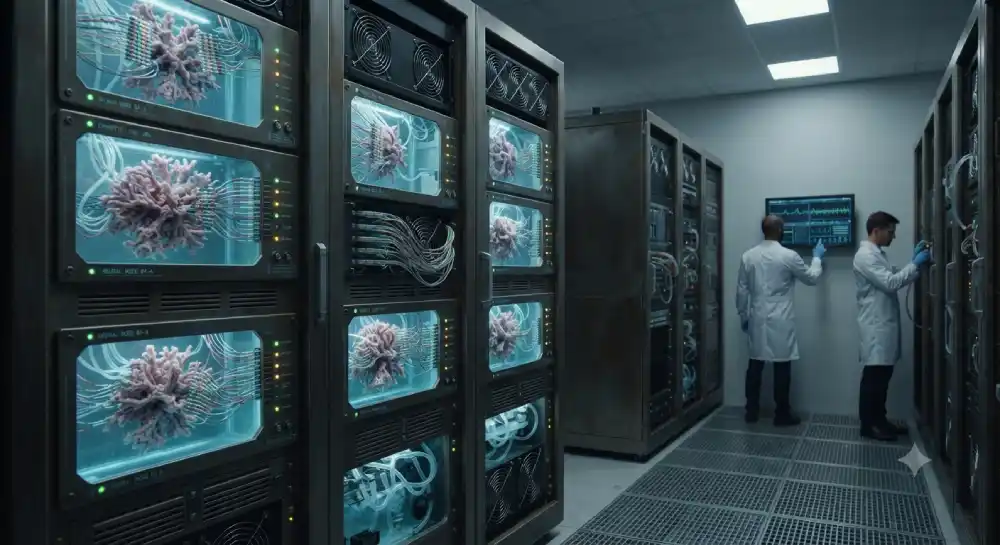
Singapore has built a data center where the processors are alive. At the National University of Singapore, a server rack now contains 20 biological computing units made by Australian startup Cortical Labs, combining conventional silicon hardware with lab-grown human neurons. The system has been described as the world’s first independently operated biologically integrated server rack, and widely reported figures put the total at around 16 million living neurons.
That sounds like something that should be sitting inside a science-fiction laboratory rather than a data centre, but the hardware is very real. The neurons are grown from stem cells and connected to silicon chips through tiny arrays of electrodes, allowing computers to send electrical signals into the cells and read their responses. The project brings together NUS Medicine, data centre operator DayOne and Cortical Labs, with one rather unusual goal: finding out whether future computing can run partly on biology instead of endlessly adding more silicon.
The Server Rack Is Actually Alive
The idea behind the system is called biological computing, or wetware computing, and it takes a radically different approach to the problem that has been driving the AI industry into ever larger data centres. Instead of building increasingly powerful chips that imitate some of the behaviour of a brain, Cortical Labs puts actual living neurons onto a silicon platform. The cells receive electrical stimulation, respond through their own neural activity and send signals back into the computer.
Cortical Labs says its CL1 is designed as a closed-loop system, with software creating an environment in which the neurons can interact and learn. The company has previously demonstrated neurons playing Pong and Doom, but the Singapore project is about taking that strange experiment out of a laboratory dish and putting it into something resembling actual computing infrastructure. Twenty CL1 units now sit together in a rack at the NUS Life Sciences Institute, where researchers can study what happens when living neural networks become part of a larger computing system.
Someone Has To Feed The Computers
There is, however, one immediate difference between these servers and the machines filling conventional data centres: the biological ones need to be kept alive. The neurons sit in a nutrient-rich environment, with the CL1 providing the life-support systems required to maintain the cultures. Cortical Labs says its system can keep the neurons viable for up to six months, which creates a rather bizarre maintenance schedule for a data centre.
NUS researchers are responsible for culturing and caring for the cells, under the supervision of neuroscientist Professor Rickie Patani. This is also why calling the system a replacement for Nvidia GPUs would be getting ahead of the technology. The biological rack still relies heavily on silicon, electronics, software and specialised infrastructure.
What changes is the thing doing some of the information processing. Instead of asking a transistor to imitate a biological neuron, the system puts a living neural network into the loop and lets its natural ability to adapt become part of the computation.
Why Put Human Neurons In A Data Center?
The pitch becomes more interesting when you get to energy. AI data centres are consuming enormous amounts of electricity, while Singapore is trying to expand its digital infrastructure without allowing energy efficiency to become an afterthought. DayOne and Cortical Labs are therefore exploring whether biological computing could handle particular workloads while using substantially less power than conventional systems. The companies are not suggesting that living neurons will suddenly replace every server running cloud software.
Instead, they are looking for jobs where biological systems might have an unusual advantage, particularly situations where there is limited training data or where systems need to adapt to changing conditions. Proposed areas include drug discovery, biomedical modelling, neurological research, robotics, cybersecurity and fraud detection. The attraction is that neurons already evolved to learn from relatively small amounts of information and continuously adapt. The challenge is turning that biological trick into something engineers can reliably deploy, measure and scale.
The Brain In Your Server Rack Is Still Tiny
And there is an important reality check hidden inside the spectacular numbers. Sixteen million neurons sounds enormous until you remember what a human brain contains. The often-repeated Singapore figure comes from the reported 20 CL1 units and the roughly 800,000 neurons associated with each unit, producing the headline total of about 16 million.
However, NUS has also described CL1 units as containing at least 200,000 neurons, while other reporting has noted that current and earlier configurations have differed. So the exact number of living cells in the Singapore rack should not be treated as a laboratory-measured total carved in stone. What matters more is what those cells can actually do. The project is still a prototype, and the partners are trying to determine which workloads benefit from biological processing and whether the technology can move beyond controlled research environments.
DayOne and Cortical Labs have discussed eventually scaling the concept, but any larger deployment would depend on technical validation and regulatory approvals.
The Next Data Center Might Need A Biologist
That is what makes the Singapore project so strange. The data centre industry has spent years trying to make servers faster, denser and more efficient, with increasingly exotic cooling systems and enormous amounts of electricity feeding increasingly enormous AI workloads. Now one group is asking whether part of the answer is to stop trying to make computers behave like brains and simply put brains into computers.
The Singapore prototype is still far from becoming a replacement for a conventional AI data centre, and nobody is suggesting that racks of neurons will start training the next frontier model tomorrow. But it represents a shift from biological computing as an experiment on a lab bench toward biological computing as infrastructure.
If the researchers can demonstrate useful workloads that living neural networks perform efficiently, the humble server rack could eventually become a much stranger machine: part computer, part laboratory and part living system. And yes, somebody will still have to remember to feed the servers.
In case you missed:
- Huawei Is Coming for Nvidia Now. Its New AI Chips Arrive in 2027
- ISRO’s Next Big Plan: To Put Indian Data Centres in Space!
- You Can Now Host an NVIDIA Data Centre in Your Home. Some Neighbours Already Want Them Gone.
- Goodbye Blackwell, Hello Rubin: Nvidia’s new AI platform is here!
- NVIDIA’s Taiwan Problem: The AI Boom Is Now Dependent on One Island
- Tata Electronics to Manufacture Intel Chips & AI Laptops in India!
- Japan just made Remote Quantum Computing a reality!
- Aatmanirbhar Push: India Becomes 7th Nation to Crack Gallium Nitride Chip Technology
- India’s Mappls Revolution: The Swadeshi Push to Dethrone Google Maps
- Colossal Hatches 26 Chicks From 3D-Printed Eggs: Dodo and Moa Next?