





Most Indian drone startups buy parts and write software, but Airbound did the unthinkable: it did the physics and created a global drone brand, writes Satyen K. Bordoloi
The last time an Indian working in India won a Nobel Prize in science – Physics, Chemistry, or Medicine – was 96 years ago. To add insult to injury, C. V. Raman’s 1930 triumph had come under British rule. Three more Indian-origin scientists have won since: Hargobind Khorana, Subrahmanyan Chandrasekhar, and Venkatraman Ramakrishnan, but all three worked outside India and weren’t even Indian citizens when they were honoured. That’s the uncomfortable truth about Indian science: eight decades after independence, we continue to produce world-class minds – they just can’t seem to flourish if they stay in India.
The reasons aren’t rocket science: inadequate attention to basic research, low levels of public funding, excessive bureaucracy, and a decay of research capabilities in universities have regularly been cited as the culprits strangling India’s scientific potential. Few institutions engage, or even inspire students to go for cutting-edge research, and the number of researchers as a proportion of our population is five times lower than the global average. Thus, the pool from which a potential Nobel winner, or even a truly brilliant scientific or technical mind, can emerge is woefully small.
And even when they do emerge, most leave. Because why wouldn’t they go to a nation that has better scientific facilities? Indian science is thus a swamp – we produce brilliance, but then either throttle it or export it. That’s why India’s national flower is the lotus, and just like the flower, even in the most dreadful of swamps, sometimes, improbably, a pushp (flower) grows.
The Kid Who Started at Fifteen
It was the COVID-19 lockdown. Teens across the nation were busy playing online games, sleeping, or just having whatever fun they could in the constrained times. But one Bengaluru teen, Naman Pushp – all of 15 – was busy tinkering with his passion – building a workable drone. He won a hackathon, and even secured admission to Carnegie Mellon University. But he refused to go, and by 20 had founded Airbound, an aerospace company that is doing something almost unheard of in Indian hardware: building breakthrough technology entirely from scratch instead of assembling imported parts and calling it innovation.
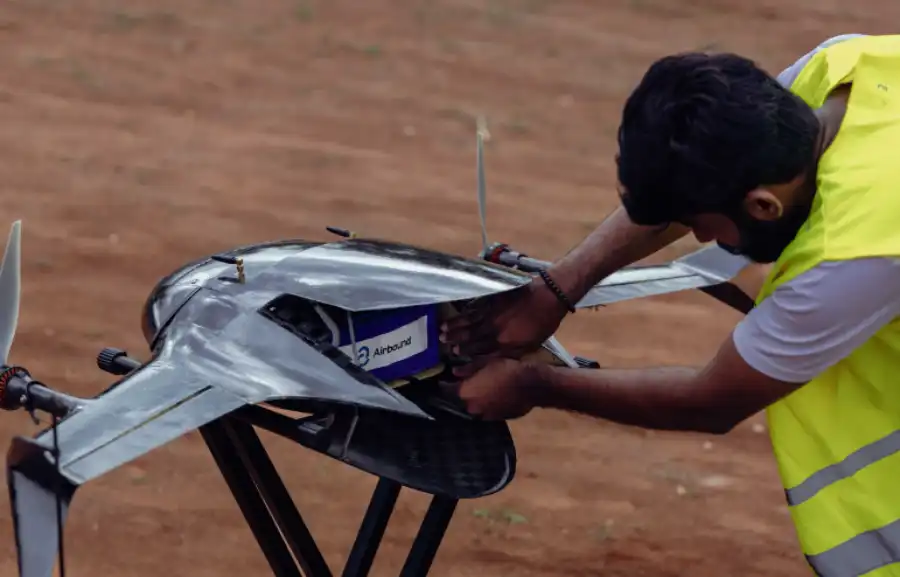
What most Indian drone startups do is focus on logistics software or repurpose off-the-shelf quadcopters. Airbound has gone the opposite way, developing a proprietary “blended-wing body tailsitter” aircraft, a design that sounds like aerospace jargon but is something truly rare in Indian deep tech: original physics-first engineering.
The concept is not just smart, but sheer elegance. Conventional drones are inefficient because they expend too much energy just carrying their own weight. Airbound’s solution was to design vertical-flight drones that weigh less than the cargo they’re carrying. The current aircraft, called TRT, weighs about 3.3 pounds and carries around 2.2 pounds of payload: one of the best payload-to-aircraft ratios among drones in the world. The next version, already in development, is expected to carry 11 pounds on a weight of about 6.6 pounds, an embarrassingly good ratio- perhaps the best in the world.
TRT’s design mixes vertical takeoff and landing capability of a helicopter with the aerodynamic efficiency of a fixed-wing aircraft; i.e., it takes off upright, like a rocket, then transitions to horizontal flight like a plane. There’s no need for a runway or a complex tilt-rotor – yet it creates a fundamentally better aircraft.
And it works.
A Thousand Missions Before Anyone Noticed
Naman hasn’t been giving TED talks about the future of logistics. Instead, he’s been flying it. Not gyan-only groundwork; that seems to be Airbound’s mantra.
The company has completed over 13,000 autonomous flights across Bengaluru and Guntur in Andhra Pradesh. That includes over a thousand flights with Narayana Health, where its drones transport diagnostic samples between healthcare facilities. On one route, its drone flies samples about 2.5 miles in around seven minutes. The same samples take three to five hours to be transported by two-wheelers when you factor in the time spent waiting for enough samples to be bundled for road transport because of cost and other factors.
The partnership is expanding. Narayana Health’s new Banashankari Hospital in Bengaluru was designed without an on-site diagnostic lab or blood bank. It will rely entirely on Airbound’s drones to connect with centralised facilities. When a hospital building is designed around a particular technology, it is no longer a pilot project of a kid, but vital infrastructure saving lives.
Airbound has also signed an agreement with the Andhra Pradesh government to build a drone delivery network connecting Guntur, Vijayawada, and Amaravati, with an eventual target of 10,000 flights a day. The agreement is minus the government contract or subsidy and the red tape that goes with such contracts. The state is working with the company on the regulatory framework needed to enable the network, with the business coming from companies using it for deliveries.
This is the part that is stunning for an Indian startup: Airbound isn’t building a demo for a grant application but already building a full-fledged business.
$50 Million and a Bigger Ambition
In August 2026, Airbound announced a $37 million Series A round led by Greenoaks, with participation from DoorDash, Lachy Groom, Lightspeed, and Humba Ventures. Combined with an earlier $8.65 million seed round, the company has already raised nearly $50 million since its 2023 launch.
The money is meant to fund engineering, commercial-scale manufacturing, and go-to-market efforts. But Pushp has made clear that the ambition extends far beyond small delivery drones. “We’re basically building a template for better aircraft,” he told Moneycontrol.
His near-term plan is to expand into quick commerce, e-commerce, and food delivery: that’s where the revenue will come from. But the long-term plan is R&D, where Airbound will keep building larger aircraft that can eventually carry people. Pushp wants to retain vertical takeoff and landing even as it develops larger aircraft, to avoid dependence on runways. “We want to build towards a world where everything has cost parity with trucking,” he has said. It’s no longer a startup pitch; it has the sort of ambition and work to show for it that India has rarely seen.
Why This Matters
India’s drone ecosystem is not only growing, but is a success story. Startups like Skye Air Mobility, TSAW Drones, and Garuda Aerospace are building aerial logistics businesses with the government pushing drone manufacturing and easing regulations. But most of this activity is about assembling and deploying technology that already exists. Airbound is the only one that seems to be doing something truly different: designing the aircraft itself, manufacturing key components in-house, and building a physics-first manufacturing stack that they could then scale to larger autonomous systems.
We haven’t seen this often in a nation known for jugaad, but I believe this is what indigenous engineering would look like if and when it actually happens. One that does not rely on repackaged imports, but on original hardware, physics and manufacturing. Make in India? Naman and Airbound show we can do science in India as well.
India has quietly wept as our system both forced and facilitated brain drain of scientists into better-funded labs in the West. Hence, the lack of global science awards is not an accident, but a symptom of a system that doesn’t work. A company like Airbound doesn’t solve that problem because no single company can. But it represents the fact that when Indian science is given the chance to happen in India, under Indians, we can still produce something genuinely new.
Naman Pushp didn’t go to MIT, refused a Carnegie Mellon offer and went on to build a company at 20 that is the toast not just of Bengaluru, but the world. This proves one thing: the swamp is real; so is the drought. But every once in a while a ‘pushp’ will grow in it anyway.
Maybe, one day, enough will grow to turn it into a garden.
In case you missed:
- How Can Indian AI Startups Access Global VC Funds?
- Indians Using AI For Faster, Better Work: But Psst.. Don’t Tell The Boss
- The B2B AI Revolution: How Enterprise AI Startups Make Money While Consumer AI Grabs Headlines
- How India Can Effectively Fight Trump’s Tariffs With AI
- The AI Peace Race: Why India’s Real Opportunity Starts Where the Arms Race Ends
- With AI Set to Destroy Millions of Indian Jobs, Traditional Career Advice is a Death Trap
- OpenAI, Google, Microsoft: Why are AI Giants Suddenly Giving India Free AI Subscriptions?
- Not Fastest, but Frugalest: Why Indian EVs Are Suddenly World-Class
- Great quantum poker: Who’s bluffing, and who is holding the aces?
- No, AI Didn’t Unleash a Virus on the World: It Might Have Done Something Far More Terrifying – Save It