



When a man in a religious robe understands AI better than techies in hoodies, something has gone profoundly right – and wrong – with our world, writes Satyen K. Bordoloi
When I heard that Pope Leo XIV had written an encyclical on artificial intelligence, my first, reflexive instinct was not to bother. I am an atheist. What do I have to do with a religious man’s thoughts on AI? Then again, I am also perennially curious about anything AI. And the combination of a man who derives his authority from an invisible deity, speaking about the most material, most secular technology ever built, was a lure too hard for me to say: “Lord, lead me not into temptation.”
So, I read it here. I skipped through the initial and end portions (which are most of the document) about Christian mythology and doctrine, and focused more on the points about AI that begin from about paragraph 90. After reading it, I find myself saying something I did not expect to ever say, something that is Silicon Valley blasphemy: Pope Leo XIV understands AI better than most people building it.
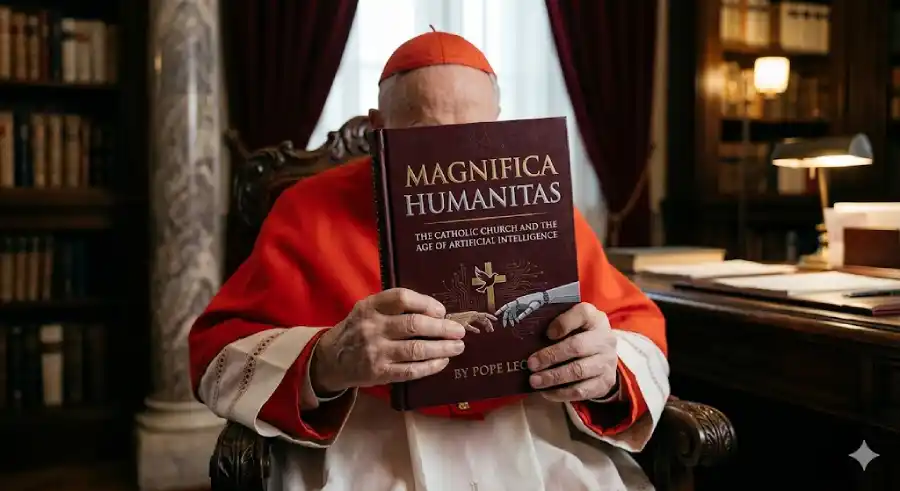
The document is called Magnifica Humanitas – the Magnificence of Humanity. It arrives exactly 135 years after Leo XIII published Rerum Novarum, which addressed the social catastrophe of industrialisation and gave the world what the Church calls its Social Doctrine. Leo XIV might be a servant of god, but he has given in to the temptation of the ambition of deliberately choosing that date for a key reason: I suspect he wants to do for the age of AI what his predecessor, from whom he took his name, did for the age of the factory.
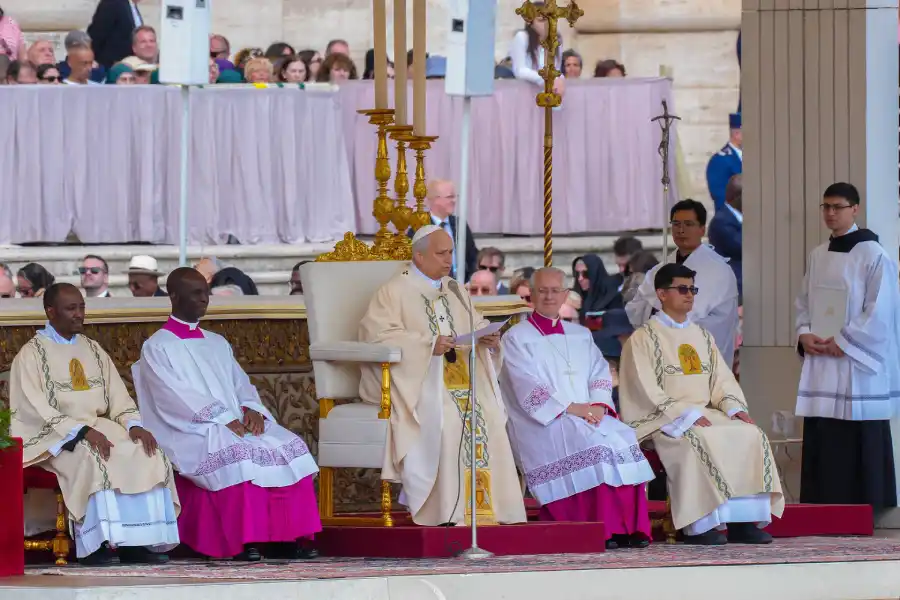
What strikes you first about the document is that he is not doing the thing most institutional leaders usually do when confronted with disruptive technology, which is to either bless it unconditionally or condemn it theatrically. He does neither and strives for a tricky balance. He acknowledges immediately that “any statement regarding AI risks becoming quickly outdated, given the remarkable pace at which these systems are developing.”
That is more intellectual humility than you will find in most AI conferences, congressional hearings, or even with someone like me. He is not pretending to have solved a problem he – and the world – has barely begun to understand. He is naming the difficulty of the exercise while trying to address it anyway.
His definition – or rather, his deliberate refusal to offer a single comprehensive definition of AI – is where he earns genuine respect. In paragraph 99, he writes something that I challenge any AI researcher to disagree with: these systems “do not undergo experiences, do not possess a body, do not feel joy or pain, do not mature through relationships and do not know from within what love, work, friendship or responsibility mean.” They may “imitate language, behavior and analytical skills, or even simulate empathy and understanding, but they do not understand what they produce.” Touché, dear Pope. Touché.
The AI industry has spent considerable time and effort to muddy exactly this point. Anthropomorphic language – as I have often complained – is not accidental because it sells products, attracts investment, and generates headlines. When a chatbot is described as “thinking” or “feeling,” it is a deliberate marketing choice to sell more of whatever is on display.
The Pope, with no product to sell and no stock options to divest (unless you consider every religious guru a peddler of their religion), cuts through this with a charity that is truly.. delightful.
But the more practically interesting insight – the one that surprised me most – is his reading of how AI reshapes ordinary people’s relationship with knowledge and judgment. He identifies three specific dangers in personal use of AI: “the ease with which results are obtained, the impression of objectivity and the simulation of human communication.” I was surprised because he is neither peddling grand civilisational risks, nor AI’s existential threats (remember Geoffrey Hinton).
He is pointing a finger at the quiet erosions that AI enables daily. Like how instant answers dull our habit of inquiry. Or how a confident, well-formatted response creates the illusion of truth even though it might be the greatest hallucination. Or how a machine that seems to mimic warmth can substitute for actual human connection without the user ever noticing the replacement (AI girlfriends, anyone?). This, to me, is a more pointed criticism – minus the needless fearmongering – than most AI ethicists manage in entire careers.
He also says something that cuts across political lines in a way that should make both Silicon Valley enthusiasts and government regulators uncomfortable: “as with every major technological shift, AI tends to amplify the power of those who already possess economic resources, expertise and access to data.” This is not socialism (though I believe Jesus and the gods of most religions were socialists) but an accurate observation.
The Pope is simply pointing out that the history of technology is a history of leverage, which mostly accumulates at the top. His warning about what he calls the “Babel syndrome” – the worship of profit that sacrifices the weak, the uniformity that flattens difference, and the pretence that a single digital language can “translate everything, including the mystery of the person, into data and performance” – is an apt description of what platform monopolies in AI have already done to public discourse, and what is only accelerating in a world under AI systems.
Of course, I do not fully agree with the Pope. Where I disagree with him most is when he points to theology as a prescription. Calling for AI development “in fidelity to the Gospel” is the point at which the framework closes in on itself for me. The Gospel is not a product roadmap, and the billions of people who will be affected by artificial intelligence, other than Christians, like say Hindus, Buddhists, Muslims, etc., do not share the same mythological worldview.
The Pope’s framework is consistent within its own premises, but those aren’t universal. You cannot build a global AI governance ideology on the Book of Nehemiah. You need something that everyone – secular democracies, Muslim-majority nations, Hindu nationalist governments, and Chinese technocrats can all, however reluctantly, agree to sit around.
That said, his failure to offer a universal solution does not invalidate the diagnosis. The Pope is extraordinarily good at naming what is wrong. He is less convincing about who gets to fix it and under whose authority.
Yet, what I tip my hat to is that Magnifica Humanitas exists at all. The man could have sat quietly with his rosary, beautiful house, popemobile, and his 1.4 billion followers and left the messy business of AI to the engineers, the regulators and the think tanks. Instead, he chooses to engage with the hardest questions of our moment, in public, in writing, with his name on it. And that he does so while acknowledging complexity, resisting the temptation of easy answers, and also refusing to call AI either a miracle or a catastrophe, is truly praiseworthy.
There is something clarifying about hearing from a voice that has no financial stake in the outcome. Perhaps that’s why it can say: slow down, think harder, and do not mistake the simulation of wisdom for the real thing.
I do not share his faith. But I have lived long enough to know that even crooked logs can give straight fires. The Pope, in his 38,000 words, has lit one. I hope heads of other religions – those of the Hindus, Muslims, Sikhs, Buddhists, etc. – will also try to do the same.
In case you missed:
- GoI afraid of using foreign GenAI in absence of Indian ones? Here’s how they still can
- The Verification Apocalypse: How Google’s Nano Banana is Rendering Our Identity Systems Obsolete
- What The First Fully AI Film To Enter A Major Festival Says About AI Filmmaking’s Future
- The AI Peace Race: Why India’s Real Opportunity Starts Where the Arms Race Ends
- Have We Already Built AGI, Are Using It, But Just Don’t Call It That?
- Not Fastest, but Frugalest: Why Indian EVs Are Suddenly World-Class
- Reviving Old Research With AI: How It Can Transform The World
- Does your company need AI or simple automation? Don’t spend more on wrong solutions
- 75 Years of the Turing Test: Why It Still Matters for AI, and Why We Desperately Need One for Ourselves
- The AI Prophecies: How Page, Musk, Bezos, Pichai, Huang Predicted 2025 – But Didn’t See It Like AI Is Today