



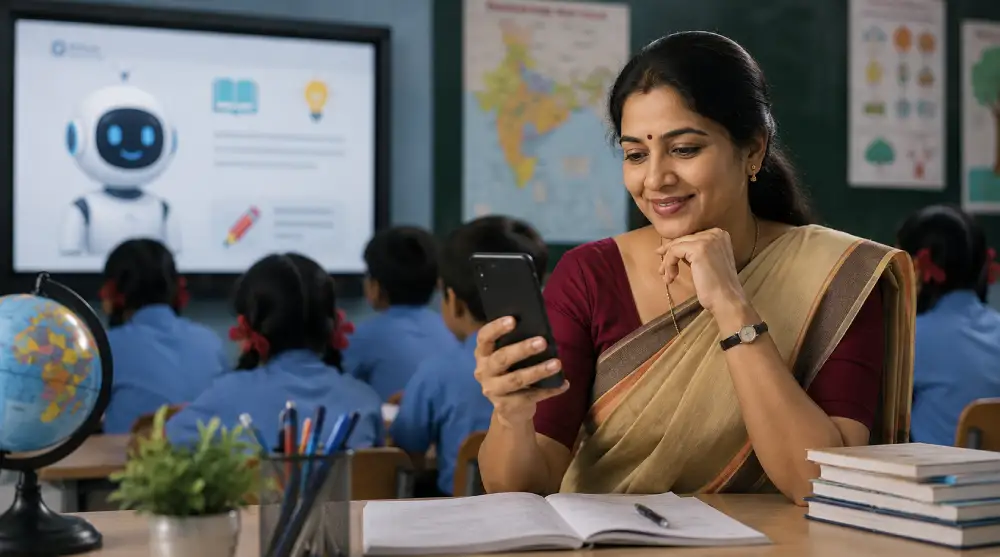

Google has launched ATL Saathi, a Gemini-powered AI assistant designed to help Indian teachers plan lessons, create classroom activities and bring cutting-edge technology into thousands of schools.
Google has unveiled ATL Saathi, a new AI app designed to help teachers across India run more engaging science and technology classes. Announced at Google I/O Connect India 2026, the Gemini-powered assistant can help educators put together lesson plans, dream up classroom activities, create quizzes and guide students through hands-on innovation projects.
The app has been built in partnership with the Atal Innovation Mission (AIM) under NITI Aayog, making it one of Google’s first AI tools created specifically for India’s school ecosystem. More importantly, it offers a glimpse of how the company thinks AI will be used in classrooms, not as a replacement for teachers, but as something that helps them spend less time preparing lessons and more time actually teaching. More importantly, it reflects a much broader trend.
Rather than asking whether AI can replace teachers, companies are increasingly asking how it can help them teach better.
An AI Assistant for the Classroom
Google just gave teachers in India free AI tools, and every classroom could change because of it
ATL Saathi has been built primarily for teachers running Atal Tinkering Labs (ATLs), the innovation labs established in schools across India to encourage students to experiment with robotics, electronics, coding, artificial intelligence and design thinking. Since their launch, more than 10,000 Atal Tinkering Labs have been set up across the country, reaching millions of students and becoming one of India’s biggest efforts to promote scientific curiosity and innovation at the school level.
Yet many teachers running these labs are not specialists in every emerging technology they are expected to teach. That’s where Google believes AI can make a difference. Powered by Gemini, ATL Saathi is an on-demand classroom companion that helps teachers in preparing lessons, explaining difficult concepts, generating quizzes, suggesting hands-on activities and even recommending project ideas for different age groups.
Unlike a general-purpose chatbot, ATL Saathi has been built around the kinds of questions teachers actually ask every day. Someone preparing for class could ask it to plan a robotics lesson, explain artificial intelligence to a room full of 12-year-olds, generate a quiz, come up with a hands-on classroom activity or even suggest science experiments that match a particular age group. Teachers running Atal Tinkering Labs often find themselves covering subjects ranging from coding and electronics to AI and design thinking, even if they are not specialists in every field. Google says ATL Saathi is designed to fill those gaps by acting as an on-demand classroom assistant, helping educators spend less time searching for resources and more time working directly with students.
Google’s Bigger India Bet

The launch also says a great deal about Google’s changing priorities. India is no longer simply a massive market where global technology companies release products built elsewhere. Increasingly, it has become a country where AI tools are being designed specifically for local needs. ATL Saathi was one of several India-focused announcements made during Google I/O Connect India, alongside initiatives aimed at developers, startups and the country’s expanding AI ecosystem.
The company also unveiled new AI programmes for developers and startups, reinforcing a message that India is no longer just a market for Google’s products but an increasingly important place where new AI tools are being built, tested and rolled out first. By working directly with the Atal Innovation Mission and NITI Aayog, Google is embedding itself within one of India’s most ambitious education programmes rather than offering a generic AI service to schools.
That strategy makes sense when viewed against India’s rapidly growing digital ambitions. The country has invested heavily in promoting innovation among students, encouraging schools to expose children to coding, electronics, robotics and problem-solving from an early age. At the same time, artificial intelligence is becoming an increasingly important skill across industries, creating pressure on schools to prepare students for careers that barely existed a decade ago.
Giving teachers access to AI tools could help bridge that gap, particularly in schools where specialist resources are limited. Rather than replacing existing education programmes, Google appears to be positioning Gemini as a layer that makes them more effective.
Teaching the Next Generation of Innovators
ATL Saathi is another reminder that the next phase of artificial intelligence may not be about replacing people at work but helping them do their jobs more efficiently. Teachers still lead the classroom, answer questions, inspire students and adapt lessons to individual needs. AI simply takes over some of the repetitive tasks that consume valuable time behind the scenes.
If Google’s experiment succeeds, millions of Indian students could benefit from richer lessons, more engaging classroom projects and greater exposure to emerging technologies without requiring schools to completely rethink how they teach. As AI continues to move beyond chatbots and into everyday professions, the classroom may become one of the places where its impact is felt first, not because teachers are being replaced, but because they are finally getting an assistant that never gets tired.
In case you missed:
- India’s Mappls Revolution: The Swadeshi Push to Dethrone Google Maps
- These Indian Workers Are Teaching Robots How to Be Human
- No Internet, No Cloud: India’s ‘BharatGPT’ Is Taking a Different AI Path
- Malware with AI-Powered Code Mutations: Google Sounds the Alarm!
- Truecaller vs TRAI: Why India’s Biggest Caller ID App Is Fighting Back
- Huawei Is Coming for Nvidia Now. Its New AI Chips Arrive in 2027
- Singapore Just Built a Data Center With 16 Million Living Human Neurons
- Deepfake Politics: How AI Could Undermine the World’s Largest Democracy
- Tata Electronics to Manufacture Intel Chips & AI Laptops in India!
- QpiAI Unveils Kaveri, India’s First Aatmanirbhar 64-Qubit Quantum Chip