


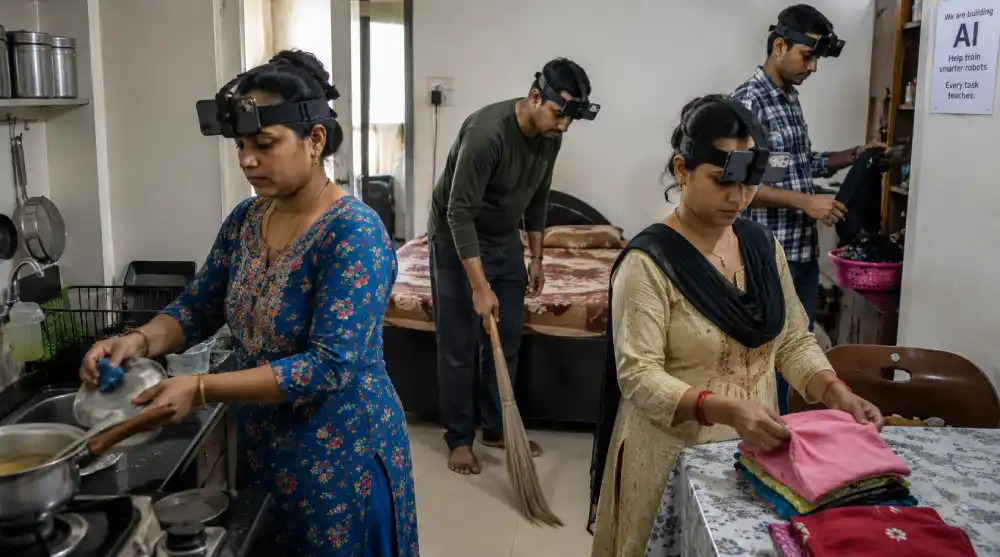

Indian workers are being paid around ₹250 an hour to wear cameras and perform household chores so AI systems can learn how to behave like humans.
A growing industry is paying workers about ₹250 an hour to wear cameras and teach robots how to clean, cook, and move through the world. The irony is impossible to miss: people are helping build the systems that may eventually automate their own jobs.
The New Teachers of AI
In offices and training facilities across India, workers are spending hours performing ordinary tasks while wearing head-mounted cameras and motion-tracking equipment. They fold clothes, wipe tables, open doors, arrange objects, and move through rooms exactly as they would at home. Every gesture is recorded. Every movement becomes data. The footage is then fed into artificial intelligence systems and humanoid robots that are trying to learn how humans interact with the physical world. The workers earn roughly ₹250 per hour for the job, according to reports from India Today and other outlets.
What makes the story remarkable is not the technology itself, but the reversal of roles. Instead of machines replacing workers from a distance, workers are actively teaching machines how to do the work. The training process turns everyday human behaviour into one of the most valuable raw materials in the AI economy.
The demand exists because AI has reached a new frontier. Large language models learn from books, websites, and digital conversations, but robots cannot learn to wash dishes or sort laundry from text alone. They need examples of real people performing real tasks. That has created a growing market for first-person video, motion capture, and behavioural data. In effect, companies are trying to build a library of human experience that machines can study.
India is becoming an important source of that data because of its large workforce, growing technology sector, and relatively low training costs. The workers participating in these projects are not necessarily programmers or engineers. Many are ordinary people hired specifically to demonstrate routine activities that most of us perform without thinking. Those demonstrations may eventually help create robots capable of performing the same tasks autonomously.
Training the Physical World
The work looks deceptively simple. A worker might spend an afternoon repeatedly picking up household objects, placing them on shelves, or navigating around furniture. Yet those actions provide information that is difficult for machines to obtain in any other way. Humans unconsciously adjust grip strength, body position, and movement speed depending on the object and environment.
Capturing those subtle behaviours is crucial for building robots that can operate safely and effectively in homes, hospitals, warehouses, and factories. The data can help AI systems understand how to manipulate objects, avoid obstacles, and coordinate complex sequences of movement. Researchers often describe this as giving robots a kind of practical common sense about the physical world.
The process is labour-intensive precisely because human behaviour is far more nuanced than a simple set of instructions. What seems obvious to people is often extremely difficult for a machine to learn.
There is an irony that hangs over the entire industry. Many of the tasks being recorded, such as cleaning, sorting, moving items, and basic household chores, are exactly the kinds of jobs that companies hope future robots will automate. The workers collecting the data understand this. Some see the work as a temporary opportunity in a rapidly changing economy. Others view it as a chance to participate in an emerging industry before the technology becomes widespread.
Economists have long argued that automation creates new jobs even as it eliminates old ones, but that transition can be uneven and painful. This story captures that tension in a particularly vivid way. Workers are earning money today by helping machines learn skills that could reduce demand for similar human labour tomorrow. It is a snapshot of technological change happening in real time, with humans acting as teachers training their own replacements.
When the Student Becomes the Worker
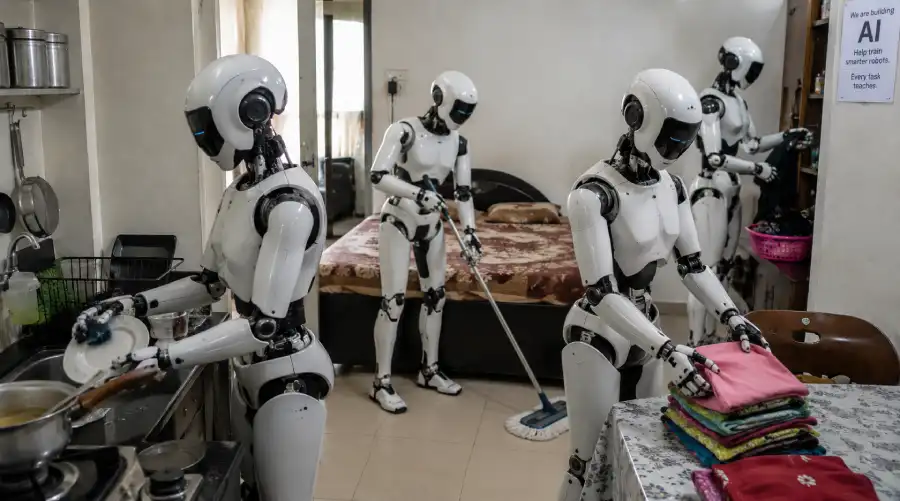
The bigger significance goes beyond wages or individual jobs. Artificial intelligence is moving from the digital world into the physical world. Chatbots can answer questions, but robots must learn how to grasp objects, navigate cluttered rooms, and interact safely with people. That requires a new kind of training data, one built from human actions rather than human words.
India helped supply much of the labour that powered earlier waves of data annotation and content moderation. Now it may play a similar role in teaching machines how to move, work, and live among us. Whether that ultimately creates more opportunities than it destroys remains an open question.
What is clear is that the next phase of AI is no longer just about software. It is about teaching machines to behave like humans, and many of those lessons are currently being delivered by Indian workers wearing cameras on their heads.
In case you missed:
- RentAHuman.ai: The Big Uno Reverse as AI Hires Humans to Get Work Done
- While Bezos Bets $100 Billion on Physical AI, His Top AI Picks Walk Away to Model the Universe
- Amazon Caught Destroying Rare Books to Feed AI: Historians and Book Lovers Furious
- Japan just made Remote Quantum Computing a reality!
- FIFA 2026: How AI Is Taking Over the World’s Biggest Sporting Event
- Moltbook: AI agents now have their own Reddit, and humans aren’t allowed to post!
- GPT-6 Astra Is Here. OpenAI Says the AGI Era Has Begun
- AI vs Your Poker Face: The Battle Unfolding at ESPN’s World Series of Poker 2026
- Google Launches ATL Saathi: An AI App for India’s Teachers
- Goodbye Blackwell, Hello Rubin: Nvidia’s new AI platform is here!