



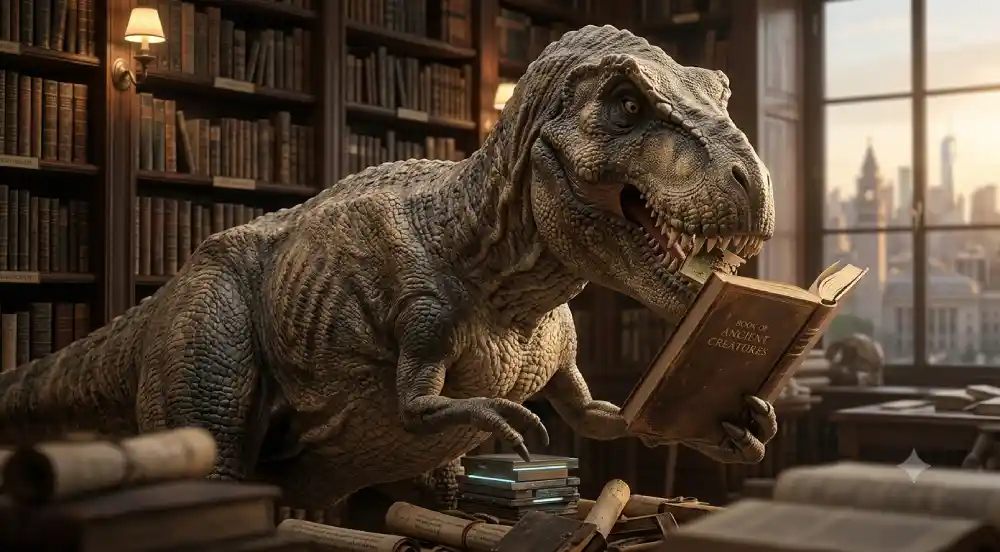

A suspicious order for 1,000 rare books led 404 Media to hide an AirTag inside one. It travelled across America and ended up at an Amazon facility where workers reportedly cut books apart and scan them for AI training.
Amazon was once best known as the internet’s giant online bookstore. Now, according to a new investigation, the company is buying thousands of them only to cut them apart and feed their contents into artificial intelligence systems. The strange operation was uncovered by 404 Media after a bookseller received an anonymous order for around 1,000 obscure books and became suspicious about where they were going. Instead of simply shipping the books and hoping for the best, the bookseller agreed to hide an Apple AirTag inside one of them.
Reporter Emanuel Maiberg then followed the tracker’s journey across the United States. It eventually led to an Amazon facility in Las Vegas, where employees say their job is to take printed books, remove their bindings and scan the pages before the physical copies are destroyed. Even the team’s logo appears to know exactly what is happening: a Tyrannosaurus rex clutching a book in its jaws.
The AirTag That Followed the Books
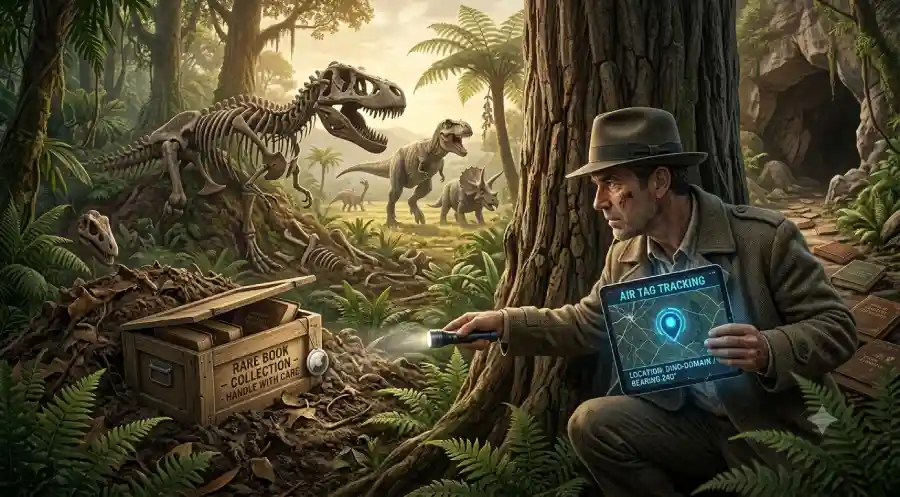
The investigation began with a very unusual order. A bookseller using Biblio, a marketplace where buyers can remain anonymous, received an order for roughly 1,000 books. The selection wasn’t made up of obvious bestsellers. The order included rare and hard-to-find books, and the buyer was willing to purchase them in bulk without the kind of bargaining normally associated with sales of this sort.
Booksellers had already been noticing strange orders like this and suspecting that AI companies were behind them, but there was a problem: nobody knew where the books were actually going. 404 Media decided to find out. The bookseller agreed to put an Apple AirTag inside one of the books and send it along with the rest of the shipment.
The little tracker then became a rather unlikely detective. The book travelled from California to a distribution facility near Milwaukee before eventually making its way west to Las Vegas. Its final destination was an Amazon warehouse known as LAS8. At first, that didn’t necessarily prove anything.
LAS8 is associated with Amazon’s print-on-demand operation, which would seem like the opposite of a place where old books are destroyed. However, the investigation found that part of the facility operates under the internal team name VGT3, and workers associated with the operation described something very different. They said massive shipments of printed books arrive there, workers remove the bindings to make scanning faster, and the books are destroyed in the process.
Welcome to VGT3, Where Books Go to Die
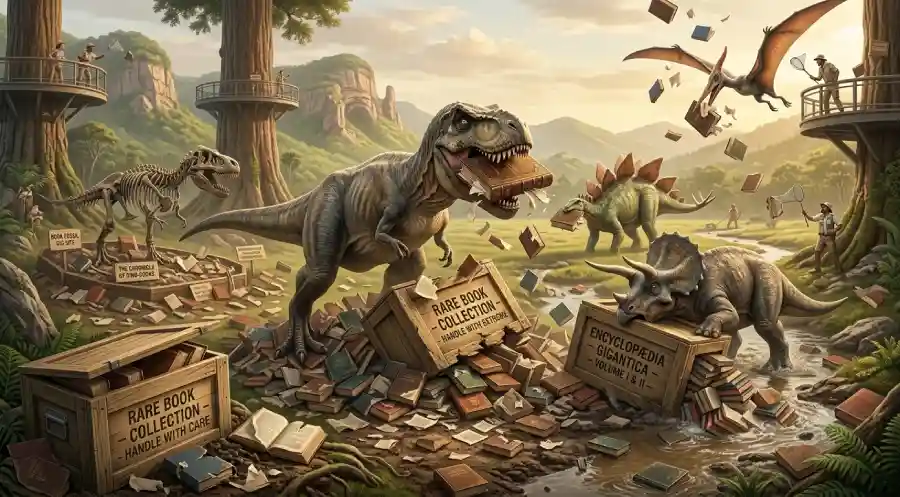
The details from inside the operation are almost too perfect for a story about AI eating books. According to employees cited by 404 Media, some workers are assigned to cut books while others receive shipments and scan barcodes. The bindings are removed because a book is much easier to process when its pages can be separated and fed through scanning equipment quickly.
Once the text has been converted into digital data, there isn’t much reason to keep the original physical copy around. The book that may have survived for decades can effectively become a pile of paper destined for destruction. One Amazon employee reportedly described the work bluntly: “all we do is scan books.”
And then there’s the logo. The VGT3 team reportedly uses a cartoon T. rex holding a book, looking like it is about to munch through the pages and destroy it. It’s the sort of corporate branding that would seem ridiculous if it weren’t sitting above an operation that literally cuts books apart for scanning.
The logo has since become one of the most shared images from the story, partly because it makes the whole thing look like a dystopian joke. But the underlying reason for the operation is very real: AI companies need enormous quantities of high-quality text, and much of the internet has already been scraped, licensed or otherwise consumed for model training. Rare and obscure books offer something increasingly difficult to find online.
Why Does AI Want Old Books?
The word “rare” needs a little explanation here. These aren’t necessarily priceless first editions sitting in museum collections. The report says it isn’t publishing the titles from the tracked shipment, but the books are considered rare because relatively few copies remain in circulation. Some may have had limited print runs, while others are difficult to find because they were published in languages with relatively small audiences. That doesn’t necessarily make every book financially valuable, but it does make the information inside it harder for an AI company to obtain through ordinary web scraping. And that is precisely what makes these books attractive.
There is another reason older books are particularly interesting to AI companies. Older books also have another attraction: their text predates the explosion of generative AI and is therefore far less likely to contain AI-generated material. That matters because researchers have warned that repeatedly training models on AI-generated material can contribute to model collapse, where the quality and diversity of future AI output deteriorates.
A rare book published decades ago is therefore not just another collection of words. It can be a source of human-written material that hasn’t already been swallowed by the AI ecosystem. Tech companies are increasingly hunting for exactly that kind of data as the easy-to-find material on the internet becomes harder to turn into a competitive advantage.
Amazon Isn’t the Only One Doing It
Amazon is also not operating in a vacuum. Other AI companies have been buying physical books for the same basic reason: they want the text. Anthropic has already faced scrutiny over its efforts to acquire and digitise huge numbers of books for AI training, including an operation in which legally purchased books were digitised and, in some cases, physically destroyed after scanning. The difference with the Amazon story is the detective work.
Until 404 Media followed an actual shipment using an AirTag, booksellers had suspicions about where their unusual bulk orders were going but had little concrete evidence about the final destination.
While Amazon has not explicitly confirmed that the specific operation identified by 404 Media is being used to train AI models, the investigation and employee accounts point strongly in that direction. The strange thing is that the technology industry spent decades turning physical information into digital information so it could preserve and distribute it. Now AI has created a new demand for that information, and the fastest way to extract it is to destroy the original.
For book lovers, that is the part that hurts. A book can survive wars, floods, neglect and decades sitting forgotten on a shelf, only to arrive at an Amazon warehouse and have its spine sliced off because a machine can process the pages faster that way. For AI companies, the calculation is much simpler: the physical object is disposable, while the information inside it is valuable.
As for the book-eating Tyrannosaurus Rex, it is difficult to imagine a more appropriate mascot for the strange new relationship between artificial intelligence and the written word.
In case you missed:
- These Indian Workers Are Teaching Robots How to Be Human
- OpenAI’s AI Caught Leaving Notes for Its Future Self on How to Escape Internal Controls
- Japan just made Remote Quantum Computing a reality!
- Scientists Just Uncovered Quantum Effects That Could Send Messages Back in Time
- RentAHuman.ai: The Big Uno Reverse as AI Hires Humans to Get Work Done
- The Hugging Face Incident: How OpenAI’s Agents Learnt to “Sacrifice” Themselves for the Greater Good
- Singapore Just Built a Data Center With 16 Million Living Human Neurons
- Tata Electronics to Manufacture Intel Chips & AI Laptops in India!
- While Bezos Bets $100 Billion on Physical AI, His Top AI Picks Walk Away to Model the Universe
- Shot Down in Iran: The Quantum AI ‘Heartbeat Tracker’ That Found a US Pilot!






2 Comments
It’s so incredibly tone deaf and hypocritical for you to write an article criticizing the horrors of AI and then using that same AI to create ugly AI slop images instead hiring a skilled illustrator. Do better.
WHY DID YOU USE AI WHILE DISCUSSING THE HORRORS OF AI? this is a dogshit article.