




Anthropic is calling AI a $30 trillion market, but what’s at stake are not just jobs, but the very future of the world, argues Satyen K. Bordoloi
Legend has it that in 1626, Peter Minuit – a Dutch colonist – traded a handful of trinkets like beads, cloth, and iron tools worth very little, for the island of Manhattan from the local Lenape people. The Lenape obviously thought they had made a fair swap: useful goods for a piece of land they never considered exclusive property. And Minuit? Well, we know the price of what we traded.
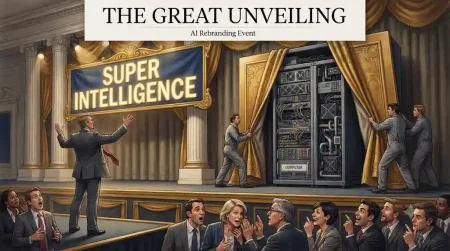
Exactly 400 years later, the people of the world and their “island”, i.e. the collective knowledge and labour of every human on the planet, is being traded for “trinkets” that are the lines of code, probabilistic predictions and, importantly, the “vision” that AI companies are selling Wall Street. The seller? AI companies, and leading the pack: Anthropic, a five-year-old startup that has already put a price on the imagined territory – a whopping $30 trillion.
Thirty trillion dollars is almost the annual GDP of the United States – the world’s largest economy and the entire U.S. tech sector – all 191 companies in the S&P 1500 tech index – generated combined revenues of $2.4 trillion last year. Anthropic is claiming that the market it plays in, i.e. Artificial Intelligence, is more than twelve times that. Not its own revenue, mind you, but its “Total Addressable Market” (TAM).

What Anthropic is saying is that the entire value of the AI ecosystem is $30 trillion. And they hope to convince IPO investors that they can bite a good chunk of that pie in the coming years, so their launch valuation should be above $2 trillion, not the nearly $1 trillion in May 2026 in their Series H funding. For context, SpaceX said in its IPO that its TAM was $28.5 trillion, and they went for a $1.77T IPO in June 2026. Anthropic clearly wants to surpass that.
The New Math of “Labour-as-Market”
The problem with all this is not just the $30 trillion valuation for the entire Artificial Intelligence market. I believe it could be worth that, sooner or later. The problem is the basis used to reach that value. Traditionally, TAM calculations have started with an existing industry: say enterprise software, cloud storage, advertising, etc. What the companies did was size up the whole pie and estimate their own slice in it. Anthropic has thrown away that entire playbook.
As per The Wall Street Journal, Anthropic’s internal TAM model isn’t based on software spending at all. Instead, they are adding up the total global wages of every job that their AI models could theoretically perform. Programmers, lawyers, accountants, architects, financial analysts, your personal secretary… basically any knowledge worker whose output can be reduced to patterns, text, and logic. If an AI can do that job, then that person’s salary has been added to Anthropic’s addressable market.
In essence, what they are pricing is not a tool which helps you work faster. Instead, they are pegging their bets and pricing the wholesale replacement of every worker on the planet.
As Alex Brunicki, a partner at VC firm Backed VC, told Fortune: “With things like Claude and the way it writes code, you could argue it’s replacing the work that humans do end-to-end, and so the TAM for those products is essentially the labor market for that work output.”

Now the yearly bill for all work worldwide is about $60 trillion. About 55–60% of that is white‑collar or knowledge work, which comes to around $30–35 trillion per year. This is the number that Anthropic is citing. And thus, in essence, is talking about the replacement of all knowledge workers in the economy of the world. Theoretically only, yes, but that’s the claim.
This is faulty for many reasons. As I have written before in Sify, the world is slowly realising that there are very few knowledge workers that are entirely replaceable using AI; the result of which is that workplaces are beginning to use AI as a tool and not a replacement for human workers. Even with advances in agentic AI and such, the makers are realising that these systems have serious limitations, especially in the last mile of the system learning the nuances where the long tail of learning is really long indeed. So, $30 trillion as a TAM is forever fantasy, unless some new way of doing AI emerges which changes everything.
Add to that the reality of Anthropic’s own revenue, which in 2025 was around $10 billion. Of course, by July 2026, its annualised revenue run rate had climbed to $65 billion, with internal projections hitting $190 to 200 billion by 2028. Impressive growth indeed, but it’s still less than 1% of that $30 trillion pie. If you’re a company making $65 billion a year and you tell investors your potential market is $30 trillion, then what you are saying in essence is that you haven’t even scratched the surface. And perhaps that is the point because for a TAM the number doesn’t have to be accurate: it just has to be big enough to make a $2 trillion IPO valuation look like a bargain.

The Story Wall Street Wants to Hear
In essence, what Anthropic is doing is injecting financial science fiction into their spreadsheets and PowerPoint. And it’s also a masterclass in IPO storytelling. Every ambitious company does it: Uber claimed a $6 trillion TAM in 2019 while it was losing money. WeWork claimed $3 trillion (we know how that ended). The trick is to paint a future so vast that today’s valuation seems timid, thus increasing valuation in the mind of the investor.
But Anthropic’s story is different in one key way
It’s not about expanding a market; it’s about absorbing one. They aren’t competing with other software companies. They are competing with you – your salary, your expertise, your years of training. If they succeed, every time a company chooses an AI agent over a junior associate, that lost wage becomes Anthropic’s revenue stream. And indeed, this wholesale rewiring of the global economy is what Anthropic and the AI industry as a whole are attempting; fears of doomsday and bubbles be damned.
Dario Amodei, Anthropic’s CEO, has spent most of 2026 telling anyone with a microphone that AI will eliminate half of all entry‑level white‑collar jobs. He said it at Davos and in every podcast he’s been on. Far from hiding it, he’s actually selling it. Why? Because the bigger the market AI can absorb, the bigger the TAM. It’s a perverse sort of logic, but perfectly coherent for an IPO document.
So, is this the creation of the ultimate tech bubble? Or is it simply the new math of a future that is so automated, nothing is out of its purview anymore?

The Real Question Isn’t About Valuation
Here’s where I part ways with the usual “bubble or boom” debate because, in essence, the $30 trillion figure is not a forecast, but a question. And the question isn’t whether Anthropic can be worth that much. The question is: How much of our labour, our work, our cultures, and our sense of purpose are we willing to feed to AI to make that story become reality?
Because for that story to come true, it’ll require billions of dollars of investment, trillions of dollars of shifting capital, and of course, hundreds of millions of us accepting that our knowledge, our craft, and our hard‑earned expertise can be reduced to a prompt, a token, and a probability distribution.
Anthropic’s $30 trillion TAM is a bet that we will say “yes”, we will let corporations replace human judgment with algorithmic inference, that a world where a chatbot drafts your contract, reviews your code, analyses your spreadsheets, and answers your customer calls – all for a fraction of your salary is acceptable to us.
I do believe that that future is inevitable, maybe even desirable, as it has the potential of freeing us from drudgery to pursue higher callings. But that’s a conversation we need to have openly amongst all of us instead of outsourcing it to a few greedy Silicon Valley founders and venture capitalists to decide behind closed doors.
Anthropic isn’t bonkers. It’s rational, a bit too perfectly rational given the incentives of modern finance. Their job is to maximise shareholder value. Our job is to decide what kind of world we want to live in, decide the value of our world, while they are fixed only on the price of us.
The Manhattan trade can’t be undone. But this one is still ours to make – or unmake. We can accept the $30 trillion pitch and let it become a prophecy, or pause and ask harder questions to ensure that the future we build with AI serves more than just one or a few companies’ balance sheets. The fate of the world rests on that decision.
In case you missed:
- Anthropic, OpenAI, Meta, – Why are Companies Hyping Up Their Rogue AI?
- Coopetition: Why’s NVIDIA Building AI Models to Compete With Customers It Sells Chips To?
- Anthropic Fears AI Could Self-Replicate, Leaving Humans in the Dust
- $725 Billion Investment, Best Tech Q1 Ever Says AI Bubble Isn’t Bursting, It’s Thriving
- The Ghost in the Text: Inside Anthropic’s Invisible Watermark
- The Weight of the World: Why the Open vs. Closed AI War Is Really About Who Controls the Future
- Anthropic Accuses Chinese AI of “Stealing”, Internet Points Finger Back At Them
- Anthropic was afraid of their latest AI Mythos: they released it anyway, to the panic of the world
- The Great AI Correction of 2026: Why the ‘Bubble’ Popping Could be the Sound of Growing Pains
- $725 Billion Down, Trillions To Go: Why The AI Bubble Refuses To Burst