





The AI world is in the middle of intense co-opetition, as NVIDIA forays into developing frontier models, even as its customers venture into making designs for TPUs and Trainium chips, writes Satyen K. Bordoloi
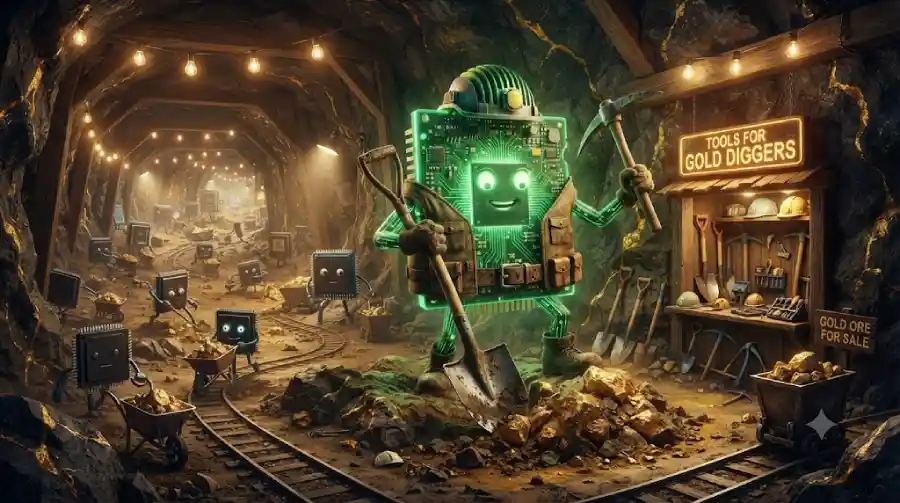
To many, Silicon Valley is more about ‘gold’ than silicon. And in the current AI gold rush, something strange is happening: the company that makes the shovels that miners use is now getting into the business of digging for gold itself.
At $5 trillion, NVIDIA has risen to the very top of global valuations, all by powering nearly every major artificial intelligence system on the planet. Now, it is spending billions to build its own frontier AI models and going in direct competition with OpenAI, Anthropic, and Google, companies that also are its biggest customers. At face value, this sounds like business suicide: why compete against the very people writing you fat paychecks?
But that question is negated by the fact that the same companies are doing to NVIDIA what it is doing to them: Google is designing its own TPU chips, Amazon is making Trainium chips, while OpenAI is partnering with Broadcom to make custom silicon. Even Microsoft has its own Maia chips. Call it the age of coopetition where everyone is competing with everyone else even as they partner with each other.
Even with the impending threat, the market for frontier models is much more crowded than that for chips. Why, then, does the question arise: would NVIDIA make its own models? Yet, the bigger question is not that, but how and why they might win even if they lose in the model development space.
The Age of Coopetition Has Arrived
For decades, the fundamental principle of the tech industry has been: stay in your lane. Intel made chips. Microsoft crafted software. Google created search. Everyone respected the boundaries they or the market set for them. Today, no such limitations exist anymore.
Google’s cloud business grew 63% to $20 billion in a single quarter, with a backlog approaching $462 billion. Google is making TPUs a cornerstone of its AI-cloud offerings, offering them to outside customers, and they are expected to become a large part of Google Cloud.
Amazon’s Trainium business has crossed a $20 billion annual run rate, and Trainium2 undercuts comparable NVIDIA GPUs by 30% on cost per unit of performance. Both companies are building alternatives to the chips that made NVIDIA the most valuable company in the world. Meta, Anthropic, and OpenAI have all signed on as anchor Trainium customers.
So, when NVIDIA’s best customers quietly build their own escape routes by designing custom silicon to replace the ones they have been using, the old customer-supplier relationship no longer holds. Hence, to NVIDIA, the question wasn’t if they should respond to this; it was how to go about it.

NVIDIA’s Answer: Spend $7 Billion on a Model Factory
In August 2026, NVIDIA announced a $7 billion deal with Poolside, an AI startup focused on open-weight models. The structure was unusual. NVIDIA paid $6 billion for a non-exclusive license to Poolside’s “Model Factory” technology and offered jobs to 109 of its engineers. Another $1 billion went in as equity investment at a $12 billion valuation.
This wasn’t an acquisition in the traditional sense, but was in line with what analysts call an “acqui-hire”: a way to absorb talent and technology without triggering antitrust reviews that a full merger could invite.
Those engineers are now working on NVIDIA’s Nemotron project, an open-weight model family that began production in 2023. The goal? Build a model with over one trillion parameters with frontier-level performance that can compete with DeepSeek, Kimi, and even OpenAI’s closed-source systems.
NVIDIA hasn’t been quiet about its ambition. They launched the Nemotron Coalition in March 2026, bringing together Mistral, Perplexity, Cursor, and Thinking Machines Lab to co-develop open frontier models. Remember Jensen Huang’s open letter in July arguing that “U.S. AI leadership depends on building open models across the industry rather than a single most-advanced model”. In essence, what that letter argued was that instead of a world where three or four closed labs controlled the most powerful AI, they wanted one where open models were everywhere.

The Real Reason: Commoditise the Model Layer
NVIDIA is being extremely clever in what they are doing, because they are not in the model race to win it. They just need the race to be cheap enough. The logic is simple. Powerful models locked behind OpenAI’s and Anthropic’s APIs mean they set the prices and control customer relationships, with NVIDIA just selling them chips, even as they try to replace those chips with the ones they’re designing themselves.
However, if open-weight models become just as good and cheap enough to be almost free to use, it’d mean that the entire model layer becomes a commodity that no single company controls. Enterprises then can download a model, customise it, and run it on their own infrastructure, with the value of the models shifting from the model to the GPUs, the networking and the software ecosystem they run on. And who owns and controls most of that infra: NVIDIA.
Analysts have called this a strategy where they are trying to commoditise intelligence, while making compute the scarce resource, and NVIDIA can sacrifice profit at the model level just because it has never run on or needed that revenue. Every developer building on Nemotron becomes a potential customer for NVIDIA GPUs, CUDA software, and networking equipment. The model becomes the funnel to direct the creation of money by selling the pipes.

The China Factor
Let’s not forget the geopolitical dimension either. With DeepSeek’s release in January 2025, the world woke up to a rude awakening with a model that was low-cost and open-weighted, yet performed as well, if not better than the proprietary, closed ones. That was only the start, with other open models from China like Kimi and GLM becoming the default foundation for nations unwilling to depend on American closed platforms. If Chinese open models become the standard for the world, they might not run on NVIDIA’s hardware.
NVIDIA has reacted by flooding the market with its own open models. By making Nemotron models free, customizable, and deeply integrated with its CUDA software stack, NVIDIA aims to keep the open AI ecosystem firmly anchored to its hardware.
The Customer Conflict Nobody Wants to Talk About
There’s no hiding from the obvious conflict of interest: NVIDIA is now competing with OpenAI and Anthropic even as they sell the company chips. If Nemotron becomes truly competitive, why would enterprises pay OpenAI for API access when they could just as well download a Nemotron model, run it on their own GPUs, all while keeping their precious data private? That’s a real threat to the business models of NVIDIA’s largest customers.
And those customers are reacting by trying to build their own chips: Anthropic hired a chip expert who led Google’s TPU development, and OpenAI has partnered with Broadcom on inference chips.
NVIDIA is betting on the fact that open models will expand the overall AI market so much that everyone will benefit eventually, afterall there’s no limit to how much intelligence companies and individuals want or can use. More models mean more inference, more training, more demand for compute, and even if the model layer becomes a commodity, the infrastructure layer would remain as valuable as ever, if not more so. Which means NVIDIA wins either way.
If Nemotron becomes one of the best open models in the world, NVIDIA wins because developers will build on it, enterprises will deploy it, and the demand for their hardware will skyrocket. Even if Nemotron ends up being mediocre, their push for open models means that they become more dominant; NVIDIA will still win as the model layer will be commoditised, and value will flow to the infrastructure underneath.
If OpenAI and Anthropic closed models continue to be dominant, NVIDIA will continue to earn revenue – at least into the near future as they’re already running on their chips.
The only way NVIDIA can lose is if a competitor builds a complete alternate stack with chips, software and models atop one another, one that is so good that people begin abandoning NVIDIA. Google is the closest to attempting this with its TPU-Gemini vertical integration. But so far, even most of Google runs on NVIDIA chips.
NVIDIA is different from everyone else. By spending billions on models they might never monetise, they are pushing not for the model as the product, but the demand for infrastructure it will generate.
It is the age of coopetition: the winner won’t be the company with the best model or the best chip, but the one that owns the layer everyone else depends on. NVIDIA’s bet has always been on the compute layer. Now they’re also trying to make everything above it compete so fiercely that its customers themselves can never become powerful enough to threaten them.
And so far, it is looking like a bet that simply cannot be lost.
In case you missed:
- The Weight of the World: Why the Open vs. Closed AI War Is Really About Who Controls the Future
- NVIDIA’s Strategic Pivot to Drive our Autonomous Future with Innovative Chips
- Anthropic, OpenAI, Meta, – Why are Companies Hyping Up Their Rogue AI?
- Anthropic was afraid of their latest AI Mythos: they released it anyway, to the panic of the world
- South Korea Made Generative AI a Citizen’s Right: Should the Rest of the World Follow?
- Makers of Toilets & Ajinomoto: The Unlikely Companies Getting Rich Off the AI Boom
- $725 Billion Investment, Best Tech Q1 Ever Says AI Bubble Isn’t Bursting, It’s Thriving
- The AI Prophecies: How Page, Musk, Bezos, Pichai, Huang Predicted 2025 – But Didn’t See It Like AI Is Today
- The AI Peace Race: Why India’s Real Opportunity Starts Where the Arms Race Ends
- Anthropic Accuses Chinese AI of “Stealing”, Internet Points Finger Back At Them