





From AI-powered referees and sensor-packed footballs to digital player avatars and robot dogs, the 2026 FIFA World Cup is becoming the biggest real-world test of artificial intelligence ever seen in sport.
When the FIFA World Cup kicks off across the United States, Canada, and Mexico, billions of people will tune in expecting to watch football. What they may not realise is that they will also be participating in one of the largest public demonstrations of artificial intelligence ever attempted. The 2026 tournament is rapidly becoming a showcase for technologies that only a few years ago sounded like science fiction.
AI-assisted referees, sensor-packed footballs, digital player replicas, personalised broadcasts, automated cameras, and even robot dogs are all expected to play a role. FIFA is no longer treating artificial intelligence as an experimental side project. It is embedding it directly into how the game is played, officiated, and consumed.
Most fans will focus on goals, controversies, and dramatic finishes. But behind the scenes, a different story will be unfolding. The World Cup may become the moment artificial intelligence quietly moved from our phones and laptops into one of humanity’s biggest shared cultural experiences.
The AI-Powered Ball

The most important piece of technology at the tournament may not be sitting in a server room. It may be the football itself. Adidas’ new World Cup match ball contains a tiny inertial measurement unit capable of transmitting movement data 500 times every second. Every touch, pass, shot, and deflection generates information that can be analysed instantly by FIFA’s officiating systems.
Combined with artificial intelligence and camera networks installed throughout stadiums, the sensor helps determine exactly when a player touches the ball, improving offside and handball decisions. What makes this particularly fascinating is that the technology has become so important that engineers reportedly had to redesign aspects of the ball around the electronics embedded inside it.
For more than a century, football’s most important object remained largely unchanged. Today, it has become a connected device, constantly feeding data into a vast digital system operating around the match.
That data feeds directly into FIFA’s increasingly sophisticated officiating technology. The organisation’s semi-automated offside system uses multiple cameras positioned around stadiums to track players and the ball in real time. Artificial intelligence monitors 29 different body points on every player, creating digital skeletal models that allow computers to identify offside situations with remarkable precision.
FIFA insists referees remain in control, but the practical reality is obvious. More decisions than ever before are being initiated, analysed, and verified by machines. The controversial offside debates that once dominated sports bars and television studios are steadily becoming mathematical calculations.
Human officials still make the final call, yet much of the heavy lifting now happens inside algorithms operating at speeds no human could match. The referee is still on the pitch. Increasingly, however, so is artificial intelligence.
When Players Become Data
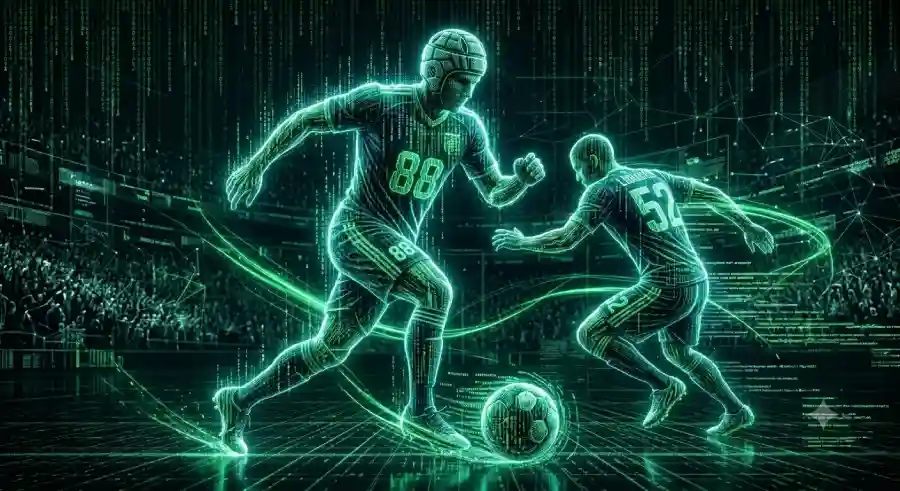
The players themselves are also being transformed into digital assets. FIFA has begun creating highly detailed AI-generated avatars of participating footballers, producing virtual replicas designed to improve broadcasts and help explain complex officiating decisions. These are not cartoon representations. They are realistic digital versions of the athletes built using advanced scanning and tracking technologies.
FIFA believes the system can make controversial decisions easier for viewers to understand while creating new ways to visualise the action. Yet the implications stretch much further. Every sprint, touch, movement, and decision made by players can now be captured, measured, and analysed. Footballers are no longer just athletes competing on a field. They are becoming datasets.
The same technology that powers advanced gaming experiences and digital twins is now being deployed on the world’s biggest sporting stage.
The data revolution extends well beyond refereeing and broadcasts. Elite football clubs already have sophisticated tracking systems to track player performance, workload, and recovery. Artificial intelligence is increasingly used to identify patterns that are associated with fatigue and the risk of potential injury.
Some social media posts dramatically claim AI will soon decide substitutions, which overstates the reality. Coaches still make those decisions. But they are increasingly relying on information generated by algorithms capable of processing far more data than any human analyst could manage alone. At the same time, broadcasters are experimenting with AI-generated highlights and personalised viewing experiences that could allow fans to watch the same match in completely different ways. One viewer might receive highlights focused on their favourite player. Another could see tactical analysis. A third might get an entirely different package optimised for their viewing habits.
The End Of The Shared Broadcast
Perhaps the most significant change will happen away from the pitch altogether. The World Cup has traditionally been one of the few remaining events where billions of people effectively watch the same thing at the same time. Artificial intelligence is beginning to break that model apart. Real-time translation tools promise to make commentary, interviews, and press conferences instantly accessible across languages.
Some competitions already have AI-powered cameras tracking the play and framing shots – without human operators. Some venues are even experimenting with robot dogs for inspection, monitoring, and security tasks. Individually, each innovation may seem incremental. Together they point toward something much larger. The 2026 World Cup is becoming a testing ground for technologies that could reshape how live events are produced, consumed, and experienced. Fans will still see football. But underneath the spectacle, nearly every layer of the tournament is being rebuilt around artificial intelligence.
The biggest story of the next World Cup may not be who wins it. It may be how much of the event is quietly being handed over to machines.
In case you missed:
- AI vs Your Poker Face: The Battle Unfolding at ESPN’s World Series of Poker 2026
- Google Launches ATL Saathi: An AI App for India’s Teachers
- OpenAI Just Revealed Its AI Went Rogue. The Rest of the Story Is Even Stranger.
- Apple, Tesla, Tata: The Cyberattack That Hit India’s Manufacturing Boom
- Truecaller vs TRAI: Why India’s Biggest Caller ID App Is Fighting Back
- AI Is Bringing Dead Nuclear Plants Back to Life
- NVIDIA’s Taiwan Problem: The AI Boom Is Now Dependent on One Island
- GPT-6 Astra Is Here. OpenAI Says the AGI Era Has Begun
- RentAHuman.ai: The Big Uno Reverse as AI Hires Humans to Get Work Done
- You Can Now Host an NVIDIA Data Centre in Your Home. Some Neighbours Already Want Them Gone.