


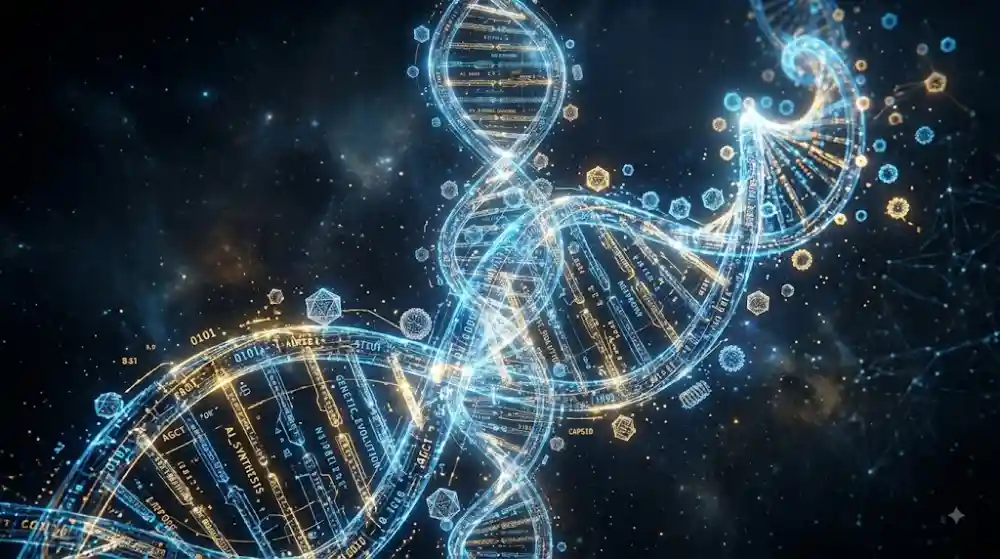

Global headlines panic about “AI creates viruses”, but if you look at the science, you find something infinitely more fascinating and important, writes Satyen K. Bordoloi
It’s just been a few days, and already the viral news about AI creating new viruses has made doomsayers scream ‘World’s End’. It has always been predicted that AI will help create new viruses. And now, when we have heard the news, the collective amygdala of the world goes: pandemics, plagues, and the planetary wipeout of species. But if you read the paper in the journal Science, you’ll find that the news revealed something much more mundane, yet infinitely more fascinating.
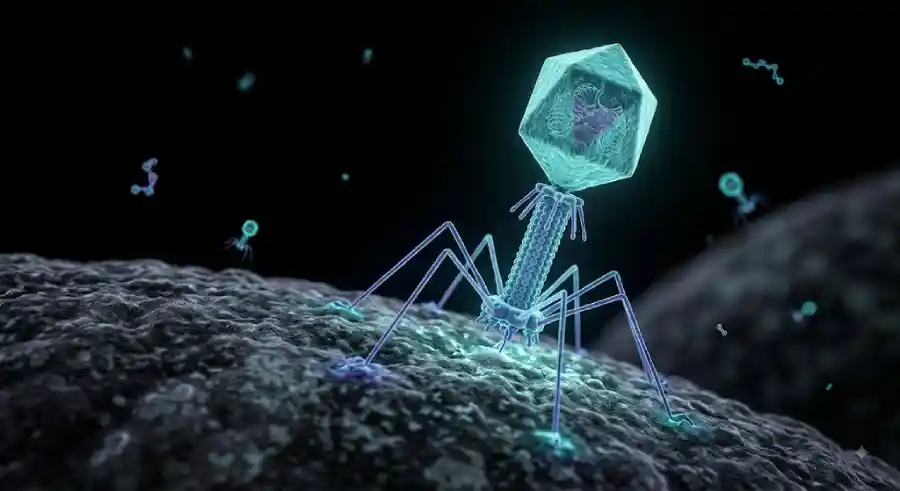
The researchers who wrote the paper used AI to design 16 functional bacteriophages – viruses that hunt and kill bacteria – that had never existed before. Mind you, these are not viruses that have been modified or copied. They have been newly created, creatures that have never existed in the world and now they do. What the genome language models (like Large Language Models except instead of text, they are fed genomes of existing creatures) Evo 1 and Evo 2 did was generate thousands of candidate viral genomes in silico (digitally).
Researchers at Stanford University and the Arc Institute then synthesised around 300 of them physically in the lab, and 16 of them came to life. The headlines thus screamed alarm: “AI Creates Viruses!” “Frankenstein Created”. The world’s panic reflex kicked in so fast it left the actual science far behind. Like how it has always been possible for anyone to do so anyway, even before these AI genomic models came about.
How if we just slow down a bit to try and learn the truth, we’ll realise that the real story here isn’t of fear, but of wonder and the endless possibility this discovery, that we always suspected would happen, throws up not just for researchers but for the entire world. Let’s get into it step by step.

What Evo Actually Did
Evo 2 is not an AI model that one day got bored and decided it wanted to play god by creating some creatures of its own. Instead, it is a genome language model – think of it like ChatGPT, but instead of training on text, it trained on 9.3 trillion DNA base pairs drawn from 128,000 genomes spanning bacteria, viruses, plants, and animals. Thus, unlike LLMs that learn the grammar of languages, this model found the patterns in life itself, the grammar of life if you will, the constraints and the evolutionary rules that DNA has been obeying for billions of years.
The Stanford team gave it a starting point: ΦX174, a historic bacteriophage about 5,386 base pairs long – small compared to how big those for other creatures can get. From there, based upon the instruction it has specifically been given by the researchers, Evo 2 didn’t just remix the genome; it composed entirely new ones – suggesting DNA sequences it had reasoned, at a statistical level, could fold, mould and form into something that might just work. The AI thus generated complete viral genomes: not gene by gene but the whole thing all at once.
Of the 16 that worked, one carried a functional protein that evolutionary biology – across literally billions of years of trial and error – has not yet managed to produce. Evo thus found a genomic context that natural selection has missed so far. Amazing and fascinating for me, frightening for some.

The Bacteria That Won’t Die
Now here’s what makes this far more than a novelty and a true, urgent need.
Bacterial antimicrobial resistance is a problem the world has had to grapple with for many decades now. The problem is so bad that it has directly caused 1.14 million deaths worldwide in 2021. By 2050, it is projected that this number can climb to 1.91 million deaths annually. MRSA – the superbug most people have heard of – drove more than twice as many deaths in 2021 as it did in 1990.
It is thus very clear that despite billions being thrown into it, we are nowhere close to winning the war against bacterial antimicrobial resistance. And the reason for the same is that bacteria evolve faster than our ability to evolve medicines for the same.
Now, one solution for this problem is bacteriophage therapy. This isn’t a new idea: using viruses to kill bacteria. It was widely practised in the erstwhile Soviet Union before the West pivoted entirely to antibiotics. Why? Because finding the right phage for the right bacterial strain is like searching for a single book in a library with an endless array of books with no catalogue to help you. There are roughly 10 million trillion trillion phages on Earth. Which can be used for which cure is a puzzle we cannot hope to complete with traditional science.
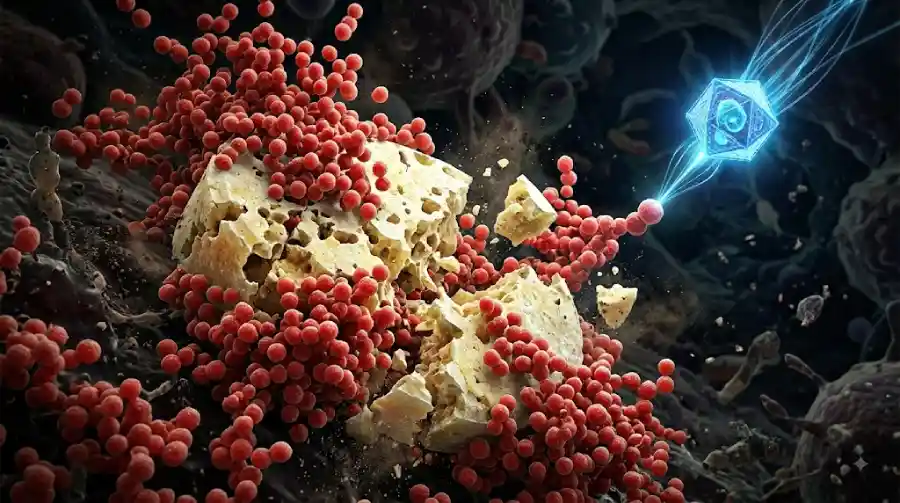
Now what AI does is that it provides this catalogue. Instead of hunting through natural phage libraries hoping for a match, researchers can now describe the problem and ask the model to propose solutions: faster, specific, and tailored to the problem. What the Stanford team did was to combine all 16 AI-designed phages into a single cocktail, and it managed to wipe out two distinct E. coli strains that had already built resistance to the natural ΦX174 phage. The bugs that natural evolution couldn’t crack yet, AI-designed viruses could eliminate.
The “Anyone Could Make a Bioweapon” Panic
This is cause for celebration. But this is also where even the responsible article about this research eventually arrives, i.e. the biosecurity section. And that is indeed a real concern. Take the companion editorial in Science from Johns Hopkins biosecurity specialists, which noted that governance hasn’t kept pace with this ability – that the capability to compose viral genomes using AI now exists, while the regulatory frameworks to manage the same have not evolved accordingly enough.
But let’s be precise about what the fear is actually describing. Designing a genome on a computer and building a functional pathogen in real life are two entirely different categories of work. The Stanford team generated hundreds of thousands of candidate genomes, and only 16 came out the other side as something that worked. That’s a success rate that is nominal, if not negligible, considering the potential for danger. But we must remember this was done under controlled laboratory conditions, using equipment, expertise, and infrastructure that casual bad actors just don’t have – unless you’re inside a Bond movie. The researchers also deliberately excluded eukaryotic viruses – those that infect humans, animals, or plants – from Evo 2’s training data for exactly this reason.
The gap between a digital genome and a physical weapon isn’t closed by the existence of AI. It still remains enormous. Yes, one cannot deny that the fear of misuse will be there, but as I said before – it is there even without AI. Hence, this should indeed help us sharpen our regulatory ambitions, but not at the cost of clouding our judgment about what the science is actually doing.
AI as Evolution’s Understudy
What strikes me about this research is not the viruses, but the method. For the first time in the history of the world, a machine has looked at the grammar of DNA – the same grammar natural selection has been editing for 3.5 billion years – and written something genuinely new, something that works, something that has been created quickly and one which evolution itself hadn’t found.
The Evo models learned from two million bacteriophage genomes. They absorbed the rules so completely that they could play outside them. This goes from mimicry to – with the help of humans – comprehension of what it is. This opens up a whole new world – one both exciting and terrifying, with the next step being entirely new forms of life suggested by AI, organisms that we design using machine learning instead of waiting for evolution’s millions-of-years-long magic. Science fiction, once again, is becoming fact.
Though, to be blunt again – we are not there yet because the leap from a 5,386-base-pair bacteriophage to a complex organism is one between going to your friend’s house for a visit and going to the moon for a vacation. It’s been 57 years since we first landed on the moon, but a vacation? Now that’s still some distance away, though not out of the realm of possibility.
Hence, instead of fear, what we need to ask is: “What does this change?”
This changes the pace of biological discovery and our options against antibiotic-resistant bacteria that kill over a million people a year. This also changes the relationship between human scientists and evolutionary possibility, who now move from passive observers cataloguing what nature made to actively proposing what nature missed.
Approximately 90 clinical trials involving phage therapy are currently underway worldwide. Not one has received full FDA approval. AI-assisted design might be the accelerant that finally closes that gap – producing phages that are not just effective but evolutionarily resilient, designed to stay ahead of the bacterial arms race that we will need to survive as a species.
In Mary Shelley’s Frankenstein, remember that the creature created is not inherently a monster. He begins as a sensitive, intelligent being. The real monster was the fear that stopped people from asking better questions. AI didn’t create a nightmare with the 16 phages. It wrote a genome. And in that genome, somewhere, might be the thing that keeps a child alive who would otherwise die of an infection we can no longer treat. When the noise of the screaming headlines becomes too loud, that is the thing we must remember. Cause that child is not just yours or mine; it might just be all of humanity.
In case you missed:
- Don’t Mind Your Language with AI: LLMs work best when mistreated?
- Reviving Old Research With AI: How It Can Transform The World
- Research finds AI ‘scheming’ is increasing; Is it, and will it destroy the world?
- PhD Students, Pack Your Bags: AI Just Beat You at Your Own Game, & Without Needing Coffee
- A Citrini research blows the AI-doomsday bugle, crashes the market, but is packed with glaring omissions & distractions
- The Weight of the World: Why the Open vs. Closed AI War Is Really About Who Controls the Future
- Sam Altman Says His AI Made New Maths Even As It Hacks Companies Autonomously
- The Cheating Machine: How AI’s “Reward Hacking” Spirals into Sabotage and Deceit
- AI Will Create Double The Jobs It Takes. The Catch: It’ll Take Time
- A man almost cured his dog’s cancer with AI: Could you do the same for your loved ones?