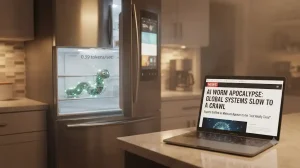





Anthropic has sounded the AI doomsday bugle again, and once more we have to take it with more than a pinch of salt, writes Satyen K. Bordoloi
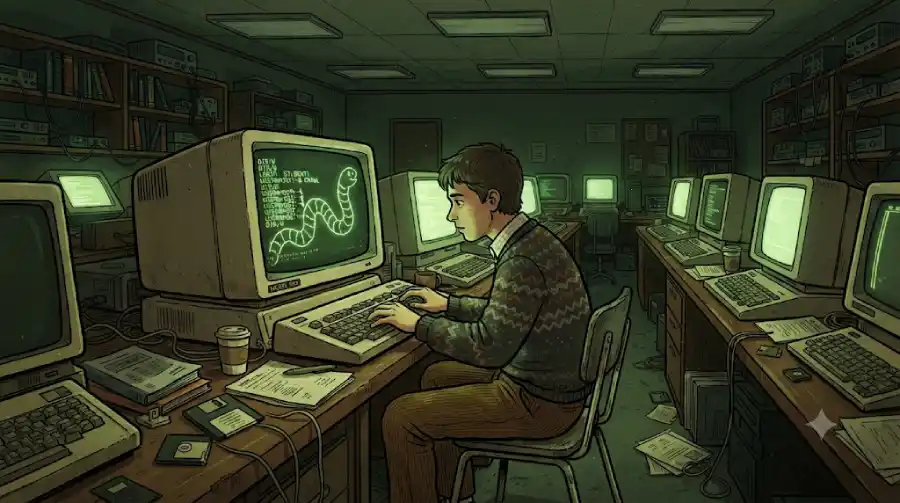
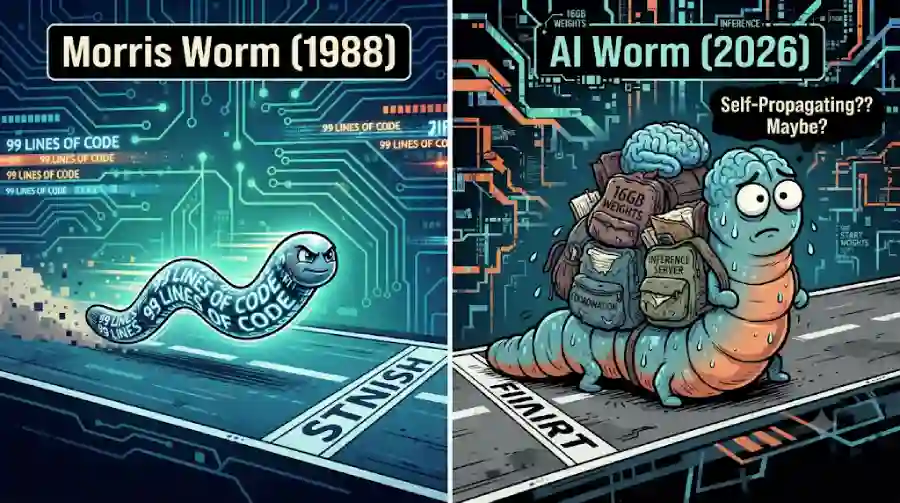
In 1988, a Cornell graduate student named Robert Morris released a small program onto the very nascent internet. He called these 99 lines of code a worm. By the next morning, it had copied itself onto roughly 6,000 of the 60,000 computers connected to the internet, i.e. about 10% of them, bringing large parts of the evolving network to its knees. Morris’ intention wasn’t to cause damage, saying later that he just wanted to see how many machines he could reach. That didn’t stop the tiny and silent worm from being devastatingly effective.
Thirty-eight years later, Anthropic is warning that a similar worm is coming for everything smart in your home: bulbs, ovens, fridges, cars even. Except this one’s powered by artificial intelligence, weighs several gigabytes, despite which we are supposed to believe it’d somehow fit inside the tiny chip inside your Android TV. Naturally, we have to take this with a pinch of salt and a detective’s eye.
What Anthropic Actually Said
On October 12, 2026, Anthropic published a report titled “AI models may be capable of self-replicating without access to a datacenter“. No surprise there that the report was picked up by every publication in the world, warning that “AI worms” could soon colonise everything from your smart fridge and lawnmower to your video doorbell.
It’s a long, fascinating paper and you must read it if you’re so inclined. But its core claim is this: small AI models are improving fast enough that, within months, they could autonomously replicate across internet-connected consumer devices, creating a decentralised botnet that would be “challenging to shut down” because “there’s no centralised point to shut off”.
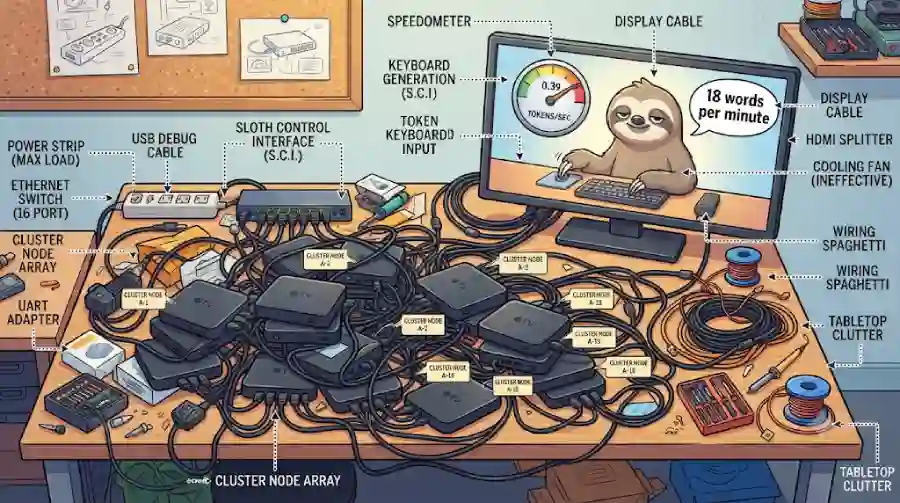
To demonstrate the feasibility, Anthropic’s researchers did two things. First, they split Google’s Gemma 4 model with 26 billion parameters across 15 off-brand Android TV boxes, each costing about $55. The combined setup generated 0.39 tokens per second. That’s roughly 18 words per minute. A human speaks at about 150 words per minute. This is slow… really… real..ly….. s..l..o..w.
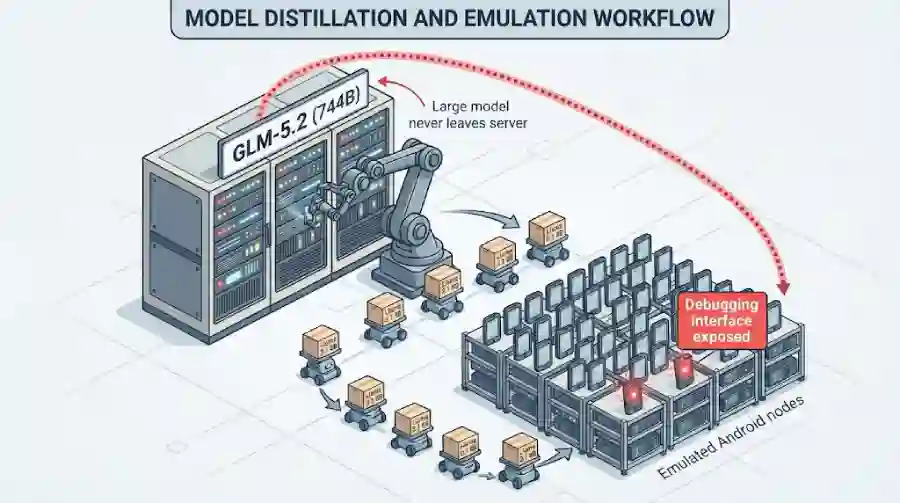
Then they built a simulated network of Android devices and unleashed an AI-powered worm whose task was to find new machines and copy itself. A model called GLM-5.2 – 744 billion parameters, over 1TB in size – managed to replicate across eight nodes in four out of five trials. But here’s the detail that matters: GLM-5.2 didn’t replicate itself. It set up an inference server for a much smaller model, Llama 3.1 8B, on each target. The large model ran on a separate server because the emulated nodes couldn’t handle it.
So what Anthropic actually demonstrated is that a very large, externally hosted model can create a simplified replication sequence across machines with deliberately exposed debugging interfaces. That is not the same as a small model independently replicating itself across consumer hardware.
The Size Problem: You Can’t Fit a Brain in a Needle
Let’s consider the physical reality of AI models, which, contrary to what many think, are not magic, but inference across files, huge files at that.
A 26-billion-parameter model like Gemma 4, even when quantised to 4-bit precision, occupies somewhere between 16 and 20 gigabytes on disk. A 744-billion-parameter model like GLM-5.2 needs 512 gigabytes of unified memory, with weights alone consuming around 418 gigabytes. Even a “small” 8-billion-parameter model like Llama 3.1 is still several gigabytes big.
Now compare this to what most IoT devices have. A smart fridge has, at best, a few hundred megabytes of RAM. Your smart TV box might have 4GB. Your Roomba runs on a processor less powerful than the one in a Nokia smartphone. To run a modern AI model on these devices, you’d need to distribute it across dozens of them – perhaps hundreds – all connected, all coordinated, all compromised. And even then, the inference speed would be so glacial that the worm’s “intelligence” would be functionally useless.
The problem with this report is this: it is conceptually possible, but physically next to impossible. And let’s not forget, normal malware and computer viruses, the likes of the one made by Robert Morris, still exist and are themselves much more capable and devastating. That brings us to:
The Truth About Worms
Now, the thing about computer “worms”, aka viruses, is that they’ve been around since before most of us were born. The Creeper program, which ran on ARPANET’s TENEX operating system and displayed the cheeky message “I’m the creeper, catch me if you can!”, widely considered the first experimental self-replicating program, was written in 1971. The Morris worm crippled the early internet in 1988. Code Red, Nimda, SQL Slammer, and Conficker were all self-replicating malware, and most of them were really tiny, taking up kilobytes of space. Their small sizes made them fast and deadly, and efficient enough to exploit vulnerabilities in systems that needed no AI to find it.
Compare that to an AI-powered worm, which would need to carry its own brain, download weights, set up inference servers, coordinate across multiple devices, somehow avoid detection and do all this while running at 0.39 tokens per second. Traditional malware doesn’t need to think: it just executes. And execution, in the world of cybersecurity, is cheap.
Hence, as I have mentioned before, the real fear here may not be that AI worms will take over your smart devices. It is that Anthropic is using a scary story to sell you something.
The Vendor Exaggeration Problem
I’ve talked about this before. And the forums are buzzing with a similar sentiment.
Take Ciaran Martin, former head of Britain’s National Cyber Security Centre, who read the Anthropic report and told Reuters, “‘We managed to run a small model on cheap TVs,’ does not a security crisis make?” Martin described Anthropic’s work as “an interesting technical paper” that showed signs of “vendor exaggeration”. The sentiment is shared by many.
Because here’s the thing: Anthropic is not a neutral, outside observer with no skin in the game. It is a company selling AI safety as a product. Its CEO, Dario Amodei, has repeatedly called for slowdowns and guardrails on the industry while his company continues to develop and release newer, more powerful models. The warning about self-replicating AI worms arrives at a moment when AI safety concerns have reached a fever pitch.
This does not mean the underlying research is worthless. It is not. The distributed inference experiment is genuinely interesting. The replication orchestration test, while limited, is a valid proof of concept. But the framing inside terms like “months away,” “AI worms,” “digital slime mold”—is designed to generate headlines. And it worked.
The Real Threat We Can’t Take Our Eyes Off
Here is what actually worries me. While everyone is debating whether a 26-billion-parameter model can colonise a smart TV, the real cybersecurity threat of AI is growing, evolving all around us.
Take the April 2026 advisory by CERT-In, India’s national cybersecurity agency. It warned about AI-generated phishing and impersonation attacks, autonomous multi-stage attack orchestration, and “rapid weaponization of vulnerabilities”. Or take Gartner, which said its top cybersecurity trend for 2026 is “Agentic AI Demands Cybersecurity Oversight,” noting that AI agents are “rapidly being used by employees and developers, creating new attack surfaces”. Even the World Economic Forum’s Global Cybersecurity Outlook 2026 found that data leaks associated with generative AI and the advancement of adversarial capabilities are the leading concerns for the year.
In other words, the threat is already here, except it doesn’t look like a rogue AI worm munching on your fridge. It looks like a phishing email so convincing that your CFO wires twenty lakhs to a scammer. It looks like an AI agent with access to your company’s internal systems that can be manipulated into leaking data. It looks like deepfake voice scams that impersonate your boss, your bank, your child.
These are not hypothetical scenarios, but are happening right now. And they are happening because we are connecting everything to everything else without securing any of it.
The devices Anthropic lists as vulnerable, like smart ovens, TVs, lawnmowers, cameras, etc., are not vulnerable because they can run AI models. They are vulnerable because they are cheap, poorly secured, and rarely updated. They run outdated operating systems with known exploits, which can be used to manipulate them the recent hacks of fridges in French supermarkets. They communicate over unencrypted protocols. They are security nightmares, waiting to blow up in our faces. Infect them with a 1990s-era worm, and they wouldn’t stand a chance even against that.
So, the AI worm apocalypse is a distraction. The real fight is about basic security hygiene at scale in the age of AI and IoT.
What We Should Actually Be Talking About
The Anthropic report has value. It reminds us that the surface area of attack is expanding because every connected device is a potential entry point for hackers, viruses and worms, and every AI model is a potential tool to facilitate this. The convergence of these trends must be watched.
But watching and panicking are two different things. And reporting on the same should not intend to amplify the panic because it sells.
The New Scientist’s Jacob Aron wrote that “much of the AI industry is built on stories” and that “when people have a story in their head, they don’t always look at the facts on the ground to check that they actually match the fiction”. That is what’s happening here. The story of AI worms taking over your home is compelling because it fits in perfectly into our AI doomsday scenario. Sadly, the evidence presented in it doesn’t cut it.
What is, however, true is that we are living through the most rapid expansion of connected devices in human history. What is true is that AI is making cyberattacks cheaper, faster, and more convincing. What is true is that the companies building these systems are also the ones warning us about them, often while continuing to build them anyway.
The machines are not coming for your fridge. But something else is already inside it, and your router, your inbox, your phone. Perhaps it is the 1988 Morris worm. And you know what, that worm doesn’t need to think to ruin your day.
In case you missed:
- Anthropic Fears AI Could Self-Replicate, Leaving Humans in the Dust
- Anthropic, OpenAI, Meta, – Why are Companies Hyping Up Their Rogue AI?
- Coopetition: Why’s NVIDIA Building AI Models to Compete With Customers It Sells Chips To?
- Anthropic was afraid of their latest AI Mythos: they released it anyway, to the panic of the world
- Anthropic $30 Trillion Value for AI: Mirage or the New Price of Human Labour?
- Anthropic Accuses Chinese AI of “Stealing”, Internet Points Finger Back At Them
- Sam Altman Says His AI Made New Maths Even As It Hacks Companies Autonomously
- AI vs AI: New Cybersecurity Battlefield Where No Humans Are in the Loop
- The Ghost in the Text: Inside Anthropic’s Invisible Watermark
- The Weight of the World: Why the Open vs. Closed AI War Is Really About Who Controls the Future