


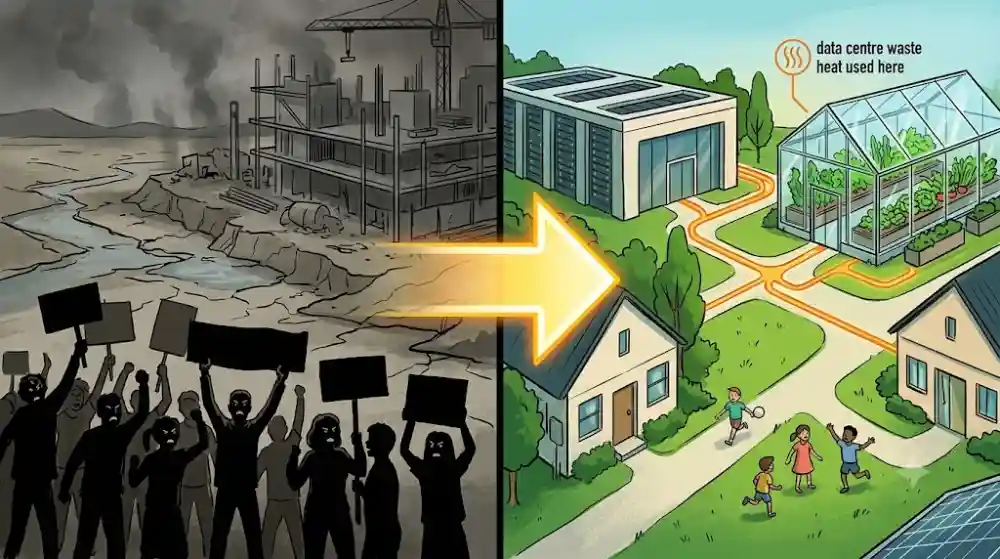

Protests against hyperscale data centres are heating up in India, but it need not be so, as working solutions to issues already exist, finds Satyen K. Bordoloi
A man walks down a street, phone in hand, scrolling through reels like hundreds of millions do every day. He steps off the curb without looking up to cross the street and suddenly stops, because the video stops playing and a car has to brake hard to avoid him. As the reel stopped buffering, so did he. That momentary interruption, that glitch in the data stream, is perhaps the only time anyone ever thinks about where the data actually comes from.
Cloud, we call it, and many actually believe it is up in the air or even made of air; this data we stream, trade, swipe and use to train our AI without a second thought. That is, until a data centre proposal appears in our backyard and then, be it in Virginia or Visakhapatnam, Texas or Thane – we mobilise against it, we form citizen groups, carry banners, we protest… while continuing to stream millions of bits of data every day.
I call it the central hypocrisy of our digital lives: we demand instant access to everything, everywhere, all at once but don’t want the machinery that makes it possible.
THE LOUD PROTESTERS
Take the protests near the financial capital of India, Mumbai. In Thane, residents of Balkum, Majiwada, Kolshet and Dhokali have been protesting against Amazon’s proposed hyperscale data centre. Hundreds have protested at the sites demanding answers about water, electricity, noise, and environmental impact. Their questions are not unreasonable and touch the very heart of the issue: Will this facility drain already scarce water resources? Will the constant hum of cooling systems and generators make life unbearable? Will the heat generated by thousands of servers turn their neighbourhood into a heat island?
About 800 kilometres away, the scene in Visakhapatnam is no different, with citizen groups opposing a proposed $15 billion Google-Adani hyperscale AI data centre complex, children marching with banners that read “We cannot drink DATA” and activists questioning environmental approvals, water requirements, and site selection, pointing out that the proposed locations are connected to the catchments of important reservoirs and lie within the ecological zone around the Kambalakonda Wildlife Sanctuary.
Far away in Brazoria County, Texas, residents near major data centre developments have reported a persistent low-frequency hum they say never really goes away, one that has caused them headaches, dizziness, nausea, vertigo, and severe sleep disruption. Operators point to tests showing compliance with permitted limits. The issue is that standard noise measurements often fail to capture what people claim they are experiencing. This gap between what’s captured and what’s felt is the problem.
And the protestors are not wrong because these data centres are indeed wasteful. As servers generate enormous heat, keeping them cool requires water and electricity that’s often scarce in the regions they are put in, and compliance with sustainability norms is often not met.

THE SOLUTIONS EXIST
In a sense, all the protests and the resistance to these protests by hyperscalers is pointless because solutions do exist: not experimental or theoretical, but ones that work and are being deployed in many parts of the world, especially Europe.
Take Tallaght, a suburb of Dublin, where a district heating scheme captures waste heat from an Amazon data centre and redirects it to heat a university campus, council offices, a library, an innovation centre, and 133 apartments. The heat of server processors is captured by recovery coils and carried as hot water to a nearby energy centre. Here, the heat pumps raise the temperature before distributing it to connected buildings. The great part of this solution is that because data centres operate around the clock, the available heat barely fluctuates through the year, making heat generation much more stable than any renewable heat source.
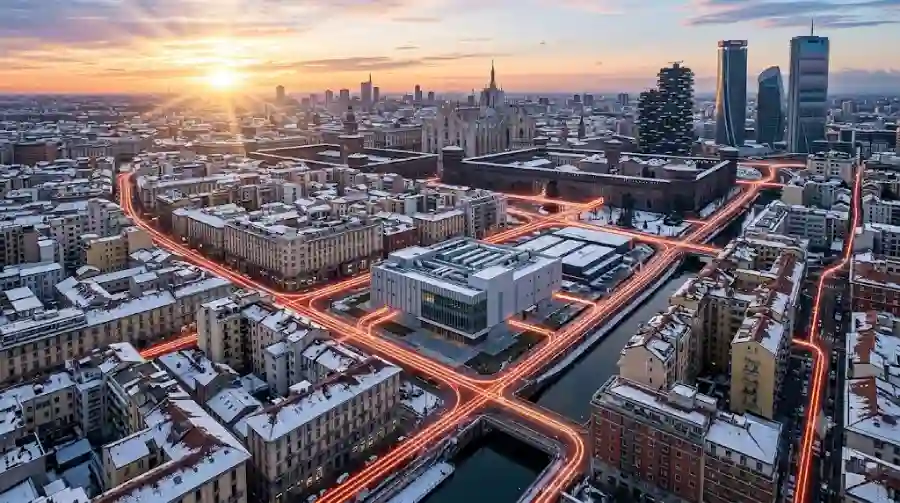
A similar project is going on in Milan where Equinix and A2A are capturing waste heat from a data centre campus and feeding it into the city’s district heating network, heat enough for 21,000 homes. This is estimated to recover up to 225 gigawatt-hours of thermal energy each year, increase the heat supplied through Milan’s district heating network by around 20 per cent, and absorb carbon equivalent to that done by around 220,000 trees.
It’s no different in Denmark, at North’s DEN01 data centre, which channels excess heat into district heating for over 8,000 homes.
Immersion cooling is another way, with Microsoft revealing in November 2025 that immersion cooling already runs 22 per cent of its GPU capacity across 18 data centres. This tech, once reserved for crypto miners, has become mainstream hyperscale infrastructure as it improves energy efficiency by over 30 per cent through immersion cooling and thermal energy storage.

INDIA SPECIFIC SOLUTIONS
Of course, that same solution cannot be applied to India. We are a hot country, and our houses need cooling, not heating. So, instead, the data centre heat can be used to generate electricity, just like in a nuclear power plant where nuclear power is used to boil water, and the steam thus created is used to turn turbines to generate electricity. The problem is that the heat generated in data centres is not hot enough to boil water and turn it into steam.
But even for that, solutions exist. Take the Organic Rankine Cycle (ORC), which is a thermodynamic process used to turn low-to-medium-temperature heat into electricity by boiling a special carbon-based fluid instead of water. Now, even to increase the temperature enough, there is a process called Solar-Boosted ORC, which combines a rooftop solar thermal collector with ORC to raise the temperature of data centre coolant streams, achieving 60-80 per cent more electricity recovery compared to ORC alone.
This has been demonstrated to work in simulation studies and pilot projects, but has not yet been widely deployed in live hyperscale data centres. And they won’t be, until mandated so by the government. This is where the governments should clarify their stand. Instead of ignoring the concerns of local residents protesting data centres across India, they could mandate that the companies putting up these centres won’t be allowed to operate until they fulfil these requirements.
This calls for a shift in mindset where you look at communities not as an obstacle to be managed, but partners to be engaged with. Just like the Tallaght project, which started with a municipality mapping heat demand and identifying opportunities, getting local planning involved in the process. In their case, regulation created the conditions for cooperation, instead of resistance that we are seeing elsewhere. But it was mandated by those running the governments there.
This should happen in India as well. And the data centre industry, be it in India or abroad, must understand that it has a choice: it can continue to build the way it has and face resistance or evolve and find cooperation. Because the future won’t be about building more data centres; it will be about building better ones.
One should, but perhaps one cannot do anything about the hypocrisy at the heart of our modern lives. But the invisible cloud feeding data into our digital systems, once it becomes visible in our backyards like it is in Visakhapatnam and Virginia, Thane and Texas, perhaps then we can look at these solutions and ensure that visible next to them are also the solutions that keep them sustainable.
Europe found their solution to the data centre problem. India must as well.
In case you missed:
- Inside Elon Musk’s Plan to Move the Internet into Space
- Forget Chernobyl: Your Instagram Feed Might Cause The Next Nuclear Disaster
- Indian AI’s Power Problem: We Woke Up Late to AI, We’re Still Half-Asleep
- Not Fastest, but Frugalest: Why Indian EVs Are Suddenly World-Class
- $725 Billion Down, Trillions To Go: Why The AI Bubble Refuses To Burst
- 5.6 Cr Pending Cases: How India Is Letting AI Slip Through Even As World Courts Revolution
- South Korea Made Generative AI a Citizen’s Right: Should the Rest of the World Follow?
- The AI Peace Race: Why India’s Real Opportunity Starts Where the Arms Race Ends
- The Default Bias: Why Women’s Underrepresentation in AI is Turning the World Crooked
- The Great AI Correction of 2026: Why the ‘Bubble’ Popping Could be the Sound of Growing Pains