



The global AI boom increasingly depends on a single geopolitically fragile island, turning Taiwan’s chip factories into one of the most strategically important pieces of infrastructure in the modern world.
The servers powering the AI boom are concentrated in anonymous warehouses scattered across America, Europe, and the Gulf, but the industry itself increasingly depends on a single island sitting barely 100 miles off the coast of China. Nearly every serious AI system now runs through chips tied in some way to Taiwan Semiconductor Manufacturing Company, better known as TSMC, the Taiwanese giant manufacturing the advanced processors underneath systems built by Nvidia, AMD, and much of Silicon Valley.
For years, that arrangement looked efficient, even elegant. Taiwan became the world’s chip factory while the West focused on software, platforms, and design. But the AI explosion has changed the emotional weight surrounding the island entirely. What once looked like a supply chain now feels more like a pressure point for the global economy.
Every AI race, every trillion-dollar valuation, and every futuristic promise suddenly appears tied to one geopolitically fragile place sitting directly inside China’s line of sight.
The AI boom now runs through Taiwan
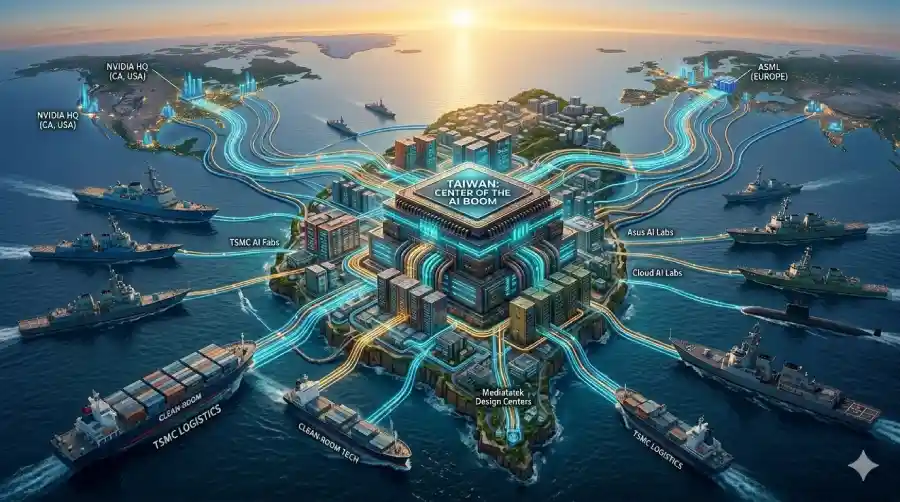
That dependence has become impossible to ignore, partly because the scale of the AI industry itself has exploded so violently over the last two years. Jensen Huang recently called Taiwan the “epicentre” of the AI revolution while announcing plans tied to roughly $150 billion in annual Nvidia-related investment flowing through the island’s ecosystem.
NVIDIA’s newest AI chips are manufactured almost entirely through Taiwanese infrastructure, with TSMC sitting at the centre of that network. Around those fabs sits another dense industrial web involving packaging companies, server manufacturers, cooling systems, and advanced component suppliers concentrated across Taiwan.
The result is something the technology industry rarely likes admitting publicly: modern AI infrastructure is not globally distributed at all. It is heavily clustered around one island whose political future remains one of the most dangerous unresolved flashpoints in global geopolitics. Investors increasingly understand that reality, even if ordinary consumers still mostly see AI as software floating harmlessly in “the cloud.”
That tension has become even sharper as relations between Washington and Beijing grow more unstable. During recent meetings between Donald Trump and Xi Jinping, Taiwan reportedly sat near the centre of discussions alongside AI chips, trade restrictions, and the ongoing Iran conflict. Chinese state media quoted Xi warning of “clashes and even conflicts” if the Taiwan issue was not “handled properly.”
At the same time, reports emerged that a major US arms package for Taiwan had slowed amid wider geopolitical negotiations, feeding nervous speculation online about whether the island is quietly becoming leveraged in a much larger strategic bargain. None of this means an invasion is imminent tomorrow morning. But the atmosphere has changed.
The possibility no longer feels abstract in the way it once did. Markets, governments, and tech executives increasingly behave as though disruption around Taiwan is now a scenario that must be actively planned for rather than dismissed outright.
One island is carrying the AI economy
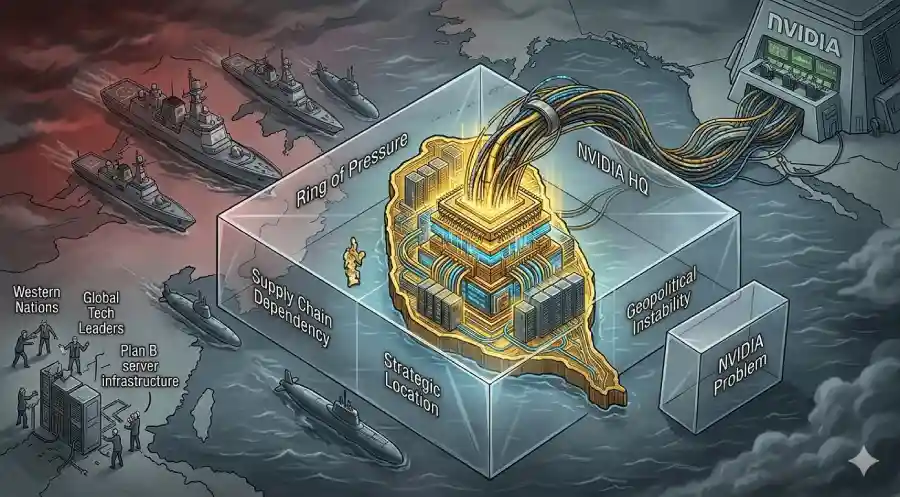
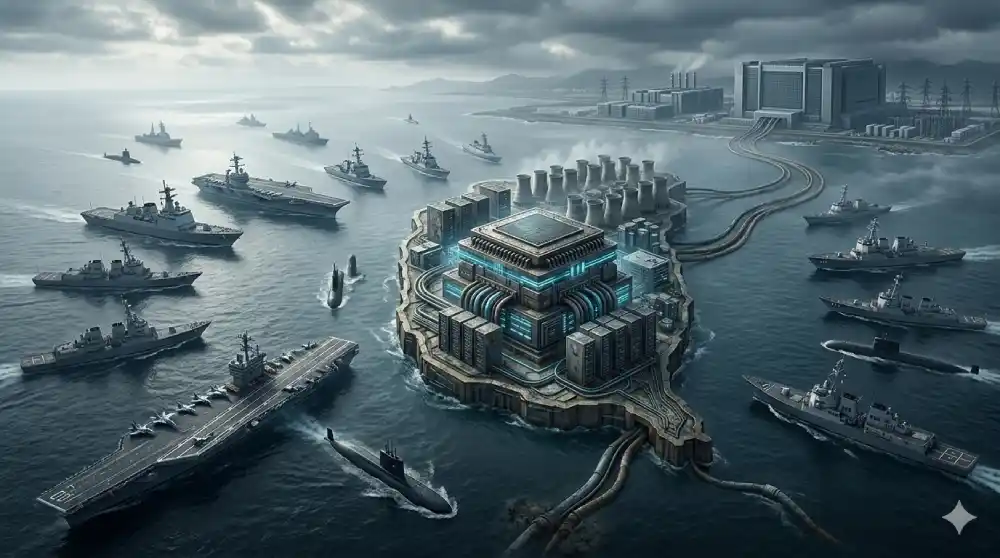
That is partly why every unusual Chinese naval movement near Taiwan now triggers instant headlines and panic across social media. Even relatively small military manoeuvres generate viral speculation because people intuitively understand what is at stake economically. Taiwan is not simply another geopolitical hotspot anymore. It has become the physical foundation underneath the AI boom itself.
Analysts sometimes compare the island’s semiconductor role to oil in the twentieth century, except concentrated in a far smaller and more vulnerable geography. A serious disruption to Taiwan’s chip industry would ripple through almost every advanced technology sector simultaneously, from smartphones and cloud computing to military systems and AI infrastructure. The nightmare scenario for governments is not only military conflict. It is paralysis. Modern economies increasingly depend on a constant flow of advanced semiconductors, and no other country currently replicates Taiwan’s manufacturing scale at the highest end of AI chip production fast enough to fully replace it.
That dependence is already reshaping political calculations in uncomfortable ways. The United States spent years trying to restrict China’s access to advanced AI chips while simultaneously relying on Taiwanese factories sitting directly beside China to manufacture many of its own systems. NVIDIA itself has become strangely symbolic of the contradiction.
The company sits at the centre of the AI boom, yet much of its physical production chain runs through Taiwan and broader Asian manufacturing networks. Even Trump’s recent Beijing meetings reportedly included major technology executives and chip discussions as Washington attempted to balance trade disputes, Iran tensions, and AI competition all at once. For China, Taiwan represents unfinished political history.
For the United States, it increasingly represents strategic technological infrastructure. And for the AI industry, it may quietly be the single most important physical location on Earth. That overlap is what makes the situation feel increasingly combustible beneath the surface of diplomacy.
The global supply chain was never global
The deeper irony is how completely this breaks the fantasy many people still carry about modern technology. Artificial intelligence is often presented as something detached from geography, floating invisibly across digital networks beyond borders or politics. In reality, the entire system rests on extremely physical foundations: fabs, minerals, shipping lanes, cooling systems, power grids, and a tiny number of strategic manufacturing chokepoints.
Taiwan sits at the centre of that map more heavily than most consumers realise. The AI boom did not erase geopolitics. It intensified it. Every chatbot query, AI-generated image, and trillion-dollar valuation increasingly runs through supply chains vulnerable to military tension in the Taiwan Strait.
That does not mean war is inevitable. But it does mean the future of artificial intelligence may depend far less on algorithms alone than on whether one island can continue operating without interruption. All while the world’s two largest powers stalk each other around it.
In case you missed:
- Not Just Oil Part 2: How the Iran War is Disrupting Helium, Chips, and the AI Boom
- Huawei Is Coming for Nvidia Now. Its New AI Chips Arrive in 2027
- AI Is Bringing Dead Nuclear Plants Back to Life
- Tata Electronics to Manufacture Intel Chips & AI Laptops in India!
- Apple, Tesla, Tata: The Cyberattack That Hit India’s Manufacturing Boom
- You Can Now Host an NVIDIA Data Centre in Your Home. Some Neighbours Already Want Them Gone.
- Goodbye Blackwell, Hello Rubin: Nvidia’s new AI platform is here!
- Aatmanirbhar Push: India Becomes 7th Nation to Crack Gallium Nitride Chip Technology
- While Bezos Bets $100 Billion on Physical AI, His Top AI Picks Walk Away to Model the Universe
- AI vs Your Poker Face: The Battle Unfolding at ESPN’s World Series of Poker 2026