



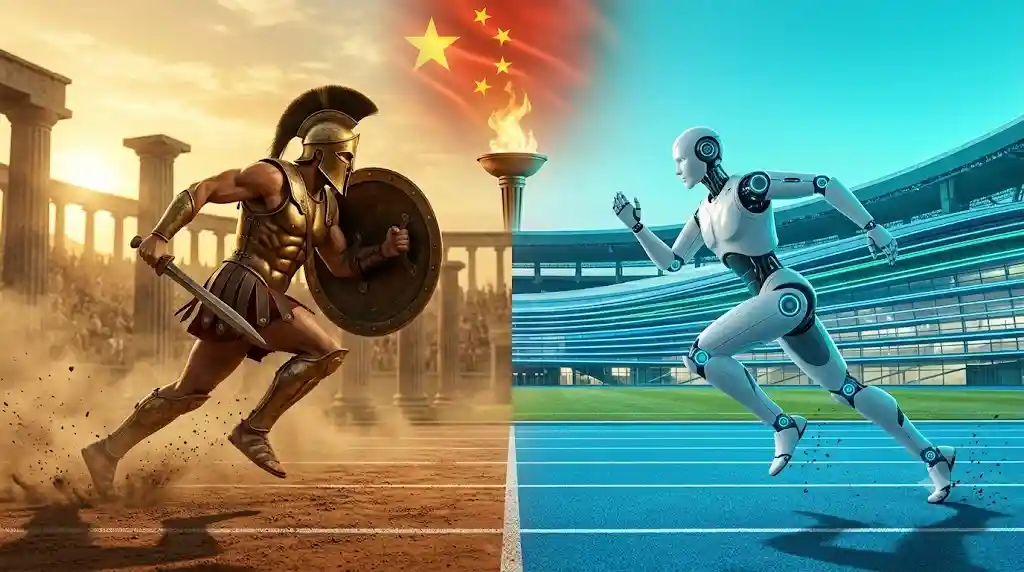

From the Olympia to Beijing, from men competing with each other to metal and plastic robots – in China’s robot games we see the echo of the power games of the original Olympics, writes Satyen K. Bordoloi
The dust, like a deadly fog, rose over the stadium at Olympia. It is 520 BC, and the thousands-strong crowd of Greek men packed onto the grassy slopes have fallen into a strange, anticipatory silence for below them at the starting line are a row of warriors knelt on one knee: full hoplite infantry, wearing bronze helmets, greaves strapped to their shins, and round shields gripped in their left hands. This was the hoplitodromos – the just introduced armed race in the Olympic games.
As the herald raises his arms, the runners explode off the line: shield clanking against thighs, metal glinting in the sun. They run two lengths of the stadium: in full armour, clanking all the way to the finish line, trying to be the first because winning proved – in the most public way possible – that your state bred men who could win wars. Olympics back then weren’t just about ‘faster, higher, stronger’ but about city-states flexing their martial muscle, a way of saying to the world: look what we can produce.
2,546 years later, Beijing is saying the same thing. Only this time with metal, plastic and silicone-made robots. And the effect might be the same.
On the evening of August 22, 2026, the National Speed Skating Oval in Beijing, the “Ice Ribbon” built for the 2022 Winter Olympics, was filled with the whir of servomotors and the clatter of mechanical feet on polished concrete. The second World Humanoid Robot Games began with staggering numbers: 666 teams, 2,056 robots, 16 countries, 51 events, more than 1,300 matches. Team participation had jumped 138 per cent from the inaugural Games just last year. The event was, as an observer noted, an “Olympics-like” spectacle.
And like that first hoplitodromos race in 520 BC, this was designed to do two things at once: push the limits of what these machines could do, and for China to show the world exactly who was leading the race, literally and metaphorically.
To understand ‘literally’, you need only consider a few races. In the 100-metre sprint on opening day, a humanoid robot named Tiangong Ultra developed by the Beijing Innovation Centre of Humanoid Robotics crossed the finish line in 9.39 seconds: nearly two-tenths of a second faster than Usain Bolt’s world record of 9.58 seconds. In the standing high jump, another robot cleared 2.88 metres: beating the human world record of 2.45 metres, and in the 400-metre final, another Beijing robot ran it in 38.15 seconds, nearly five seconds faster than any human.
The numbers, or these records, are not the point: that China is building robots that can outperform the best humans ever is. If foundational models were a geopolitical flex that the USA won a few years ago only for China to claw back to number two, Robots are China’s power flex today and into the future.
The modern Olympics have largely forgotten the original purpose: We have been made to believe that the games are now a celebration of human potential – faster, higher, stronger, when for the Greeks, the purpose was to keep the state in a state of readiness, to show their prowess to the world. The game produced warriors, not just athletes and kept the Greeks martially fit.
Beijing’s Robot Games serve the exact same function. Except in a different arena.
This year’s competition introduced 21 scenario-based contests, up from six last year. These were not abstract sporting events but real-world job simulations. In a hotel-service contest, over ten robot teams had thirty minutes to move luggage of different sizes, replenish guest-room supplies, and make beds. Another was a restaurant scenario where robots had to use tongs to place snacks in a microwave, turn the timer dial to exactly five minutes, and deliver drinks without spilling.
A dexterous-hand competition featured eight precision tasks including assembling power tools, picking beans with tweezers, weighing powder, opening bottle caps, connecting flexible cables, etc. In a fire-rescue scenario, robots navigated smoky corridors, identified safety hazards, closed faulty valves, and grabbed fire extinguishers.
These are not games. Nor are they stunts. These seem more like job interviews, with those that do well finding themselves selected for various real-world workplaces.
The Games thus intend to be a crucible, a pressure cooker designed to force innovation, with each little triumph representing breakthroughs in motor control, balance algorithms, battery efficiency, or structural design. The competition creates constraints; constraints create urgency, which leads to progress, which in this case is robots that can actually work.
The organisers said that the event is “designed to promote technological exchange, industrial collaboration and the development of embodied intelligence.” Embodied intelligence is the key to the robotics revolution. It is when AI works inside a body to move it and have it do things. The games are meant to push the Chinese robotics industry and its engineers to work harder and move faster to make products that can work in real-world situations and compete with the world.
In the Greek Olympics, states competed against each other: Athens versus Sparta, Thebes versus Corinth. The Beijing robot games serve similar functions with 16 countries competing, including Germany, Japan, and the United States. Its very opening ceremony showed robot formations marching in perfect sync, a robot archer showing what it can do: all a display of national prowess broadcast to the world.
At 97%, China already makes the world’s most humanoid robots. While Elon Musk’s Twitter theatrics ensure that Optimus bot gets the most press coverage in the West, the real global winners – AgiBot, Unitree Robotics, Fourier Intelligence, UBTech, Zhiyuan Robotics, Yushu Technology – are all Chinese. This is a march China has stolen from the US in recent years.
And the US has taken notice, with the Federal Communications Commission announcing a ban on imports of new foreign-made humanoid robots. The reason cited is the same old: national security concerns. The Pentagon recently added Unitree, one of China’s leading robot makers, to its list of companies deemed to have ties with the Chinese military.
In such a scenario, the robot games are a demonstration to prove that China’s robotics industry is not just large, but superior to anyone else. With reels going viral across the world, in each one China seems to be screaming: look what we can produce.
The Chinese government has set clear targets: by the end of this year, they want robots to achieve “operation mode”, i.e. work in real-world scenarios with over 100 high-value applications and deployment of 10,000 robots. The Ministry of Industry and Information Technology and the State-owned Assets Supervision and Administration Commission jointly launched a nationwide “real-scenario training” initiative to make this happen. The robot Games are a key part of this strategy, a proving ground where technologies are stress-tested, failures are exposed, and winners emerge clearly.
And it is working, with last year’s inaugural games producing tangible results for robots that actually do things, proving that the Games are not just a spectacle. They are both a PR stunt and a feedback loop – competition generates data which leads to improvements, thus producing better robots that win competitions. Eventually, these robots leave the stadium and enter the economy.
Beijing, in this way, is competing for something far more tangible: not just global market share or industrial dominance but the future of work itself. And if the games are any indication, they are winning at the rate of 9.39 seconds per hundred meters, like its Tiangong Ultra.
In case you missed:
- The Robots Are Coming; China’s Metal Militia is Leaving the World in the Dust
- Talk to the Hand: Why the Robot Revolution Lies In Its Fingers
- Lost Job to AI? The Real Enemy Isn’t The Bot – It’s Your Boss. Here’s Proof
- The Weight of the World: Why the Open vs. Closed AI War Is Really About Who Controls the Future
- The Net That Caught Itself: How the World Learned to Cage the Internet
- Indian AI’s Power Problem: We Woke Up Late to AI, We’re Still Half-Asleep
- OpenAI, Google, Microsoft: Why are AI Giants Suddenly Giving India Free AI Subscriptions?
- Not Fastest, but Frugalest: Why Indian EVs Are Suddenly World-Class
- The AI Peace Race: Why India’s Real Opportunity Starts Where the Arms Race Ends
- 5.6 Cr Pending Cases: How India Is Letting AI Slip Through Even As World Courts Revolution